
Reviewed · DINNER & PANCAKE CRUISES
Amsterdam Walking Tour with Dutch Pancake Lunch
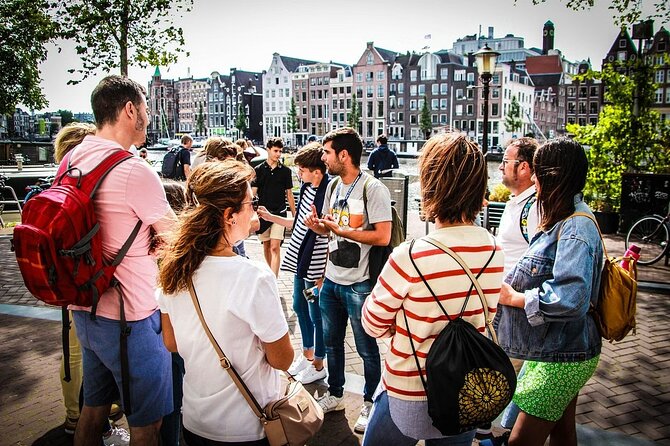
The clever hook here is the Dutch pancake lunch. You spend about two and a half hours walking through Amsterdam’s old center, then sit down for a three-part meal built around the country’s wonderfully flexible pancake tradition. It is a neat way to pair sightseeing with a proper local bite.
I like the small maximum of 15 people, which gives you a fair chance to ask questions. I also like the route’s range, from royal buildings and quiet courtyards to the Oude Kerk, Jewish Quarter, and old trading sites. The main drawback is pace: the tour covers many subjects in short stops, and admission to the Royal Palace, Nieuwe Kerk, and Begijnhof is not included.
Key points to know before booking
- The route covers Amsterdam’s historic center: You see Dam Square, Begijnhof, the Royal Palace, Nieuwe Kerk, the Oude Kerk, Spui, and the Flower Market.
- The group is capped at 15 people: That is small enough for direct questions and a more personal walk.
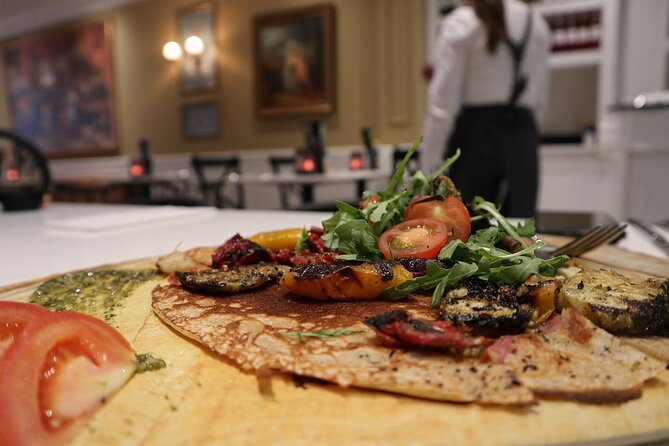
- The meal is more than a snack: Your lunch includes a starter, a main pancake dish, dessert or coffee, and tap water.
- The tour is offered in English or Spanish: Check your selected language when booking.
- You stay near the center: The walk starts and ends at Beursplein, close to public transportation.
- The booking is firm: The experience is non-refundable and cannot be changed after purchase.
Why this short Amsterdam walk works well
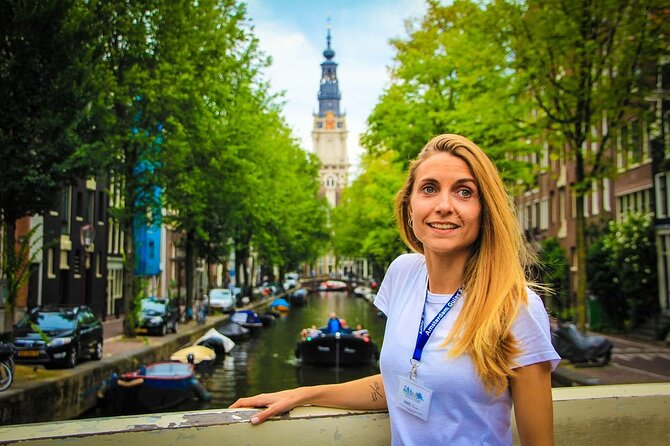
At $84.65 per person, this is not the cheapest way to see Amsterdam. You are paying for a local guide, a structured city walk, and lunch rather than for sightseeing alone. The value depends on whether you want your first look at Amsterdam organized for you.
I see this as a good choice for a first day in the city, especially if you have limited time. The route gives you a quick sense of how Amsterdam developed: as a civic center, a religious center, a trading power, and a multicultural city. You will not enter every landmark, but you will learn what each place means and where it fits in the city story.
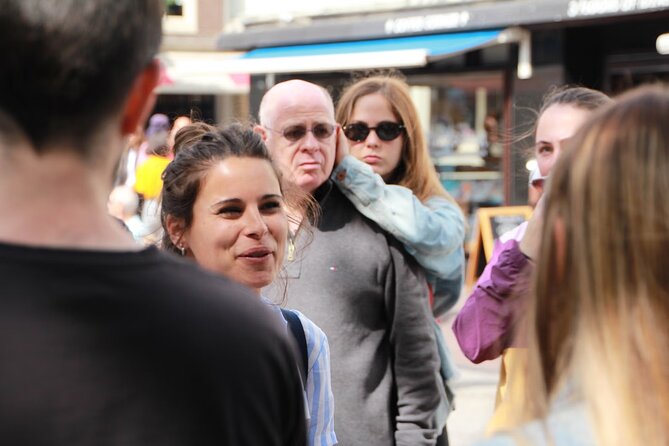
The 15-person limit matters. Amsterdam’s center can feel crowded, and a very large group makes it harder to hear or ask questions. Here, you can pick your guide’s brain as you walk, which is useful when you want practical context rather than a speech delivered from a distance.
The tour is listed at about two hours and 30 minutes, with many stops allocated around 15 minutes each. That means you should expect a brisk introduction, not a slow architectural study. Wear comfortable shoes and keep your expectations clear: this is a broad city overview with lunch, not a full museum tour.
More Walking Tours in Amsterdam
- Anne Frank’s Story – Guided Walking Tour through Amsterdam
★ 5.0 · 11,619 reviews - Amsterdam: Life of Anne Frank and World War II Walking Tour
★ 4.8 · 10,467 reviews - Absolutely Amsterdam – the Essential Introductory Walking Tour
★ 5.0 · 3,629 reviews
Starting at Dam Square and the Royal Palace
The meeting point is Beursplein 1-3, 1012 JW Amsterdam. From there, the walk moves into Dam Square, Amsterdam’s central public space. Your guide explains why this square became so important and points out the Royal Palace, one of the city’s most recognizable buildings.
Dam Square is useful as a starting point because it gives you immediate orientation. You are in the middle of Amsterdam’s historic center, with major sights, busy streets, shops, and public transportation nearby. The square can be crowded, so listen closely during the introduction and stay aware of the group.
The Royal Palace is discussed from the outside. It began as Amsterdam’s city hall and later became a royal residence. That change tells you something important about the city’s rise from a powerful merchant republic to part of the modern Dutch monarchy.
You do not get palace admission with this experience. If you want to see the interior, you would need to arrange that separately, and this walk does not provide a substitute for it. Still, the exterior visit is worthwhile because the building anchors the story of Amsterdam’s civic power.
Next door is Nieuwe Kerk, a 15th-century church now used for royal ceremonies and exhibitions. Again, the visit is focused on explanation and exterior viewing rather than included entry. The pairing of church and palace makes this a compact lesson in how religion, government, and ceremony have shared the same city center.
A quiet pause inside Begijnhof
Begijnhof provides a sharp change of mood. After the public energy of Dam Square, you enter a peaceful courtyard associated with the Beguines, a Catholic sisterhood.
This is one of the route’s most appealing contrasts. Amsterdam is famous for canals, narrow houses, and busy streets, but courtyards like this show a quieter side of the old city. Your guide explains who the Beguines were and why this enclosed place mattered.
The stop is listed at about 15 minutes. That is enough to look around and hear the basic story, but not enough for a long, unhurried visit. Entry is not included, so the tour treats Begijnhof as a stop along the walking route rather than a full paid attraction.
I would pay attention to the guide here. The value of the stop is less about checking off a landmark and more about understanding how people lived in a dense medieval city. A courtyard set apart from the street could provide community, privacy, and religious purpose within the center of Amsterdam.
The Oude Kerk and Amsterdam’s layered past
The walk then heads toward the Oude Kerk, Amsterdam’s oldest building. It sits in the Red Light District, a location that can surprise first-time visitors because the church and the district’s modern identity exist side by side.
You walk past the church and hear about its long story. The experience does not include admission, so you should not expect an interior visit. Even from outside, the Oude Kerk helps you see how old Amsterdam is beneath its modern reputation.
This part of the route also gives the guide room to explain how the city changed over time. A religious building at the center of an area now known for nightlife reflects Amsterdam’s layered character. The tour does not treat the Red Light District as a separate attraction. Instead, it places the area within the city’s broader development.
The short timing is both useful and limiting. You get context without spending a large part of the afternoon in one place, but anyone interested in the church itself may want to return independently.
Other boats that feed you around Amsterdam:
- Amsterdam: Evening Cruise with Optional Wine and Snacks
★ 4.4 · 19,696 reviews - Amsterdam: Dinner Cruise with 4-Course Menu
★ 4.4 · 1,579 reviews - Amsterdam: River Cruise With All-You-Can-Eat Dutch Pancakes
★ 4.4 · 1,504 reviews - Amsterdam: Wine and Cheese Evening Cruise
★ 4.5 · 839 reviews
Leaning houses, gable stones, and small details
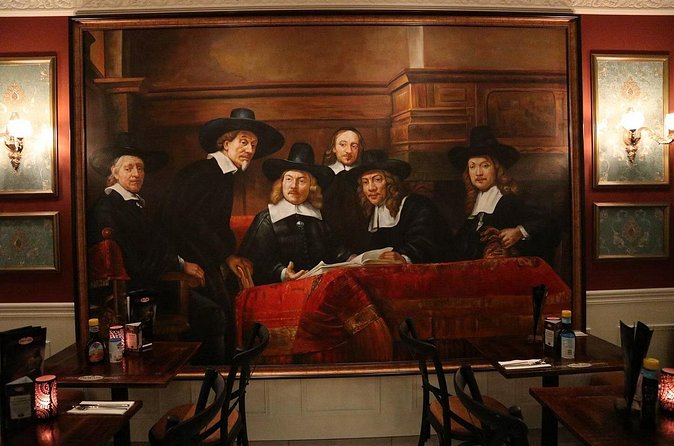
Amsterdam’s leaning buildings are a natural highlight on any central walk. Your guide points out the unusual angles and explains the gable stones that appear on many old buildings.
These details are easy to miss when you walk alone. Gable stones can identify a building’s former use or tell a small story about the people who lived or worked there. The leaning houses add visual fun, but they are also tied to the practical challenges of building on Amsterdam’s soft ground and narrow urban plots.
The tour is strongest when it helps you notice details like these. You do not need a long lecture to remember a crooked façade or a carved stone above a doorway. Once your guide points them out, you can continue spotting them during the rest of your stay.
The route does not list a separate admission fee for this part, and none is needed. It is street-level Amsterdam, experienced by looking carefully rather than entering a ticketed site.
Spui and the Flower Market
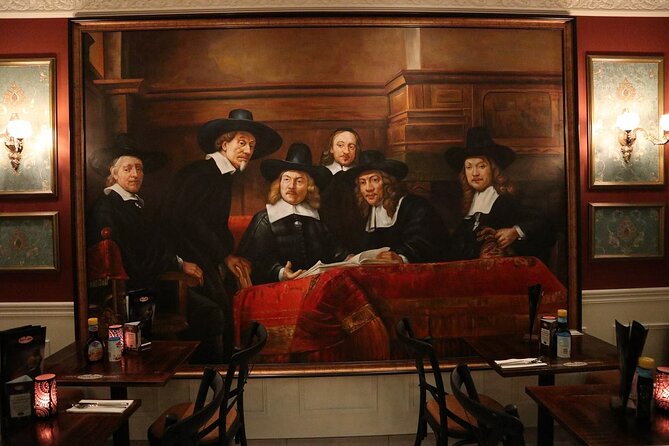
Spui gives you another shift in atmosphere. This square has a local feel, and the nearby Flower Market adds one of Amsterdam’s most recognizable shopping scenes.
The market is described as the world’s only floating flower market, with flowers arranged along the canal. It is a colorful stop, but it is still a commercial market, so the experience is best approached as a quick look at Amsterdam’s flower trade rather than as a formal garden visit.
You may want to keep this part practical. If you see bulbs or souvenirs you like, check the purchasing information carefully, especially if you are taking them home. The tour itself is designed for walking and explanation, not for a long shopping break.
Spui and the Flower Market also help break up the heavier historical subjects. After hearing about royal ceremonies, religious communities, and old trade networks, you get a more everyday view of how the center functions now.
The Dutch East India Company and world trade

The tour then turns to the Dutch East India Company, known as the VOC. Your guide explains how the company helped make Amsterdam one of the world’s most powerful trading cities.
This is a key part of the city story. Amsterdam’s wealth did not come only from attractive canals and handsome houses. It was built through international commerce, shipping, finance, and the movement of goods across the world.
The stop also gives you a chance to think about the complicated side of that success. The company’s rise brought power and wealth, but it was part of an aggressive trading system with serious human costs. The supplied tour details focus on the company’s influence on Amsterdam and global trade, so you should expect an introduction rather than a full account of every consequence.
I value this stop because it connects the city’s architecture to its economic past. The grand buildings and old merchant houses make more sense once you understand why Amsterdam became such an important center of trade.
The first stock exchange and Amsterdam’s financial story
The route also covers the world’s first stock exchange and its connection to the Dutch East India Company. This is another short stop, but it adds an important piece to the city’s identity.
Amsterdam was not only a port. It developed financial tools that shaped how companies raised money and how people invested in overseas trade. The stock exchange story helps explain why commerce in Amsterdam was organized on such a large scale.
You will not be entering a modern financial museum as part of this activity. The guide provides the setting and the story while you walk through the center. That is enough for a useful overview, especially if you are seeing Amsterdam for the first time.
Taken together, the VOC and stock exchange stops show how trade changed the city. They also make the tour more than a collection of pretty streets. You get a basic explanation of the forces that helped Amsterdam grow.
The Jewish Quarter and Chinese Quarter
Toward the end, the walk reaches the historic Jewish Quarter and the Chinese Quarter. These areas broaden the tour beyond royal buildings and old commerce.
In the Jewish Quarter, your guide discusses the impact of World War II. The subject is serious, and the information provided indicates that the stop focuses on the area’s historical experience rather than treating it as just another photo stop. You should expect a brief introduction within the larger walk, not an extended memorial tour.
The Chinese Quarter shows another part of Amsterdam’s multicultural identity. Its presence near the old center reminds you that the city has long been shaped by people, goods, and traditions arriving from elsewhere.
This final section gives the route a wider frame. Amsterdam is not only its 17th-century canals or royal buildings. It is also a city marked by migration, loss, adaptation, and cultural exchange.
What the pancake lunch adds
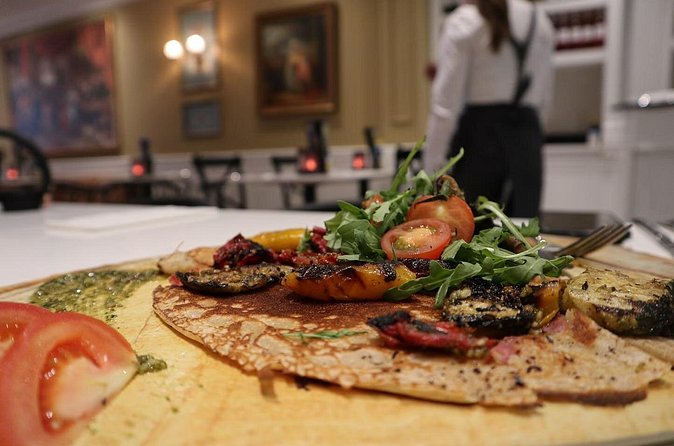
The meal is included and comes with a starter, a main Dutch pancake dish, dessert or coffee, and tap water. The menu details do not specify the restaurant, the exact pancake toppings, or whether you choose from a menu, so you should not book with a particular dish in mind.
Still, the lunch is a meaningful part of the price. Dutch pancakes are not limited to one narrow style. As the tour’s playful response to a Spanish-speaking customer suggests, the kitchen can be creative with toppings and combinations. The pancake is the memorable part, especially after a walking route that covers so much ground.
I like the meal because it gives the experience a clear finish. You do not have to search for lunch after the tour, and the food creates a relaxed moment after the historical stops. The included starter and dessert or coffee make it closer to a set meal than a quick pancake snack.
The tour ends back at the meeting point. The supplied information does not give a separate lunch time or exact restaurant address, so allow a little flexibility if you have another timed booking afterward.
Price, group size, and practical limits
At $84.65, the price is easiest to justify if you value three things: a local guide, a small group, and a full lunch. Buying food separately could cost less, and walking around the center on your own costs nothing, but you would not get the same structured explanation or planned meal.
The tour is offered in English or Spanish. The guide is described as local and the activity has a maximum of 15 people. Service animals are allowed, public transportation is nearby, and most people can participate.
There is no pickup service. You meet at Beursplein and return there, so you need to reach the starting point yourself. Confirmation is provided at booking.
The cancellation rule deserves attention. The booking is non-refundable and cannot be changed for any reason. I would only book once your schedule is firm.
Who should book this Amsterdam experience
I would choose this tour if you are visiting Amsterdam for the first time, have only a short window, or prefer a guide to connect the sights for you. It also suits anyone who likes to ask questions and wants lunch taken care of.
It is a good match for solo visitors and couples who prefer a small group to a large city tour. Families may also appreciate the mix of short stops and food, though the serious World War II history and the brisk pace may not suit very young children.
I would choose something else if your main goal is to enter the Royal Palace, Nieuwe Kerk, or Oude Kerk. Those admissions are not included. I would also skip it if you want a slow canal walk with long stops for photography, since this route covers many subjects in a limited time.
Should you book it?
Book this experience if you want a fast, well-rounded introduction to Amsterdam with a proper meal at the end. The strongest features are the small group, the broad route, and the creative Dutch pancake lunch.
Skip it if you need flexible cancellation, want extensive interior visits, or prefer to explore at your own pace. For a first orientation, though, the combination is sensible: you see the city’s central landmarks, hear how trade and community shaped it, and finish with a meal that feels distinctly Dutch.
FAQ
How long does the Amsterdam walking tour last?
The tour lasts approximately two hours and 30 minutes.
How much does the tour cost?
The listed price is $84.65 per person.
Where does the tour start?
It starts at Beursplein 1-3, 1012 JW Amsterdam, Netherlands.
Where does the tour end?
The activity ends back at the meeting point.
Is lunch included?
Yes. Lunch includes a starter, a main Dutch pancake dish, dessert or coffee, and tap water.
What languages are available?
The tour is offered in English or Spanish.
What sights are included in the walk?
The route includes Dam Square, the Royal Palace, Begijnhof, Nieuwe Kerk, the Oude Kerk, leaning buildings and gable stones, Spui, the Flower Market, Dutch East India Company sites, the world’s first stock exchange, the Jewish Quarter, and the Chinese Quarter.
Are attraction admission tickets included?
Admission is not included for the Royal Palace, Begijnhof, or Nieuwe Kerk. The walking stops at the Oude Kerk, leaning buildings, gable stones, Spui, the Flower Market, Dutch East India Company sites, and the stock exchange are listed without an additional admission charge.
How large is the group?
The tour has a maximum of 15 participants.
Can I cancel or change my booking?
No. The experience is non-refundable and cannot be changed for any reason.
More Lunch Experiences in Amsterdam
- Amsterdam: A’DAM Lookout Ticket and Lunch or Dinner Voucher
★ 4.5 · 1,046 reviews - Hard Rock Cafe Amsterdam with Set Lunch or Dinner
★ 4.0 · 224 reviews - Guided Canoe Adventure with Picnic Lunch in Waterland from Amsterdam
★ 5.0 · 85 reviews - Amsterdam: Tulip Fields Day Tour with Lunch & Windmill
★ 4.9 · 82 reviews
More guided walks around Amsterdam
- Amsterdam: Anne Frank Guided Small Group Walking Tour
★ 4.8 · 2,722 reviews - Amsterdam: Anne Frank Walking Tour – Guided in EN/DE/IT/ES
★ 4.9 · 2,676 reviews - Amsterdam: Guided Cultural Walking Tour
★ 4.9 · 2,384 reviews - Amsterdam: Guided Ganja Walking Tour of Coffee Shops
★ 4.2 · 2,092 reviews
Just added in Amsterdam
- Guided Day Trip – Volendam, Zaanse Schans, Marken & Edam★ 4.0 · 232 reviews
- Half-Day Private Guided Sightseeing Tour of Zaanse Schans★ 5.0 · 14 reviews
- Private Tour Zaanse Schans Windmills and Volendam in Jaguar★ 5.0 · 10 reviews
- Zaanse Schans and Giethoorn Unique Day Trip with Boat Cruise★ 4.5 · 17 reviews
- Zaanse Schans Private Tour Windmills★ 5.0 · 18 reviews
- Private bike tour: Hidden gems around Amsterdam and surroundings★ 5.0 · 4 reviews
- Bike tour in Amsterdam with an Italian guide★ 5.0 · 15 reviews
- Amsterdam Sightseeing Tour + Hidden Gems + Tastings + PDF guide★ 5.0 · 35 reviews
Dinner & Pancake Cruises, compared.
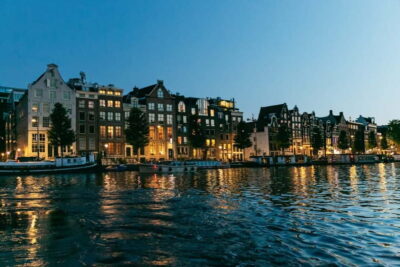
Evening Cruise with Optional Wine and Snacks
Read our review →

River Cruise With All-You-Can-Eat Dutch Pancakes
Read our review →

Amsterdam Wine and Cheese Guided Evening Cruise
Read our review →
Amsterdam 2-Hour Evening Cruise With Live Guide and Bar
Read our review →
Browse the lists this tour appears in