
Reviewed · WALKING TOURS
Amsterdam: World War II Private Walking Tour
Amsterdam’s wartime story comes into focus on the streets, lanes, and monuments where the Nazi occupation actually unfolded. On this private walk, guides Ben de Jong and Peter Schaapman explain what life was like in Amsterdam from 1940 to 1945, with special attention to Jewish resistance and the city’s continuing memory of the war.
I like two things right away: the private format, which lets your group ask questions without keeping pace with strangers, and the use of lesser-known streets rather than a museum-only approach. The main consideration is the serious subject matter. The tour is recommended for ages 13 and up, and it does not include the Anne Frank House, the Resistance Museum, or the Hollandsche Schouwburg.
Key points to know
- A private three-hour walk for your group of up to four people
- Wartime Amsterdam beyond the major museums, with sites tied to Nazi occupation and Jewish resistance
- Ben de Jong and Peter Schaapman lead the experience
- The Monument to Jewish Resistance is one of the important stops
- A short coffee and restroom break comes about halfway through
- The tour ends at the National Holocaust Names Monument, not at the starting point
Following Amsterdam’s wartime streets
This is a history walk rather than a sightseeing circuit with a few wartime facts added on. You begin at Prinsengracht 263, the Amsterdam address associated with the Anne Frank House, but the tour does not include entry to the house. From there, the focus shifts to the wider city and to the places connected with occupation, persecution, resistance, and remembrance.
That distinction matters. The Anne Frank House is one of Amsterdam’s best-known wartime sites, but it tells only one carefully preserved story. This walk aims to place that story within the larger experience of the city under Nazi control. You get a sense of how the war affected streets and neighborhoods, not just one hidden annex.
The route lasts about two and a half to three hours. That is long enough for a serious discussion, but still manageable for most people with moderate physical fitness. You should expect to walk throughout, with a planned pause around the halfway point for coffee or a restroom visit.
The exact route between the listed stops is not specified, so you should not expect a fixed museum-style sequence of rooms or displays. The value is in the guide’s explanation of what happened at particular sites and how those places relate to the wider story.
More Walking Tours in Amsterdam
- Anne Frank’s Story – Guided Walking Tour through Amsterdam
★ 5.0 · 11,619 reviews - Amsterdam: Life of Anne Frank and World War II Walking Tour
★ 4.8 · 10,467 reviews - Absolutely Amsterdam – the Essential Introductory Walking Tour
★ 5.0 · 3,629 reviews
Starting at Prinsengracht 263
The starting point is Prinsengracht 263, 1016 GV Amsterdam, and the tour begins at 9:30 am. Because this is also the address of the Anne Frank House, take care when planning your morning. You are meeting there for the walking tour, not receiving admission to the house.
Starting here gives the subject an immediate connection to one of Amsterdam’s most recognizable wartime addresses. Still, you should not book this tour expecting a visit inside the Anne Frank House. Tickets for that museum are not included, and the walk does not enter it.
An early start can work well for a history-focused day. You can take the tour before spending time at other museums or exploring the canals. Since the activity is private, your guide can keep the pace suited to your group, though the overall walk still covers several hours and calls for comfortable shoes.
Nazi occupation and daily life from 1940 to 1945
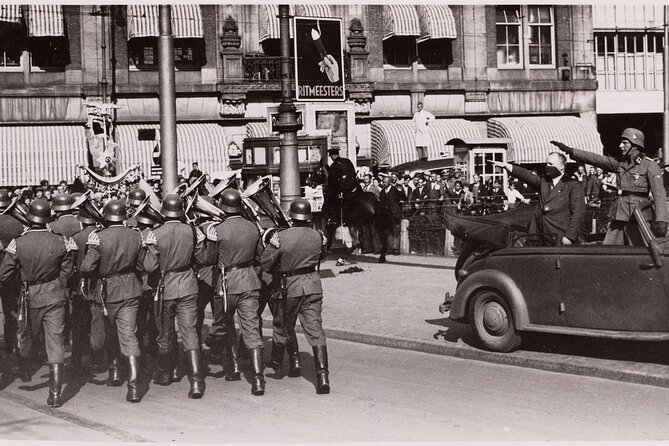
The heart of the tour is the period of Nazi occupation between 1940 and 1945. Your guide explains the occupation as a lived experience, not simply as a list of dates and military events. The supplied details do not promise a specific list of every site, but the tour visits important places and monuments connected with the occupation of Amsterdam.
That approach should appeal to you if you want more than the city’s standard highlights. The route is intended for people who want to go beyond the main tourist stops and understand how the war affected Amsterdam as a whole.
A good guide is especially important for this kind of walk. Empty streets and ordinary buildings do not explain themselves. The story comes from connecting a place to the decisions, fears, resistance, and suffering associated with it. A direct review of the experience describes Peter Schaapman as a published historian and praises his ability to lead visitors through lanes and alleyways they would not find on their own.
You should treat that as a useful clue about the style of the tour. It is not built around entertainment or quick photo stops. It is meant to make the city’s wartime past easier to understand through detailed storytelling at the locations where events took place.
The Monument to Jewish Resistance
The Monument to Jewish Resistance is specifically included among the important sites. This gives the walk a clear focus on Jewish resistance, rather than presenting the occupation only as a general military history.
Monuments can be easy to pass without understanding. With a guide, you can learn why the monument matters and how it fits into Amsterdam’s wartime story. The experience also looks at the ongoing legacy of the Second World War, so the discussion does not end with liberation in 1945.
That present-day connection is one of the tour’s useful features. You are not only learning what happened during the occupation. You are also considering how Amsterdam remembers those events now, through monuments and public places.
The listing does not provide a detailed description of the monument itself, so you should avoid expecting a formal museum exhibit or a long indoor visit there. Its importance comes from the explanation provided during the walk and from seeing it as part of the city’s public memory.
Other guided walks around Amsterdam:
- Amsterdam: Anne Frank Guided Small Group Walking Tour
★ 4.8 · 2,722 reviews - Amsterdam: Anne Frank Walking Tour – Guided in EN/DE/IT/ES
★ 4.9 · 2,676 reviews - Amsterdam: Guided Cultural Walking Tour
★ 4.9 · 2,384 reviews - Amsterdam: Guided Ganja Walking Tour of Coffee Shops
★ 4.2 · 2,092 reviews
A short break halfway through
About halfway through the walk, the guide provides a short pause for coffee and, if needed, a restroom visit. Coffee or tea is not included in the price, so plan to pay for your own drink.
This break is practical, especially because the tour can last close to three hours. It also gives you a moment to absorb the subject matter. A walk focused on persecution, resistance, and wartime suffering can be emotionally demanding, and a brief pause helps keep the experience from becoming an exhausting stream of information.
The break should not be confused with a meal stop. The information only promises a short rest and the chance to get coffee or use a restroom. If you need a full meal, arrange that separately before or after the tour.
Why the private format matters
The price is $180.04 per group of up to four people. That works out to about $45 per person if four people share the cost, or roughly $90 each for two. For one person, it is a costly walking tour, but for a small family or group of friends, the calculation is more favorable.
A private tour gives you the whole guide’s attention. You can ask about a specific family connection, request clarification on Dutch wartime terms, or spend more time on a place that interests you. You are not trying to hear a guide over a large crowd, and the pace is restricted to your own group.
That privacy is particularly helpful for a serious subject. Some people want a quiet, focused walk. Others may need to ask basic questions about the occupation without feeling out of place. The format allows both.
The tradeoff is that a private tour costs more than a shared group walk. You also do not get the built-in social atmosphere of a larger group. If your main goal is the lowest possible price, this is not the obvious choice. If you are traveling with up to four people and care about discussion and flexibility, the value improves.
What is not included
The tour does not include admission to the Anne Frank House, the Resistance Museum, or the Hollandsche Schouwburg, which served as a deportation center. You must arrange and pay for those visits separately.
This is not necessarily a weakness. It means the walking tour can concentrate on places that are not covered by those museum visits. But you need to plan your expectations carefully. You are paying for the guided walk, not a package that combines Amsterdam’s main World War II attractions.
You should also check museum arrangements separately if you want to visit them during the same day. The tour begins at 9:30 am and lasts about three hours, so your schedule needs to allow for the walking tour before fitting in other timed activities.
The tour includes all fees and taxes. Drinks are excluded, and there is no indication that museum entrance fees are part of the price.
Language, age, and walking demands
The experience is offered in English and German. The booking details also identify English as an available language, so select the language you need when arranging the tour.
The suggested minimum age is 13 because of the content. This is not a light family stroll with a few war stories. The subject includes Nazi persecution and the traumatic experience of Amsterdam’s Jewish population. Parents should decide if older children or teenagers are ready for that material.
You need moderate physical fitness. The walk lasts roughly three hours, and no special vehicle transport is described. Service animals are allowed, and the meeting area is near public transportation.
Wear comfortable shoes and bring clothing suited to Amsterdam’s weather. The walk takes place outdoors, and the tour’s value depends on moving from place to place rather than remaining in a single indoor setting. The details do not state that the route is fully accessible, so anyone with specific mobility needs should confirm the conditions before booking.
What makes the guides important
Ben de Jong and Peter Schaapman are the named guides. That personal detail matters more here than it would on a basic city orientation walk. The quality of the experience depends heavily on how clearly the guide links the locations to the events.
Peter Schaapman receives especially strong praise for leading visitors through side streets and alleyways and for explaining what Amsterdam looked and felt like under Nazi control. The description of him as a published historian suggests a guide with a serious interest in the subject, but you should still remember that guiding styles vary.
The best use of this tour is to ask questions. If you have already read about Anne Frank, Dutch resistance, or the occupation, bring those questions with you. If you know little about the period, ask the guide to explain the basic timeline before moving into specific places.
Since the experience is private, you can shape the conversation more than you could on a standard group walk. That is one of the strongest reasons to choose it.
Planning your day around the 9:30 start
The tour starts at 9:30 am and finishes at the National Holocaust Names Monument, with the end point listed as 1018 DP Amsterdam. The starting and ending points are different, so do not assume you will return to Prinsengracht 263.
That ending point is meaningful for the subject of remembrance, but it also matters for your schedule. You may want to continue with another activity from there, or allow extra time to reach your next destination. The supplied information does not give an exact walking route back to the starting point or a specific public transport connection.
The tour is commonly booked well ahead, with an average booking lead time of 54 days. That is useful planning information if your Amsterdam dates are fixed. A private activity with limited group size has less room than a large scheduled tour, so I would not leave it until the last minute if this is central to your plans.
You receive confirmation at booking, and the experience uses a mobile ticket. Free cancellation is available until 24 hours before the start time. Cancellations or changes made less than 24 hours in advance are not accepted for a refund, with cut-off times based on local Amsterdam time.
Who should book this Amsterdam walk
I would choose this tour if you want a focused account of Amsterdam during the Nazi occupation and prefer places connected to the story over a general city tour. It suits history-minded adults, older teenagers, and small groups who want time for questions.
It is also a good choice if you have already visited Amsterdam’s famous museums and want to understand the wider setting around them. The tour can add context to a separate visit to the Anne Frank House, but it does not replace that visit.
You may want to skip it if you are looking for a cheerful introduction to Amsterdam, a short attraction stop, or a tour with extensive indoor access. The subject is heavy, the walk is fairly long, and the three major museums named above are not included.
Should you book the World War II Private Walking Tour?
Book it if you want a serious, personal look at Amsterdam under Nazi occupation and are traveling with up to four people who will share the cost. The private format, named guides, lesser-known locations, and focus on Jewish resistance give it a clear purpose.
Skip it if you need a low-cost tour, cannot walk for several hours, or expect entry to the Anne Frank House and other museums. For the right audience, this is a thoughtful way to see Amsterdam’s wartime past in the places where it happened, with enough time to ask questions and consider what the city remembers today.
FAQ
How long does the Amsterdam World War II private walking tour last?
The tour lasts approximately three hours, with the stated walking time ranging from about two and a half to three hours.
What time does the tour start?
The tour starts at 9:30 am.
Where does the tour begin?
The meeting point is Prinsengracht 263, 1016 GV Amsterdam, Netherlands.
Where does the tour end?
The tour ends at the National Holocaust Names Monument, listed at 1018 DP Amsterdam.
Is the tour private?
Yes. Only your own group participates, with a maximum group size of four people.
Which languages are available?
The experience is offered in English and German.
Does the tour include the Anne Frank House?
No. The tour does not visit the Anne Frank House, and entrance tickets are not included.
Are museum tickets and drinks included?
No. Tickets for the Anne Frank House, the Resistance Museum, and the Hollandsche Schouwburg are not included. Coffee and tea are also not included.
Can I cancel for a full refund?
Yes, if you cancel at least 24 hours before the experience start time. Cancellations or changes made less than 24 hours before the start time are not accepted for a refund.
Just added in Amsterdam
- Guided Day Trip – Volendam, Zaanse Schans, Marken & Edam★ 4.0 · 232 reviews
- Private Tour Zaanse Schans Windmills and Volendam in Jaguar★ 5.0 · 10 reviews
- Zaanse Schans and Giethoorn Unique Day Trip with Boat Cruise★ 4.5 · 17 reviews
- Half-Day Private Guided Sightseeing Tour of Zaanse Schans★ 5.0 · 14 reviews
- Zaanse Schans Private Tour Windmills★ 5.0 · 18 reviews
- Private bike tour: Hidden gems around Amsterdam and surroundings★ 5.0 · 4 reviews
- Bike tour in Amsterdam with an Italian guide★ 5.0 · 15 reviews
- Amsterdam Sightseeing Tour + Hidden Gems + Tastings + PDF guide★ 5.0 · 35 reviews
Walking Tours, compared.
Anne Frank’s Story – Guided Walking Tour through Amsterdam
Read our review →
Life of Anne Frank and World War II Walking Tour
Read our review →

Anne Frank Walking Tour – Guided in EN/DE/IT/ES
Read our review →

Anne Frank Walking Tour Amsterdam Including Jewish Cultural Quarter
Read our review →
Amsterdam Highlights Walking Tour: Small Group Experience
Read our review →Browse the lists this tour appears in