
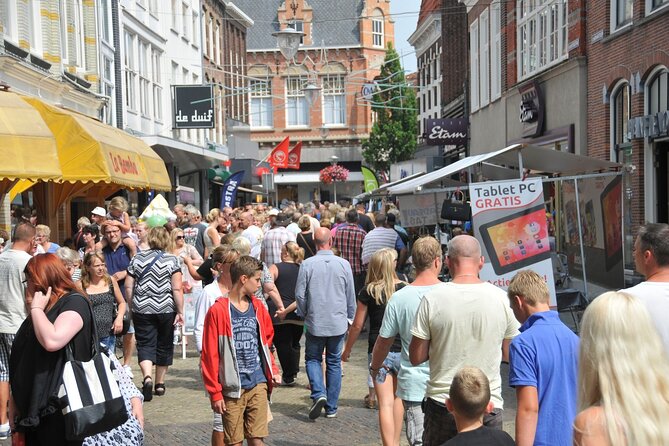
Reviewed · ESCAPE GAMES & SCAVENGER HUNTS
e-Scavenger hunt Sneek: Explore the city at your own pace
Sneek’s canals, old churches, Waterpoort, and shipping traditions become the setting for a self-guided city game. You walk from landmark to landmark, answer questions, and collect points instead of following a guide with a flag. It is a useful way to see the center while keeping your group involved.
I like the freedom to start and pause at your own speed, and I like the price: $35.86 per group of up to six, not per person. The main caution is that the app depends on your phone and data, and one question may be hard to answer if the needed information is not visible nearby.
Key points
- Sneek’s Waterpoort leads the route: This famous city symbol, with its two octagonal towers, is one of the trail’s clearest photo stops.
- The game suits small groups: Up to six people can play together, making the cost especially good for families and friends.
- The route mixes old and new Sneek: Expect churches, Town Hall, museums, a theater, canals, and local food history.
- You control the pace: Plan on roughly two to four hours, depending on how long you stop and how quickly your group solves questions.
- The app is generally easy to use: Still, bring a charged smartphone and mobile data, since both are your responsibility.
- A little competition adds energy: The leaderboard gives your walk a goal without forcing you into a fixed schedule.
A city walk with a game built in
This Sneek activity works best if you want more than a list of sights but less structure than a guided tour. The phone app directs your group around the city, asking you to observe buildings, find information, and answer trivia. You are not simply being shown Sneek. You are paying attention to it.
That distinction matters. A standard walk can blur together after the third church or canal. Here, your group has something to do at each stop. One person may read the question, another may search the building for a clue, and someone else may keep an eye on the score.
The experience is private, so only your own group takes part. Six is the maximum. That is a useful limit: large enough for a family or two or three couples, but small enough for everyone to stay involved. With a larger party, you would need to split into teams.
The route takes about two to four hours. The wide range is sensible. A fast group may move through the questions quickly, while a family may stop for photos, food, museum visits, or a closer look at the canals. The activity returns to the starting point, so you do not have to arrange a pickup at another part of town.
Other outdoor games and hunts around Netherlands:
- e-Scavenger hunt Deventer: Explore the city at your own pace
★ 4.0 · 34 reviews - Discover Amerfoort’s city center in this Outside Escape game tour
★ 4.5 · 32 reviews - e-Scavenger hunt Zierikzee: Explore the city at your own pace
★ 4.5 · 24 reviews
Starting at Johan Willem Frisostraat
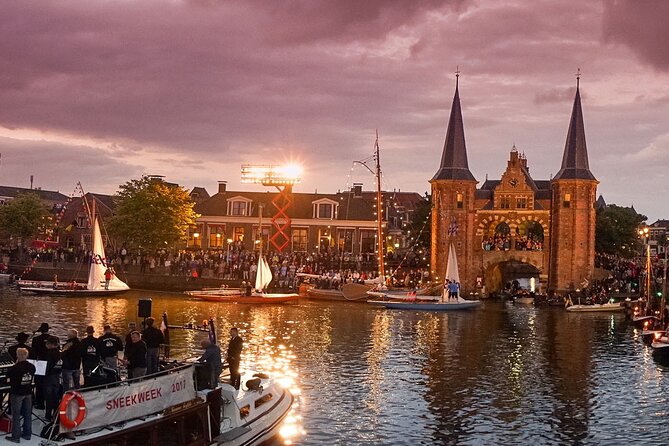
The stated meeting point is Johan Willem Frisostraat 2, 8606 CV Sneek. One practical warning is worth taking seriously: the starting point can be confusing if you expect the first question to begin at the most obvious landmark. Check the location before setting off and give yourself a few minutes to get oriented.
The activity is available every day at any time during the listed opening period, from February 16, 2020, through June 17, 2026. The hours are shown as midnight to 11:59 p.m., which gives you broad flexibility. You could fit it around a morning arrival, an afternoon in town, or an evening walk.
Still, an open schedule does not mean every stop will be equally useful at every hour. The route includes a theater, museums, churches, and local businesses. The outside views remain part of the walk, but interior access or useful information may depend on the time you choose.
Use your own smartphone and mobile data. The online app is included, but the phone and data connection are not. I would charge the phone fully before starting and keep the booking details easy to reach.
The Fries Scheepvaart Museum and Sneek’s water culture
The Fries Scheepvaart Museum introduces the shipping story of Friesland, covering the 17th through the 20th century. That makes it a fitting part of a Sneek walk, since the city is closely tied to canals and water sports.
Even if you only see the museum from outside, the stop gives context to the waterways around you. Sneek is not simply a pretty town with canals. Its water connections helped shape local work, movement, and leisure.
The activity presents the museum as one of the places where you answer a question or gather information. If you want a full museum visit, allow extra time beyond the game’s basic walking estimate. The trail is designed to keep you moving, while a museum visit naturally slows the day.
The Waterpoort, Sneek’s best-known symbol

The Waterpoort is likely to be one of the most memorable stops. This stone gateway is marked by two octagonal towers and is widely recognized as Sneek’s main icon.
It is the kind of landmark that works well in a scavenger hunt. The shape gives you something specific to notice, and the building provides a clear visual anchor as you move through the city. Your group can pause to study its details, take pictures, and then return to the app.
This stop also shows the advantage of a self-guided route. You can spend five minutes here or longer without holding up a group led by a guide. If your team enjoys the competitive side, the Waterpoort is a good place to stop, compare answers, and check your score.
Same city, a different sort of day:
- 1 Hour of Whisky Distillery Experience
★ 4.5 · 33 reviews - e-Scavenger hunt Zwolle: Explore the city at your own pace
★ 4.5 · 23 reviews - Discover Deventer with an Outside Escape city game tour!
★ 4.5 · 23 reviews - e-Scavenger hunt Bergen op Zoom: Explore the city
★ 4.5 · 21 reviews
Widow Joustra Beerenburg and a local taste of history
Another stop brings you to one of Sneek’s oldest buildings, dating from 1484. It is associated with Widow Joustra Beerenburg, which has been made there for more than 150 years.
This adds a local business and food tradition to a route otherwise filled with churches and civic buildings. You get a glimpse of how old buildings can remain connected to a product and a working commercial story over generations.
The stop is also a reminder to read the questions carefully. Some answers may depend on information displayed around the site. One piece of user feedback specifically noted that a few questions were difficult because the information could not be found in the area. If your group gets stuck, do not spend too long guessing. Record the issue, continue, and keep the walk moving.
Model trains and a change of scale
The model railway museum offers a sharp change from Sneek’s canals and medieval buildings. It has more than 5,000 models and is described as having the largest collection of model trains in Europe.
For families, this may be one of the most engaging stops. It gives children a visual subject to focus on, while adults who enjoy engineering, transport, or miniature scenes may want extra time here.
As with the shipping museum, the city trail and a full museum visit are different activities. The game can point you toward the museum and use it as a clue location, but the two-to-four-hour estimate may not include a lengthy indoor visit. If the museum is a priority, plan your timing around it rather than treating the entire route as a fixed schedule.
Sneek’s churches, from Romanesque to neo-Gothic
The route includes several churches, and they help show how Sneek changed over time. The Martini Church began in the 11th century and was originally made from tuff. Around 1300, it was enlarged, gaining three towers and a Romanesque west facade, with a wooden core also added.
The church appears more than once in the supplied route details, so you should expect it to be an important point of interest rather than assume the repeated reference means two separate churches. Look closely at the architecture and use the app’s questions to notice details that might otherwise pass by.
The Sint-Martinuskerk offers a different architectural note. It is a Roman Catholic neo-Gothic pseudo-basilica cross church dedicated to Saint Martin of Tours. Placing these churches in one walk lets you compare age, style, and religious tradition without needing a formal architecture tour.
Churches can be quiet, visually striking stops, but access is not guaranteed by the tour description. Treat the exterior as the dependable part of the experience. If a door is open, be respectful and check any local rules before entering.
Town Hall, theater, and everyday Sneek
Sneek Town Hall dates from around 1478. It was built on the foundations of two towers, including a medieval defensive and residential tower, and it was expanded and renovated many times afterward.
This is a good civic counterpoint to the churches. You can see how power and administration occupied the same old center as worship, trade, and daily life. The building’s changes over time also make it a useful reminder that historic towns are not frozen scenes. They are places that have been altered and reused.
Theater Sneek adds a modern cultural stop. Its program includes cabaret, musicals, dance, music, and family performances. You may not be attending a show during the trail, but the theater broadens the route beyond old masonry and religious buildings.
I like this mix because it keeps the walk from becoming a checklist of ancient sights. Sneek’s past is present, but so are its current cultural spaces.
How the app and scoring affect the walk
The app is the heart of the activity. It supplies the trail, presents the questions, and lets your group work toward a leaderboard position. The game is intended to be user-friendly, and the available feedback describes the app as working well and being easy to use.
The leaderboard changes the mood in a small but useful way. You can treat it as a serious contest, or simply use it to give children and adults a reason to stay alert. Questions are generally not too complicated, but not every answer will be obvious.
A few questions may not have enough visible information at the location. That is the main weakness of this format. A guide could explain a clue or correct a misunderstanding on the spot. With the app, you may need to make your best judgment and move on.
The walk is also reported as suitable for people with hearing impairments, since it is phone-based rather than dependent on spoken commentary. Service animals are allowed, public transportation is nearby, and most people can participate. The route is described as private, so your group can set its own rhythm.
Is $35.86 good value for six people?
At $35.86 per group, the price works out to about $5.98 each if six people take part. Even with four people, it is under $9 per person. That is strong value if you want a structured way to see Sneek without paying for a private guide.
The value is less about detailed expert commentary and more about the format. You pay for a route, an app, questions, and a shared activity. Museums, food, drinks, transport, and the phone itself are not included.
For a couple, the group price is less impressive than it is for a family or full group of friends. Still, a couple may prefer the independence and the chance to pause wherever they like. For six people, the price is especially appealing.
Free cancellation is available if you cancel at least 24 hours before the start time. Changes or cancellations inside that window are not refunded, and the cut-off follows local time.
Who should book the Sneek city trail?
I would choose this for a family, a group of friends, or anyone who finds ordinary sightseeing too passive. The questions give children a role, the score adds a little friendly pressure, and the private format keeps the day relaxed.
It also suits visitors who want an introduction to Sneek before choosing which places deserve a longer visit. The Waterpoort, churches, Town Hall, museums, theater, and canal-side streets create a broad first look at the city.
I would be more cautious if you want a polished historical lecture, guaranteed indoor access, or complete explanations at every stop. This is a game-led city walk, not a museum tour or a live guide experience. Rain can also affect the day, since much of the activity takes place outdoors. One group had late-afternoon rain, and the weather naturally made the walk less comfortable.
Should you book it?
Book the e-Scavenger Hunt Sneek if you want to see the city actively, at your own speed, with a small group. The best reasons are the low group price, the strong mix of landmarks, and the chance to turn a standard walk into a shared challenge.
Skip it if you dislike phone-based activities or want every historical question answered by an expert. Bring mobile data, allow two to four hours, check the starting point carefully, and accept that one or two clues may take some detective work. For the right group, that uncertainty is part of the fun.
FAQ
How much does the Sneek e-Scavenger Hunt cost?
The price is $35.86 per group of up to six people.
How long does the activity take?
The expected duration is approximately two to four hours.
How many people can play together?
One private group of up to six people can play together.
Where does the activity start?
The meeting point is Johan Willem Frisostraat 2, 8606 CV Sneek, Netherlands.
Where does the activity end?
The activity ends back at the meeting point.
Do I need a smartphone?
Yes. A smartphone is not included, and you need your own phone to use the online app.
Is mobile data included?
No. Mobile data is not included, so you need to provide your own data connection.
Can I choose when to start?
The listed opening hours are Monday through Sunday, from 12:00 a.m. to 11:59 p.m., during the stated operating period.
What sights are included along the route?
The route includes the Fries Scheepvaart Museum, Waterpoort, Widow Joustra Beerenburg location, model railway museum, Martini Church, Sneek Town Hall, Sint-Martinuskerk, and Theater Sneek.
Can I cancel for a full refund?
Yes, if you cancel at least 24 hours before the experience start time. Cancellations made within 24 hours are not refunded.
Just added in Netherlands
- e-Scavenger hunt Roosendaal: Explore the city at your own pace★ 3.5 · 5 reviews
- 1 Hour of Whisky Distillery Experience★ 4.5 · 33 reviews
- Hattem’s Windmills, Bakeries and Ghosts: A Self-Guided Audio Tour★ 3.5 · 3 reviews
- e-Scavenger hunt Zwolle: Explore the city at your own pace★ 4.5 · 23 reviews
- e-Scavenger hunt Amersfoort: Explore the city at your own pace★ 4.0 · 18 reviews
- Discover Zutphen with a self-guided Outside Escape city game tour★ 4.5 · 4 reviews
- 3 hour boarding ticket Summer sailing from Wemeldinge (Zeeland)★ 5.0 · 17 reviews
- e-Scavenger hunt Deventer: Explore the city at your own pace★ 4.0 · 34 reviews
Escape Games & Scavenger Hunts, compared.

e-Scavenger hunt Maastricht: Explore the city at your own pace
Read our review →
Rotterdam Highlights & Spies: Interactive City Game
Read our review →
Discover Utrecht with a self-guided Outside Escape city game tour
Read our review →
e-Scavenger hunt Den Bosch: Explore the city at your own pace
Read our review →
Discover The Hague with a self-guided Outside Escape city tour
Read our review →
Discover Amerfoort’s city center in this Outside Escape game tour
Read our review →
Discover Maastricht with a self-guided Outside Escape city game
Read our review →Browse the lists this tour appears in