
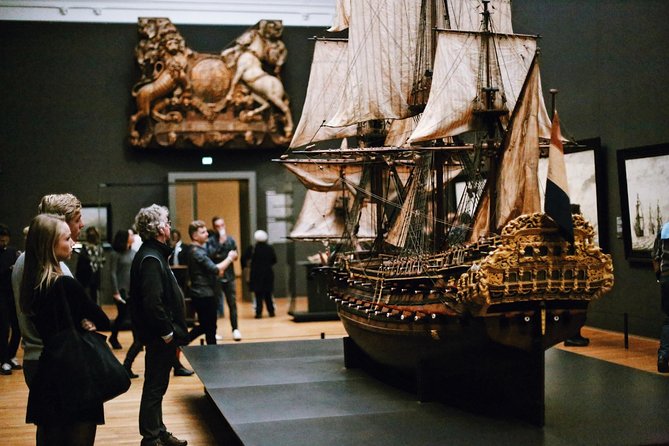
Reviewed · RIJKSMUSEUM TICKETS
Rijksmuseum & Amsterdam City Center – Exclusive Guided Tour
Amsterdam’s best story unfolds in two places: inside the Rijksmuseum, where Rembrandt and Vermeer made Dutch life unforgettable, and outside on streets shaped by trade, faith, war, and water. This private five-and-a-half-hour tour connects those two worlds with one guide.
I like the focused museum visit, especially the chance to see The Milkmaid, Rembrandt’s major works, 17th-century dollhouses, and the old library without wandering blindly through 8,000 objects. I also like the walking route’s variety, from the Amstel River and medieval towers to quiet hofjes and narrow canal houses.
The main drawback is the price, $287.18 per person, and the pace. You cover a lot of ground, with a lunch break tucked into the day. Also, the supplied meeting details conflict: one section says to meet at the Rijksmuseum, while the stated meeting point is Cobra Café and another itinerary note mentions St. Nicholas Basilica. Confirm the exact starting place before you set out.
Key points to know before booking
- A museum-and-city pairing: Start with Dutch art, then see how Amsterdam’s wealth, religion, and trade shaped the streets outside.
- Private guiding matters: Your own guide can adjust explanations and linger at major works, though the price is high for a small party.
- A wide-ranging route: The walk includes Chinatown, Nieuwmarkt, the Oost-Indisch Huis, Begijnhof, Dam Square, the Jordaan, and the Anne Frank House exterior.
- Strong art focus: Rembrandt and Vermeer receive the most attention, with useful context around The Milkmaid and the museum’s historic collections.
- Lunch is not included: Plan for a break during the day, but budget separately for food and allow time for a proper sit-down meal.
- Good walking shoes are essential: Cobblestones, bridges, and a long route make this a moderate physical outing, not a gentle museum visit.
The Rijksmuseum gives the day its backbone
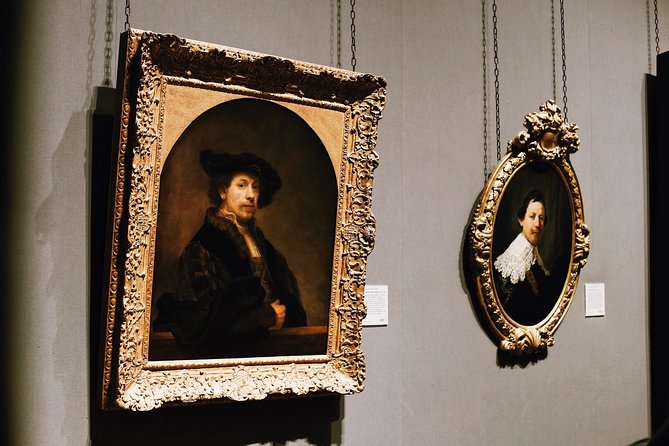
The day begins with Amsterdam’s great national museum, generally described as Holland’s answer to the Louvre. Inside, your guide leads you through a small selection of the museum’s more than 8,000 objects, rather than asking you to tackle the whole collection alone.
That focus is important. The Rijksmuseum can be tiring if you simply follow room after room of paintings, furniture, ship models, decorative arts, and historical objects. A guide helps you understand why certain works matter and how they fit into Dutch society.
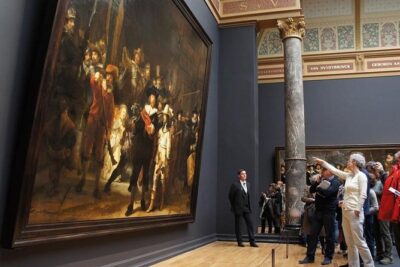
Rembrandt is one of the main attractions. You can expect attention to his skill with light, faces, gesture, and human emotion, along with stories that make the paintings easier to read. The tour is not limited to the most famous names, though. The 17th-century dollhouses offer a glimpse into domestic life and wealth, while the museum’s 19th-century library adds an architectural pause among the galleries.
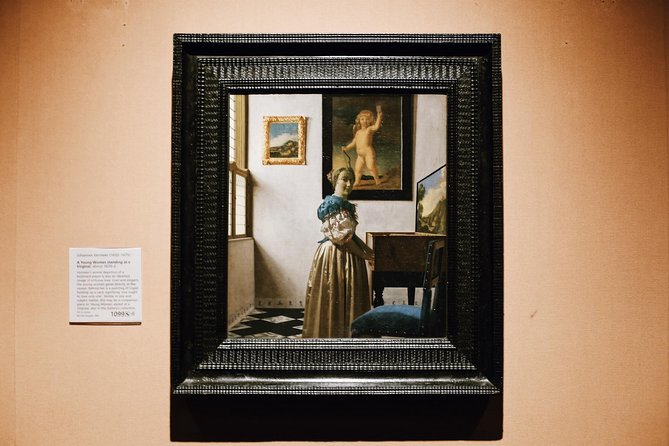
Vermeer’s The Milkmaid is another central stop. The painting’s quiet scene of a woman pouring milk becomes more interesting when you notice the simple room, the careful light, and the way an ordinary household task becomes a subject worthy of close attention.
The guides named in the feedback include Jacopo, Victoria, Josje, Giuseppina, and Paola. Their strengths are described in practical terms: clear explanations, strong art knowledge, a good sense of which details matter, and the ability to keep moving around school groups. One guide, Victoria, even continued professionally during bad weather and a bicycle-chain problem, while another guest praised Dario for handling an unexpected museum power outage responsibly.
That last incident points to a useful reality. Museum operations can change suddenly. The Rijksmuseum may close or delay opening without much warning, and the tour provider says it will offer an alternative if the opening is delayed by more than an hour. Refunds or discounts are not promised in that situation, so you should understand this before paying the full private-tour price.
Security rules also matter. Large bags and suitcases are not allowed inside. Bring only a handbag or small, thin backpack, and expect occasional quiet areas where your guide must explain information before entering. Some rooms or collections may change during the year.
More Rijksmuseum tickets and tours in Amsterdam:
- Amsterdam: Rijksmuseum Entry Ticket
★ 4.7 · 25,535 reviews - Amsterdam: City Canal Cruise and Rijksmuseum
★ 4.5 · 2,129 reviews - Rijksmuseum Amsterdam Small-Group Tour with Private Upgrade
★ 4.5 · 1,547 reviews
Your lunch break divides art from street history
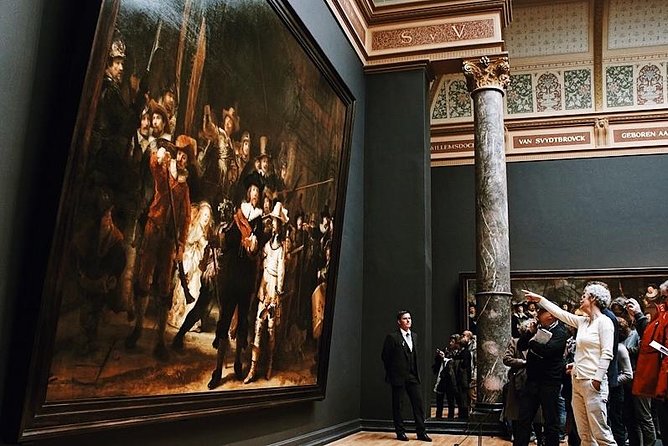
After the museum, you take a lunch break at your own expense. The tour does not specify a particular restaurant, so you should ask your guide how much time is available and where the group plans to stop.
This break is more than a pause for food. The first part of the day is largely indoors and art-centered. The afternoon is a long outdoor walk, with cobblestones, bridges, canals, and many short stops. Eat enough to keep your energy steady, but do not assume the break is included in the $287.18 price.
The tour promises private transport between locations if necessary, but most of the city section is built around walking. That gives you chances to stop for photographs and see how the city changes block by block. It also means the route may feel full rather than leisurely.
From St. Nicholas Basilica to the old city wall
The city portion begins with St. Nicholas Basilica, according to the detailed stop list. The church dates from the late 19th century, when Roman Catholics in the Netherlands could again worship openly after roughly three centuries of prohibition.
Its architecture brings together several styles and artistic movements, making it a fitting introduction to Amsterdam’s religious history. You only spend about 10 minutes here, so expect an exterior discussion or a brief look rather than a long church visit.
From there, the route heads toward the Schreierstoren, often called the Weeping Tower or Tower of Tears. This former part of Amsterdam’s medieval city wall carries a memorable story: women were believed to have cried there as husbands left the port for war or fishing.
The story is useful because it places Amsterdam’s old defenses beside its life as a seafaring city. Admission to the tower is not included, and the stop is listed as about 10 minutes, so treat it as a historical viewpoint rather than a full interior visit.
Zeedijk, Nieuwmarkt, and De Waag
Zeedijk offers a different side of central Amsterdam. The street is associated with the city’s Chinatown and includes Asian restaurants, markets, shops, and the Zeedijk Buddhist temple, described as the largest Chinese-style Buddhist temple in Europe.
The stop lasts about 10 minutes. You will not have time for a full meal or a careful shop-by-shop look, but the area helps show how Amsterdam’s old center remains shaped by international connections.
Nearby Nieuwmarkt has served as a place of trade and social activity since the 17th century. Its position just inside the old city gate made it convenient for merchants and shoppers, and it remains one of the more active squares on the route.
At the square, you see De Waag, a 15th-century building that began as a city gate and part of the city walls. It later served as a guildhall, museum, and fire station. The building’s changing roles make it a compact lesson in how old structures are reused over time. Admission is not included.
A few more things to do in Amsterdam worth a look
- Amsterdam: 75 Minute City Canal Cruise with Audio Guide
★ 4.4 · 17,501 reviews - Anne Frank’s Story – Guided Walking Tour through Amsterdam
★ 5.0 · 11,619 reviews - Amsterdam: Johan Cruijff ArenA Tour with Optional Guide
★ 4.6 · 8,954 reviews - Amsterdam: Royal Palace Entry Ticket and Audio Guide
★ 4.6 · 6,475 reviews
Narrow houses and the Dutch East India Company
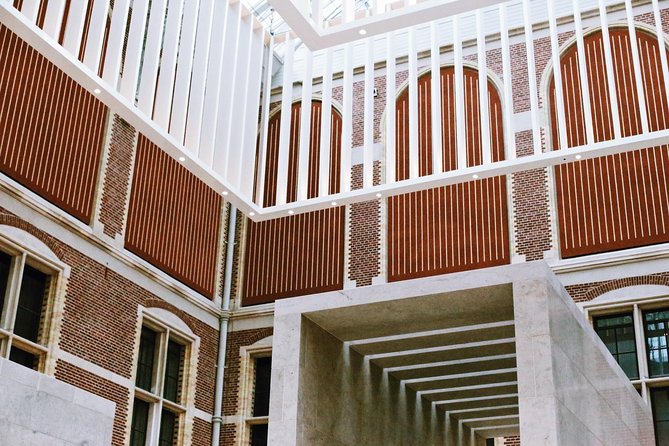
The route then shifts to architecture and commerce. The Trippenhuis is Amsterdam’s widest home, measuring about 22 meters across, while the Kleine Trippenhuis opposite it is one of the city’s narrowest houses.
This contrast is one of the tour’s most enjoyable visual moments. Amsterdam’s canal houses were shaped by limited land and taxation, so tall, narrow buildings became practical and prestigious. Looking from one house to the other makes the old city’s building habits easy to understand.
At the Oost-Indisch Huis, you step into the courtyard of the Dutch East India Company headquarters. The company is described as the birthplace of the world’s first multinational corporation, and this stop gives the earlier museum discussion of Dutch trade a physical setting.
The route also passes the Zuiderkerk, Amsterdam’s first purpose-built Protestant church. Its tower remains a key part of the city skyline, and its design by Hendrick de Keyser reflects the changing religious order of the 17th century.
You then pass Rembrandt’s former home, now Museum Het Rembrandthuis. He lived and worked there from 1639 to 1656, and the museum holds etchings and paintings connected to him and his contemporaries. This tour views the building from the route rather than including a full visit, so art lovers who want the house interior should plan a separate admission.
Begijnhof and Dam Square show two sides of Amsterdam
Begijnhof is one of the city’s oldest hofjes, or almshouse courtyards. The Beguines, unmarried women who lived together under vows of chastity, once called this secluded place home. Two churches are also found here.
The quiet courtyard offers a sharp change from the traffic and activity of central streets. You should keep your voice low and treat the area as a lived religious site, not simply a photo stop. The itinerary allows about 10 minutes, which is enough for an introduction but not a long visit.
Dam Square is one of Amsterdam’s most recognizable public spaces. The Royal Palace, New Church, and National Monument all face or sit near the square, which also hosts frequent events.
This is a useful orientation point, but it can feel crowded and exposed compared with Begijnhof. The guide’s historical explanation is likely to be more valuable than the short stop itself, since the square has been central to civic life for centuries.
Canals, the Anne Frank House, and the Jordaan
At Herengracht, the tour reaches the Golden Bend, the grandest section of one of Amsterdam’s main canals. The large canal mansions reflect the wealth created during the Dutch Golden Age and show how the city’s merchant families turned narrow plots into impressive homes.
You then pause outside the Anne Frank House. The stop does not include admission, so do not expect to enter the museum during this tour. The guide can place the house in the setting of wartime Amsterdam, while nearby Westerkerk provides another landmark, with the tallest church tower in the city.
The route continues along Bloemgracht, where you look for carved gable stones and trade symbols on ornate façades. These details are easy to miss when walking alone. A guide can point out how Amsterdam’s houses once used signs and carvings to identify trades and tell stories about the people who lived there.
The Karthuizerhof follows. Described as Amsterdam’s largest hofje, it was built as almshouses for poor and elderly residents around a quiet courtyard. Like Begijnhof, it reveals a less grand side of Amsterdam, where charity, housing, and community life shaped the city’s neighborhoods.
Noorderkerk is a 17th-century Protestant church built for the Jordaan district. Its cross-shaped floor plan reflects new ideas about worship after the Reformation. The stop is short, about five minutes, but it adds another layer to the religious story introduced at St. Nicholas Basilica and Zuiderkerk.
Finish at Het Papeneiland
The tour ends at Het Papeneiland, a brown café dating from 1642 on one of Amsterdam’s prettiest canal corners. It is known for apple pie, and this is the most relaxed ending on the route.
Because the tour ends here rather than returning you to your hotel, think about what comes next. You can remain in the Jordaan, continue along the canals, or arrange your own ride. Hotel pickup and drop-off are not included, and the stated end point is Prinsengracht 2.
Is $287.18 a fair price?
At $287.18 per person, this is not a budget sightseeing walk. The value depends heavily on group size. For two people, the private format is expensive, but you are paying for a dedicated English-speaking guide, a museum visit, a long city walk, and the ability to ask questions throughout.
For a family or small group dividing the cost, the price can make more sense, particularly if everyone wants art explained rather than simply viewed. The private setup also lets the guide adjust the museum discussion to your interests, though the experience still has a fixed route and a fixed five-and-a-half-hour length.
All entrance fees are included, as is the guided Rijksmuseum visit. Lunch, gratuities, and hotel transport are not included. The optional semi-private savings choice is different: the exclusive guide applies only to the private option, not the Save, Book Semi-Private selection.
The tour is booked an average of 63 days ahead, which suggests you should plan early if your dates are fixed. Free cancellation is available up to 24 hours before the start time, but changes or cancellations inside that window are not accepted for a refund.
Who should choose this tour?
I would choose it if you want one well-organized day that links Dutch masterpieces with Amsterdam’s streets. It suits first-time visitors who want orientation, art lovers who prefer explanation over wandering, and families or small groups that value having one guide to themselves.
You should think twice if you want long museum time, a slow canal walk, or a low-cost group outing. The route contains about 21 listed stops, many lasting only five or 10 minutes, so you will see a great deal but rarely linger.
Confirm the meeting location, bring a small bag, wear comfortable shoes, and allow extra energy for the outdoor section. The tour runs rain or shine, and a moderate level of fitness is expected.
FAQ
How long does the Rijksmuseum and Amsterdam city tour last?
The tour lasts about five hours and 30 minutes, including a lunch break.
What time does the tour start?
The stated start time is 10:00 am.
Where does the tour meet?
The supplied meeting information lists Cobra Café at Hobbemastraat 18 as the starting point. Another section says to meet at the Rijksmuseum, and the detailed city itinerary begins at St. Nicholas Basilica, so confirm the exact meeting place before the tour.
Where does the tour end?
The tour ends at Het Papeneiland, Prinsengracht 2, Amsterdam.
Is the tour private?
Yes. The private activity is for your group only. The exclusive guide does not apply if you choose the semi-private savings option.
Is the Rijksmuseum admission included?
Yes. The guided museum tour and entrance fees are included.
Is lunch included?
No. You take a lunch break, but food and drinks are at your own expense.
Does the tour include hotel pickup and drop-off?
No. Hotel pickup and drop-off are not included. Uber or a taxi is recommended for those transfers.
Can I bring a large backpack or suitcase into the museum?
No large bags or suitcases are allowed. Only handbags or small, thin backpacks are permitted through museum security.
What happens if the Rijksmuseum closes or opens late?
The museum can have occasional closures or delays. If opening is delayed by more than one hour, an appropriate alternative will be provided, but refunds or discounts are not available in that situation.
Is the tour suitable for someone with limited mobility?
The tour requires a moderate level of physical fitness and includes a long walking route over cobblestones, bridges, and city streets. The supplied information does not specify accessibility arrangements.
Can I cancel for a full refund?
Yes, if you cancel at least 24 hours before the local start time. Cancellations or changes made less than 24 hours before the tour are not refunded.
Should you book it?
Book this tour if you want Dutch art and Amsterdam’s old center explained as one connected story. The strongest parts are the focused Rijksmuseum visit, the private guide format, and the range of city stops, from Rembrandt’s house and the East India Company headquarters to Begijnhof, the Golden Bend, and the Jordaan.
Skip it if the price feels too high, you prefer to set your own pace, or you mainly want to enter the Anne Frank House or Rembrandthuis. Those sites are seen from outside here. For a small group that wants structure, context, and a full first look at Amsterdam, this is a strong, busy day, provided you confirm the meeting point before booking.
Just added in Amsterdam
- Guided Day Trip – Volendam, Zaanse Schans, Marken & Edam★ 4.0 · 232 reviews
- Private Tour Zaanse Schans Windmills and Volendam in Jaguar★ 5.0 · 10 reviews
- Zaanse Schans and Giethoorn Unique Day Trip with Boat Cruise★ 4.5 · 17 reviews
- Half-Day Private Guided Sightseeing Tour of Zaanse Schans★ 5.0 · 14 reviews
- Zaanse Schans Private Tour Windmills★ 5.0 · 18 reviews
- Private bike tour: Hidden gems around Amsterdam and surroundings★ 5.0 · 4 reviews
- Bike tour in Amsterdam with an Italian guide★ 5.0 · 15 reviews
- Amsterdam Sightseeing Tour + Hidden Gems + Tastings + PDF guide★ 5.0 · 35 reviews
Rijksmuseum Tickets, compared.
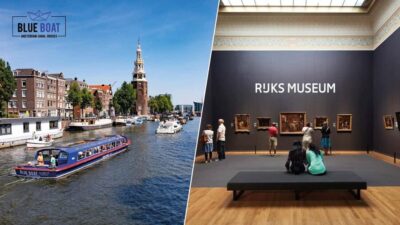
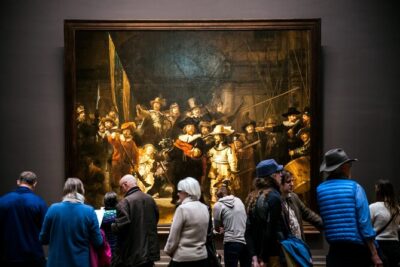
Rijksmuseum Amsterdam Small-Group Tour with Private Upgrade
Read our review →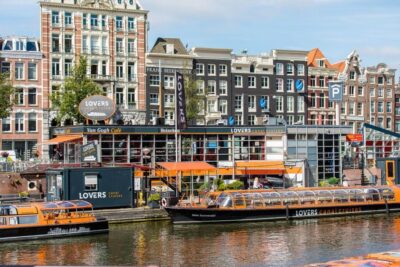
Rijksmuseum Entry Ticket and Canal Cruise Combo
Read our review →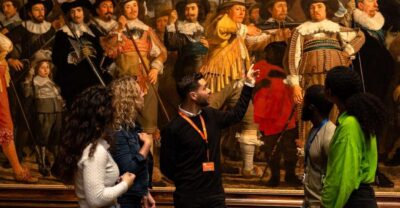
Rijksmuseum Amsterdam Exclusive Guided Tour w/ Reserved Entry
Read our review →
Van Gogh & Rijksmuseum w/ Reserved Entry Semi-Private 8ppl Max
Read our review →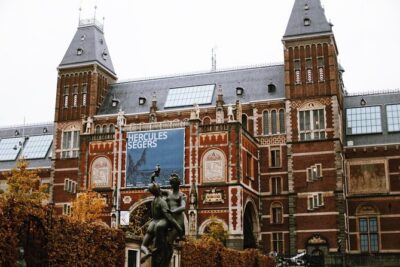
Van Gogh & Rijksmuseum w/ Reserved Entry Exclusive Guided Tour
Read our review →Browse the lists this tour appears in