
Reviewed · DELFT TOURS
Royal Delft: Delftblue Factory and Museum
The most interesting part of Royal Delft is that this is not only a museum. It is the last original Delft Blue factory from the 17th century still producing pottery by hand in Delft. You can move from displays of historic ceramics to the working factory, where clay is shaped, pieces are finished, and painters add the fine blue lines that make Delftware famous.
I like the clear look at the whole production process and the excellent choice of audio languages. I also like the peaceful courtyard garden and the chance to see the grand building from inside. The main drawback is that this is usually a self-guided visit, and the factory can be quiet in the afternoon, with only a few craftsmen at work.
Key points
- Hand-painted Delft Blue: Watch painters work on white earthenware using a centuries-old method.
- A working factory since 1653: The museum connects Dutch ceramic history with present-day production.
- Self-guided audio tour: Choose English, Dutch, Spanish, Chinese, French, German, Italian, or Japanese.
- About 1.5 hours: Allow extra time for the shop, garden, and Brasserie 1653.
- A useful Delft stop: The factory is a 15-minute walk from Delft Station and about 20 minutes from the Market Square.
- Good access and flexible booking: The building is wheelchair accessible, and cancellation is free up to 24 hours before the visit.
Why Royal Delft is more than a pottery museum
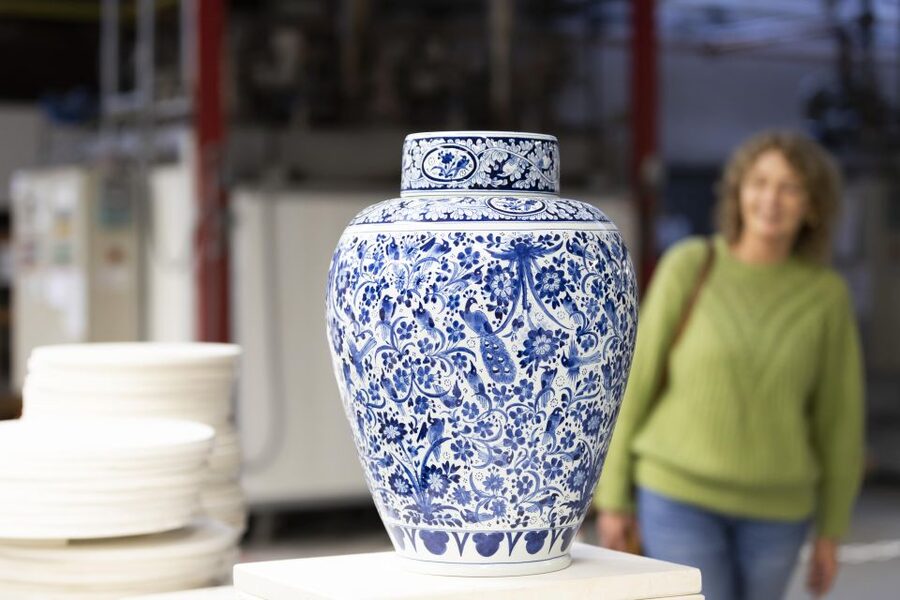
Delft Blue pottery can look familiar before you arrive. You may have seen blue-and-white plates, tiles, vases, windmills, ships, and canal houses in shops across the Netherlands. Royal Delft lets you see how those objects are made, and that changes the way you look at them.
The company began in 1653, when Delft was a major center for earthenware. Nearly 400 years later, Royal Delft still makes Delft Blue by hand. The process is slow and exact. A painter works on a white surface with a fine brush, while other workers prepare clay, use molds, sand pieces, and handle the firing process.
The visit is particularly useful if you want to understand the difference between a printed souvenir and hand-painted Delftware. Small variations are part of the human work. The pottery is not simply blue paint placed on a finished object. It passes through several skilled stages before it reaches the showroom.
I would not plan the entire day around Royal Delft, but it makes a strong half-day stop when combined with Delft’s old center. The visit itself takes about 1.5 hours. Add time for coffee, shopping, or a tile-painting activity if one is available during your visit.
More Delft trips booked from the Netherlands:
- From Amsterdam: Rotterdam, Delft & The Hague Guided Day Tour
★ 4.2 · 1,765 reviews - Delft: Canal Cruise with Guided Commentary
★ 4.4 · 990 reviews - Rotterdam, Delft, the Hague, Madurodam from Amsterdam
★ 4.0 · 793 reviews
Entering the 1653 building
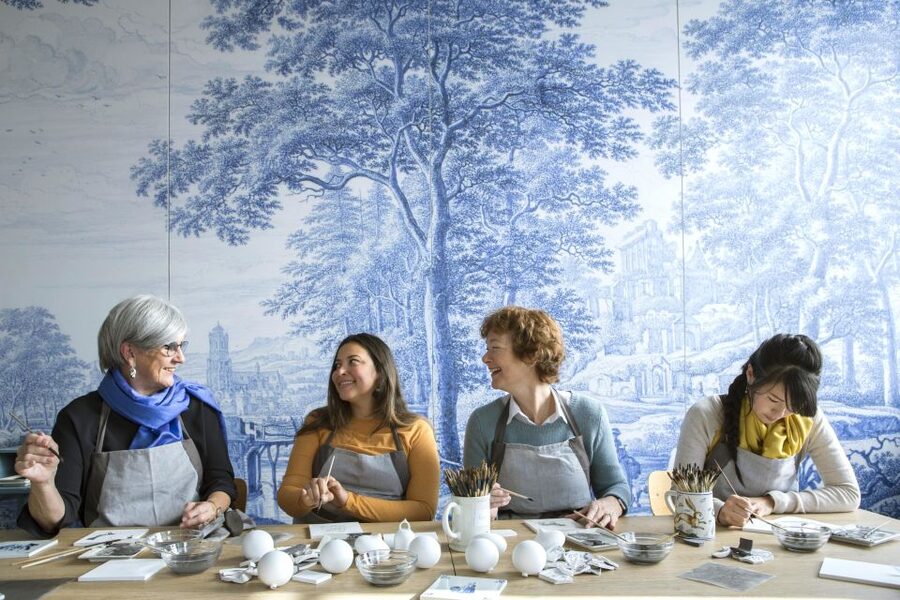
The building is part of the experience. Royal Delft occupies an old factory site with a handsome interior and a courtyard garden. The layout takes you through the museum before leading you toward the production areas, so you first learn what Delft Blue means before watching it being made.
The audio tour gives you a steady path through the exhibits. You listen at each section using the provided device, and the information is also supported by signs and displays. English-language videos and written material are available, which helps if you prefer reading to listening.
You should know that the standard visit is not usually a live guided tour. Staff members and greeters can help you get started, but the main explanation comes from the audio guide. This works well if you like to move at your own pace. It is less satisfying if you want to ask questions as you go.
The audio guide lasts about one hour, while the full visit is listed as 1.5 hours. You can spend longer in the museum or stop to watch the factory work. The pace is manageable, and families can keep moving rather than waiting for a group.
The museum explains how Delft Blue became famous
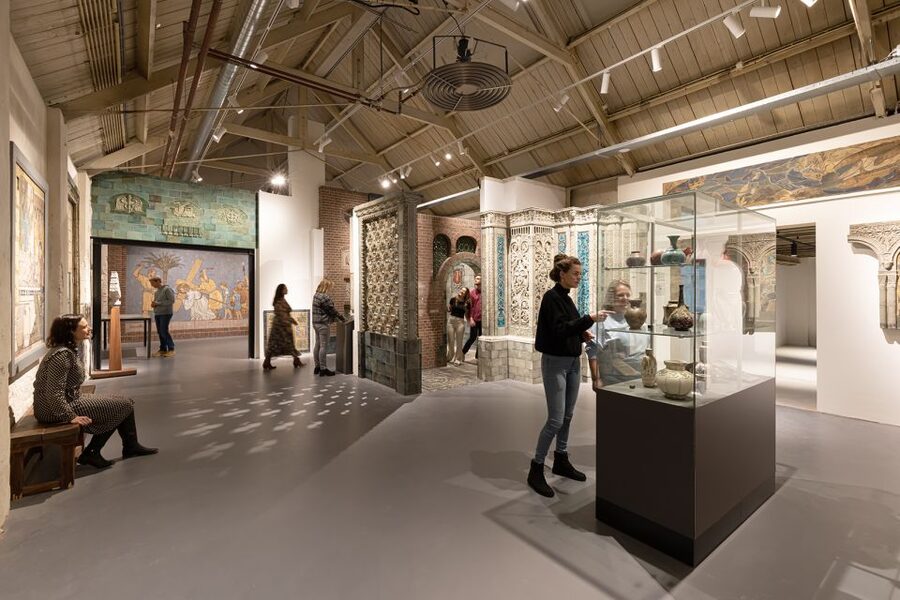
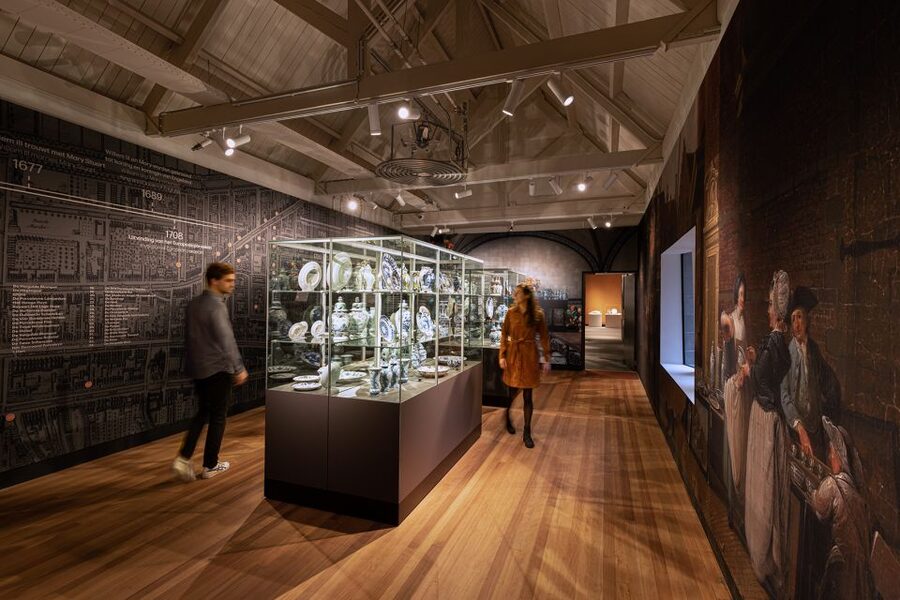
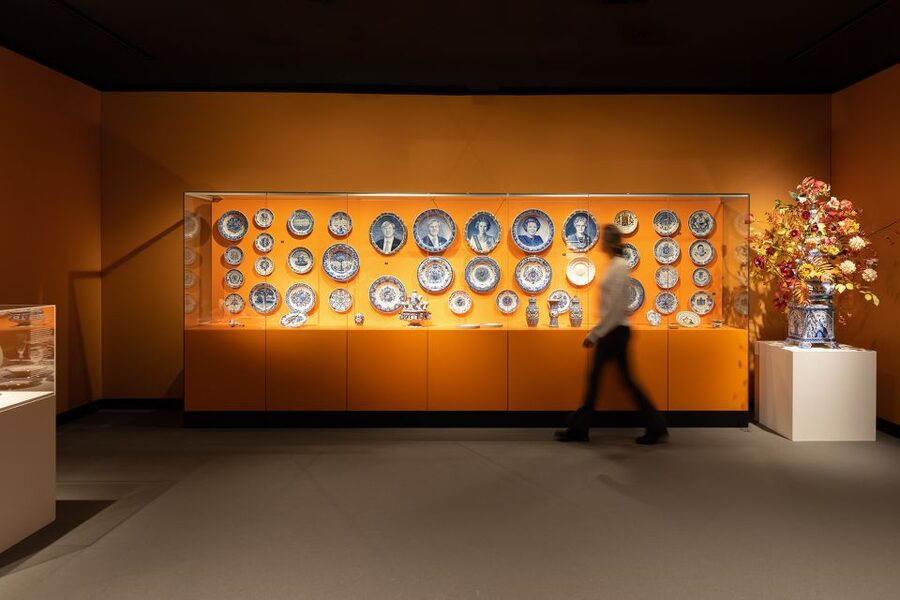
The museum begins with the story of Delftware and the company’s long history. You will see antique and modern pieces, from traditional plates and tiles to more recent designs. The collection shows how the familiar blue-and-white style has changed while keeping its central look.
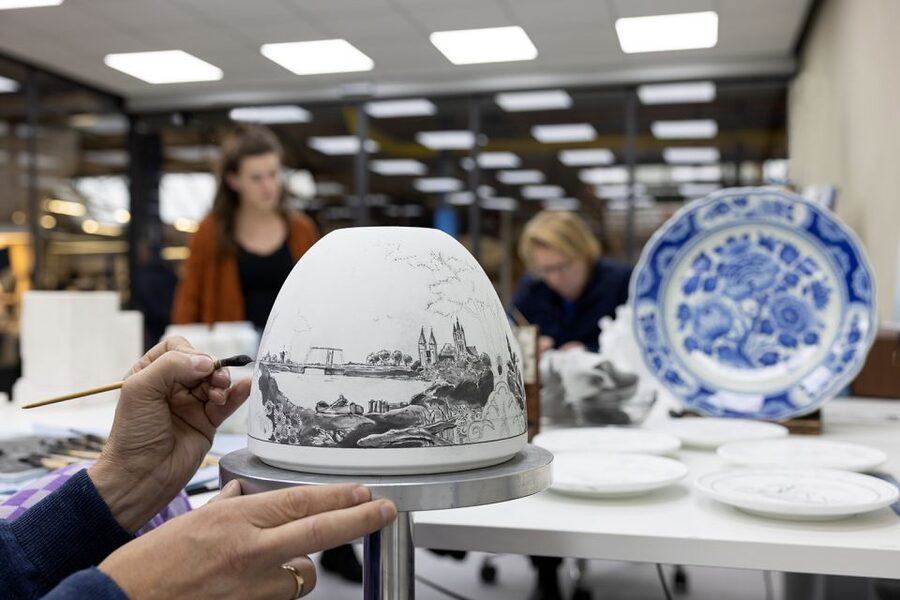
One useful detail explains the color itself. The pottery is painted with black pigment before firing, and the kiln changes it to blue. That simple fact gives you a better sense of the skill involved. The painter must work with a color that will not look the same until later.
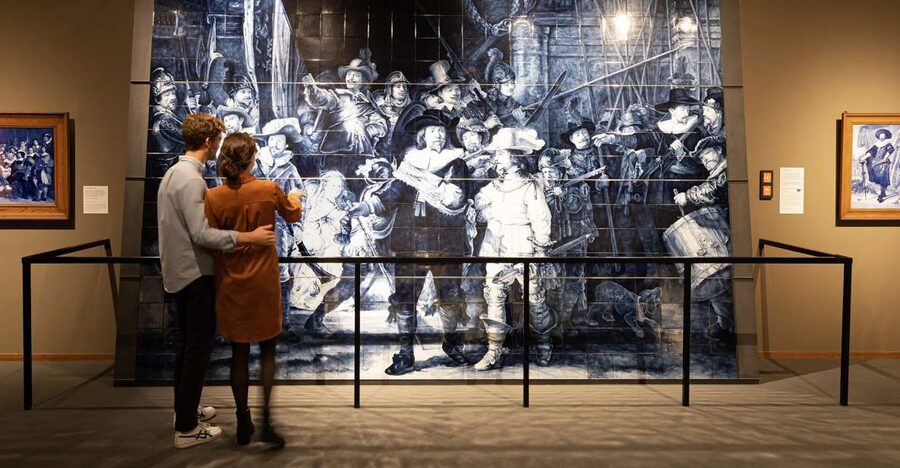
The displays also make clear that Delft Blue is not limited to small decorative plates. Large tile scenes and elaborate vessels show the scale of the work. One especially memorable piece is a life-sized tiled version of Rembrandt’s The Night Watch. It gives you a sense of how ceramic painting can become a major wall artwork rather than a small household object.
The museum is attractive and well organized, but its appeal depends on your interest in ceramics and design. If you prefer hands-on museums, some sections may feel quiet. One visitor found the audio presentation less engaging than a live guide would have been. I agree that the museum works best when you take time to look closely at the pieces instead of rushing through the displays.
Watching painters and craftsmen at work
The factory floor is the reason to visit Royal Delft in person. You can see white earthenware being handled at different stages, including clay being poured into handmade molds and finished pieces being prepared for painting or firing.
The painter’s station is the most absorbing part. Fine lines and small details are added by hand, often with a brush that demands steady control. A vase or plate may look simple from a distance, but close viewing reveals the number of decisions packed into every curve and mark.
You might see a painter working on a plate or vase, or a craftsman sanding a newly formed piece. The exact amount of activity varies by day and time. Morning can be a better choice if seeing more artisans at work is your priority. In the afternoon, the factory may be quieter, and you may see only one or two workers.
That variation is worth keeping in mind. The factory is genuine, but it is still a working business, not a performance staged continuously for an audience. A scheduled demonstration may involve an artisan sitting down to paint without a spoken explanation. If you expect a presentation with questions and answers, you may find it too passive.
For me, the quiet observation is still valuable. Watching the brush touch the pottery gives you more information than a display case can. You see how slowly the work proceeds and why handmade Royal Delft pieces cost far more than mass-produced souvenirs.
Other collections worth booking around the Netherlands:
- Amsterdam: Van Gogh Museum Ticket
★ 4.7 · 52,054 reviews - Moco Museum Amsterdam Entrance Tickets with Banksy & More
★ 4.4 · 10,088 reviews - Amsterdam: The Upside Down Museum Entrance Ticket
★ 4.4 · 9,506 reviews - Amsterdam: Red Light Secrets Museum Entry Ticket
★ 4.2 · 5,722 reviews
The difference between an audio tour and a live guide
The included audio tour is available in eight languages: English, Dutch, Spanish, Chinese, French, German, Italian, and Japanese. That is one of the strongest practical features of the visit. You can listen in a language that suits you, and the tour gives enough background to make the exhibits understandable.
The English audio is generally easy to follow and paced well. The devices can be useful when you want a clear explanation without joining a group. Families and couples can also separate for a few minutes and meet again later.
The limitation is interaction. A live guided tour is not included, and the standard ticket does not promise a guide who will answer questions throughout the route. At busy times, another guided group may pass through while you are listening, which can make it harder to hear.
If you want personal commentary, ask at the entrance about available guided tours. The attraction lists English and Dutch for hosts or greeters, but the regular audio option is the main way most visitors receive explanations.
The courtyard garden and Brasserie 1653
After the museum and factory, take a few minutes in the courtyard garden. It is a pleasant contrast to the indoor displays and gives you a chance to slow down before continuing into Delft.
Brasserie 1653 overlooks the garden and serves coffee, high tea, lunch, snacks, and drinks. Food is not included in the $21 admission, so treat the brasserie as an optional pause rather than part of the ticket. It can be a good choice if you want to sit down before walking into the center of town.
The garden is also useful for anyone who finds museums tiring. You do not need to rush directly from the final exhibit to the shop or exit. The setting gives the visit a calmer finish and makes Royal Delft feel like more than a row of indoor galleries.
The showroom has beautiful, expensive pottery
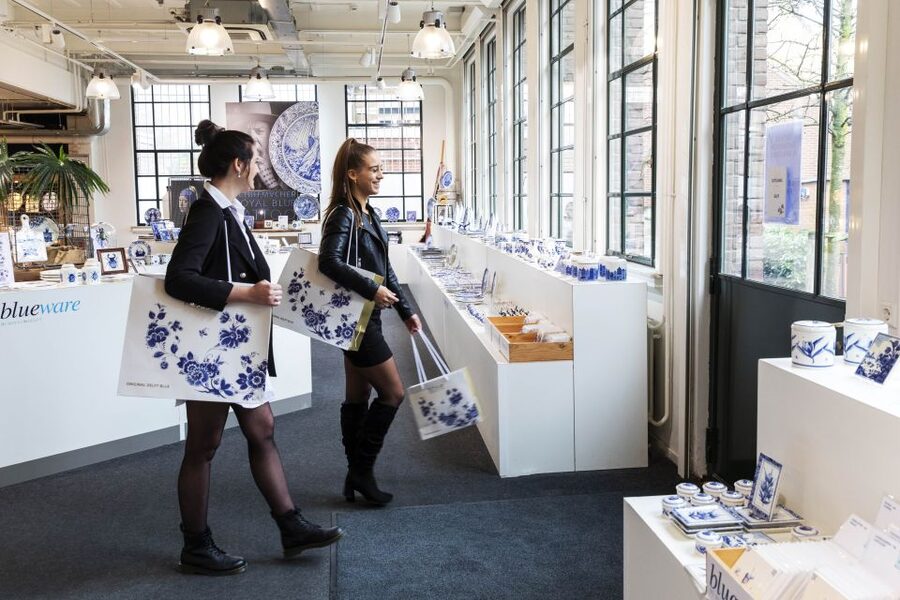
The showroom displays the full Royal Delft collection, including classic hand-painted pieces, modern designs, tiles, ornaments, and souvenirs. It is a good place to compare traditional Delft Blue with newer work.
Prepare yourself for the prices. Handmade pottery is expensive, and large or highly detailed pieces can cost far more than the admission ticket. That is not a surprise once you have watched the work being done, but it can still be a shock if you arrive expecting ordinary souvenir-shop prices.
The shop does offer practical help. Staff can wrap purchases carefully, and shipping is available for items you do not want to carry home. That matters with fragile ceramics, especially if you are flying or continuing through Europe with limited luggage space.
You do not need to buy anything to enjoy the showroom. I see it as part of the educational side of the visit. After watching a painter work, you can look closely at a finished vase and understand why the piece costs what it does.
Is $21 a fair price?
At $21 per person, Royal Delft is not the cheapest museum stop in Delft, but the ticket includes more than a collection of old pottery. You get entry to the museum and factory, an audio tour, and access to a working production site.
The value is strongest if you care about craft, design, or Dutch decorative art. You are paying to see the making process as well as the finished objects. The price is less compelling if you want a live demonstration, a personal guide, or a hands-on activity included in the basic ticket.
The visit also compares well with a short city attraction because it combines several elements: museum displays, working craftsmen, a historic building, a garden, and a shop. You can add coffee or lunch without needing to travel elsewhere.
The flexible booking terms help if your schedule is uncertain. You can reserve now and pay later, and cancellation is allowed up to 24 hours before the visit for a full refund. Check the opening hours around the holidays, since Royal Delft closes early on December 24 and 31, and closes all day on December 25, 26, and January 1.
Getting there from Delft and nearby cities
Royal Delft is at Rotterdamseweg 196 in Delft. From Delft Station, it is about a 15-minute walk. The Market Square is about 20 minutes away on foot, so you can connect the visit with the old town without needing a taxi.
Local buses stop nearby. Free parking is available around the building, which is useful if you are driving. A canal boat or Delft City Shuttle can also take you into town quickly.
From The Hague or Rotterdam, the train journey to Delft takes about 30 minutes. From Amsterdam, allow roughly 1.5 hours by train. That makes Royal Delft easy to reach from several Dutch bases, though I would combine it with other Delft sights rather than make the long trip from Amsterdam only for a 1.5-hour visit.
The building is wheelchair accessible. This is helpful for visitors who want to see both the museum and factory without worrying about difficult access. One family also found the staff friendly and helpful when visiting with a wheelchair.
Who will enjoy Royal Delft most?

I would recommend Royal Delft to anyone interested in pottery, painting, Dutch design, or traditional crafts. It is also a good choice for families, since the route is visual and the audio guide lets you control the pace.
It suits first-time visitors who want context for the blue-and-white objects found across the Netherlands. You will leave with a clearer idea of how the style developed and why hand-painted pieces command high prices.
Art lovers should allow extra time for the large tile works and detailed painted ceramics. Shoppers will appreciate the showroom and the option to ship purchases home. The garden and brasserie make the stop comfortable for people who want a slower break during a day in Delft.
You may want to skip it if your main goal is a lively guided performance. The standard visit can feel quiet, and the factory may have little activity outside working hours. Check for a live tour or workshop if you want more conversation and participation.
Should you book Royal Delft?
Book it if you want to see real hand-painted Delft Blue in production rather than only buy it in a shop. The museum gives you the background, the factory shows the craft, and the garden and brasserie make the visit easy to fit into a day in Delft.
I would aim for a morning visit if watching artisans is especially important to you. Choose the audio tour if you prefer flexibility, but do not expect a live guide with constant commentary. At $21, the ticket is fair for the combination of museum and working factory, though the expensive pottery and limited demonstrations may not suit every budget.
For a well-paced Delft itinerary, visit Royal Delft first or midway through the day, then walk toward the Market Square. That way, you get the factory experience without treating it as your only sight in town.
FAQ
How long does the Royal Delft visit take?
The activity lasts about 1.5 hours. The included audio tour takes about one hour, and you can spend additional time in the showroom, garden, or brasserie.
Is a live guide included?
No. Entry includes a one-hour audio tour. Guided tours may be available separately, but the standard experience is self-guided.
Which languages are available for the audio guide?
The audio guide is available in Spanish, Chinese, Dutch, English, French, German, Italian, and Japanese.
Can I watch pottery being made?
Yes. The route includes the working factory, where you might see clay poured into molds, pieces being sanded, and Delft Blue pottery painted by hand. The amount of activity can vary by time and day.
How far is Royal Delft from Delft Station?
The factory is about a 15-minute walk from Delft Station. The Market Square is about 20 minutes away on foot.
Is Royal Delft wheelchair accessible?
Yes, the experience is wheelchair accessible. Free parking is available around the building, and public bus stops are nearby.
Just added in the Netherlands
- Aalsmeer: Flower Auction Royal Flora Holland Entry Ticket★ 4.6 · 41 reviews
- Maastricht Privat Sightseeing City Walk★ 5.0 · 76 reviews
- The Hague 2-Hour Walking Tour | Discover The City With A Local★ 4.5 · 81 reviews
- Food Walking Tour of The Hague – by Bites & Stories★ 5.0 · 188 reviews
- Utrecht Walking Tour with a local comedian as guide★ 5.0 · 48 reviews
- Utrecht Old Town: Medieval Monster Hunt & Walking Tour★ 4.0 · 62 reviews
- The Hague: City Walking Tour★ 4.5 · 156 reviews
- Utrecht 2-Hour Walking Tour | Discover The City With A Local★ 5.0 · 138 reviews
Delft Tours, compared.

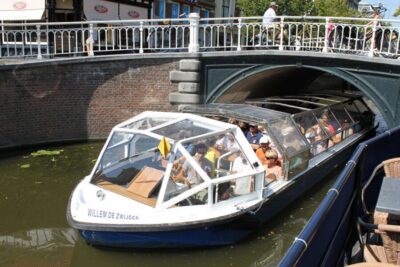

Rotterdam, Delft, the Hague, Madurodam from Amsterdam
Read our review →
Rotterdam, Delft and The Hague Small Group Tour from Amsterdam
Read our review →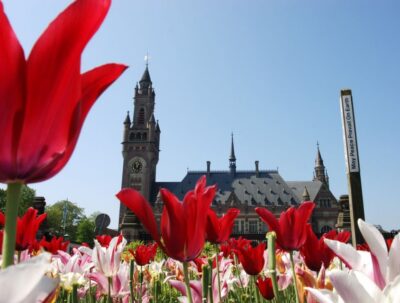

Discover Delft with a self-guided Outside Escape city game tour!
Read our review →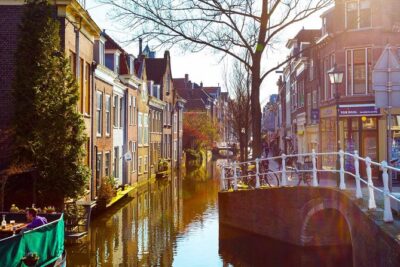
Browse the lists this tour appears in