
Reviewed · CASTLE & PALACE TOURS
The Hague: Escher in The Palace Museum Ticket
M.C. Escher’s art is most startling when you stop trying to understand it and simply let your eyes argue with your brain. At Escher in Het Paleis, more than 130 original prints fill the former Winter Palace of Queen Mother Emma, including the enormous 7-meter Metamorphosis III. I especially like the way the museum shows Escher’s artistic development, not just his famous staircases, and the hands-on exhibits that give children a real reason to look closely. The main drawback is that some rooms are small and can feel stuffy when several people gather around the videos or interactive displays.
I also like that the museum gives you two experiences in one: Escher’s precise, often baffling art and a preserved royal interior with ornate ceilings, chandeliers, and palace details. You can spend about an hour seeing the main collection, or closer to two hours if you read the labels and try every puzzle. The $15 admission is fair for the amount on display, though you will get more from it if you already have some interest in art, geometry, or visual tricks.
Key points to know before you go
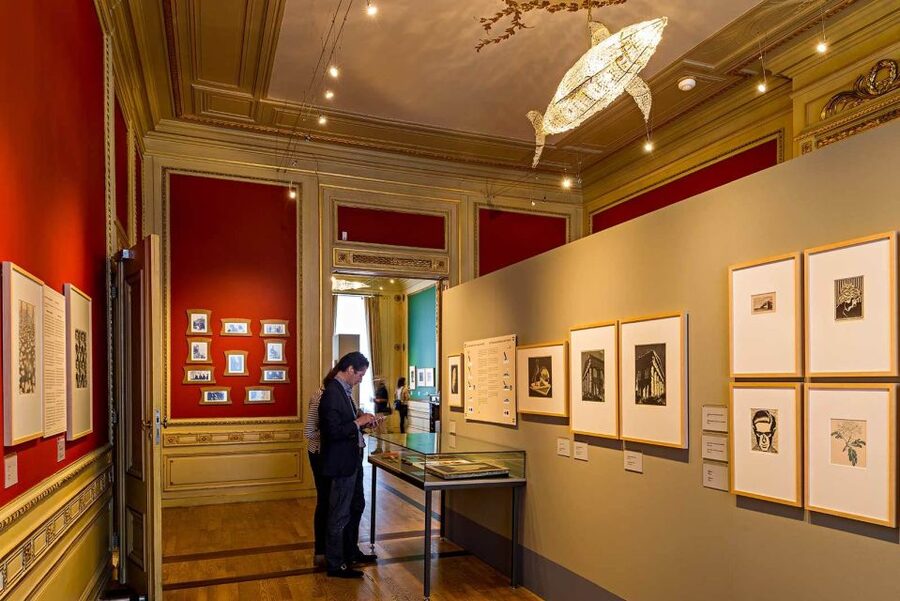
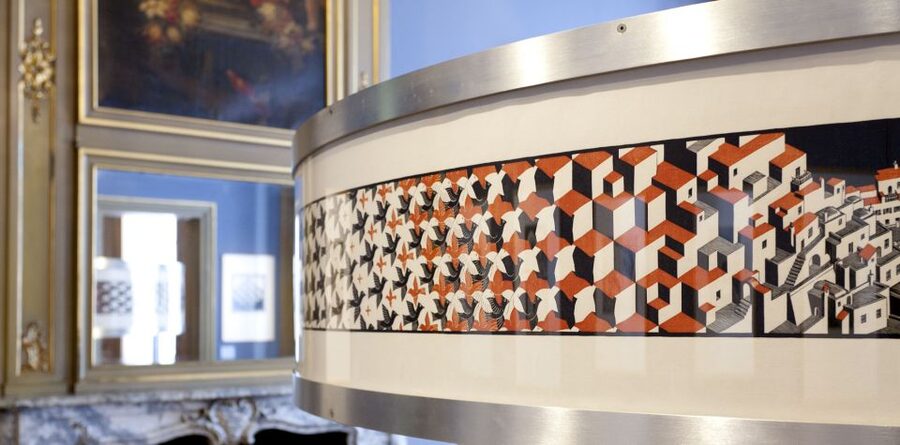
- Metamorphosis III is the showpiece: The 7-meter woodcut is displayed in an unusual way so you can follow Escher’s merging of time and space.
- The collection goes beyond impossible stairs: You will see tessellations, landscapes, portraits, early work, and pieces that show how Escher’s style changed.
- The palace is part of the visit: The former Winter Palace retains its royal atmosphere, with ceilings, chandeliers, and decorative details worth examining.
- The interactive floor suits families: Looking as Escher Does includes eye puzzles, hands-on activities, and a free treasure hunt for children.
- Plan one to two hours: A quick visit works, but careful reading and the interactive displays reward a slower pace.
- You can visit without fixing one narrow time: The ticket is valid for 365 days, subject to availability and opening dates.
Entering Emma’s Winter Palace on Lange Voorhout
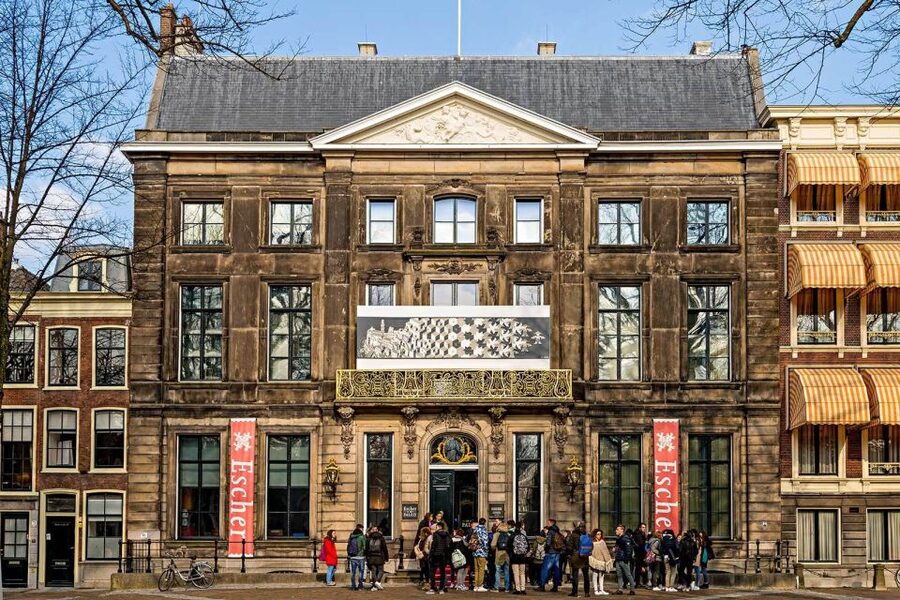
Escher in Het Paleis occupies Het Paleis at Lange Voorhout 74, in the center of The Hague. From The Hague Central Station, tram 9 takes you to Korte Voorhout, while tram 17 stops at Kneuterdijk. This makes the museum easy to add to a day in central The Hague.
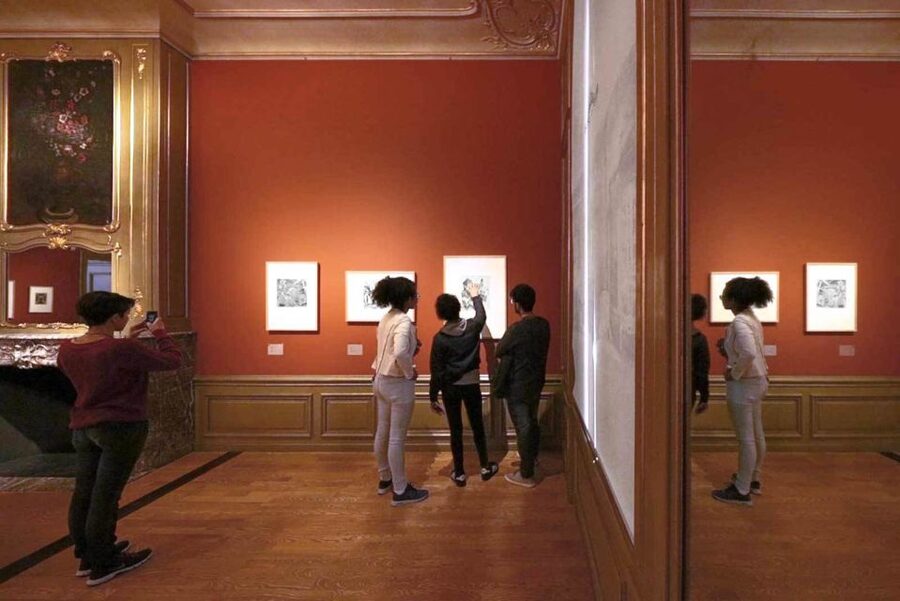
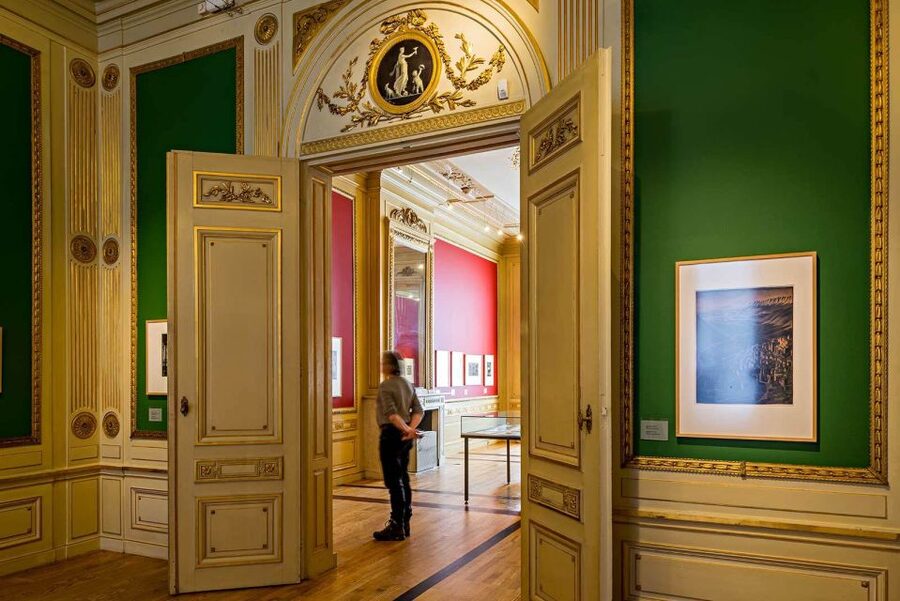
The building matters. This was the Winter Palace of Queen Mother Emma of the Netherlands, and it is described as the only public building in The Hague where the original royal atmosphere has been maintained. You are not entering a neutral white-box gallery. The rooms, fixtures, and decorative touches frame the art in a more domestic and historic setting.
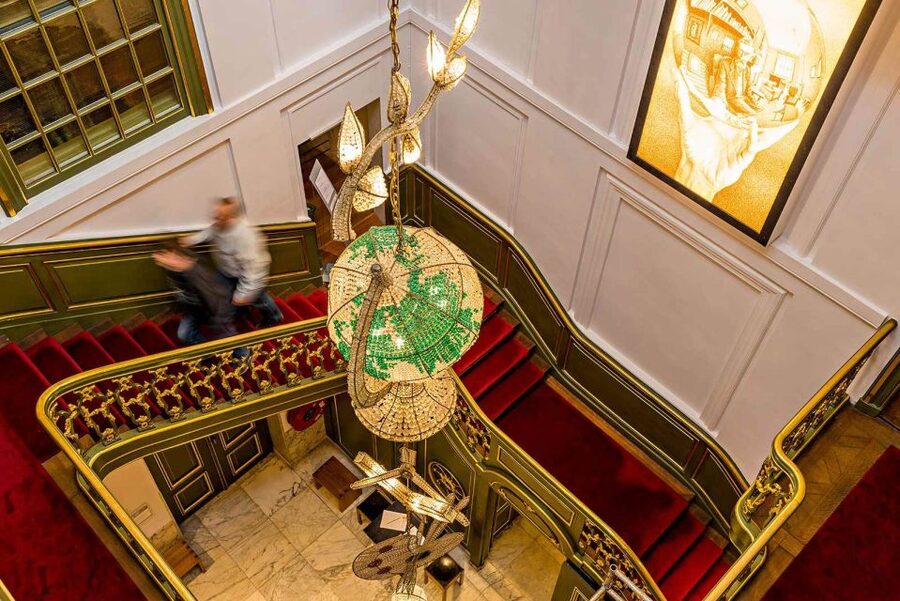
Look up as you move through the palace. The chandeliers are a special feature, and the ceiling and floor details give the visit extra texture. Escher’s work can sometimes feel coldly mathematical, but the palace surroundings soften that impression and remind you that this is also a look at how Dutch royalty lived.
The building is beautiful, but it is not designed like a large modern museum. Some rooms are relatively small, and circulation can feel less comfortable when people gather for the film or interactive displays. If you dislike crowded interiors, allow yourself extra time and move at your own pace rather than trying to see everything in one sweep.
Other grand houses near The Hague:
- Amsterdam: Royal Palace Entry Ticket and Audio Guide
★ 4.6 · 6,475 reviews - Utrecht: De Haar Castle & Park Entry Ticket
★ 4.7 · 1,350 reviews - Apeldoorn: Het Loo Palace Entry Ticket
★ 4.4 · 277 reviews
Start with Escher’s development, not just the famous tricks
The exhibition presents almost the complete range of Escher’s work. That is important because his familiar images of impossible buildings and endlessly climbing figures are only part of the story.
You will see how his ideas developed through different subjects and periods. The collection includes intricate designs, tessellations, changing forms, and work connected to his interest in mathematics. You also encounter pieces that are less familiar than the standard Escher reproductions found on posters and book covers.
I find this chronological and thematic variety useful because it turns Escher from a maker of clever optical illusions into a serious artist working through recurring problems. He kept returning to patterns, symmetry, repetition, and the uneasy boundary between two-dimensional images and three-dimensional space.
The labels help explain what you are seeing, and the exhibition includes material about Escher’s life and artistic evolution. An audio guide is available in English, Dutch, German, French, Chinese, Japanese, Ukrainian, and Korean. You can also visit without one, since the written information provides a useful basic explanation in English and Dutch.
If you know Escher mainly from Relativity, Ascending and Descending, or other impossible structures, give the less famous works a fair chance. They provide the context that makes the celebrated pieces more satisfying.
Metamorphosis III and Escher’s changing worlds
The great visual event is Metamorphosis III, a woodcut stretching about 7 meters. It is not presented as a small framed print that you glance at and pass. Its scale and unusual display encourage you to follow the image as forms shift, repeat, and become something else.
The work links time and space in a way that feels almost physical. A pattern can become an insect, a shape can become a town, and a town can lead into another pattern. You do not need a background in mathematics to enjoy it, but the piece rewards patience. Walk along it slowly instead of trying to take in the whole work at once.
Other familiar works give the collection its immediate appeal. In Day and Night, a Dutch setting changes into a flock of birds. In Ascending and Descending, figures climb and descend a staircase that can never lead anywhere. These are the images most likely to make you stop and check your own vision.
The most useful way to view them is to ask what Escher is controlling. He is not simply drawing impossible scenes. He is directing your attention through repetition, symmetry, perspective, and small shifts in form. Once you notice the method, the pictures become even more impressive.
The interactive floor: puzzles for eyes and hands
On the second floor, Looking as Escher Does changes the pace. Here, the museum explains Escher’s visual ideas through interactive displays, puzzles, and optical illusions.
This section is especially useful for families. Children can work through the free treasure hunt, and the hands-on activities give them something to do beyond reading labels. Younger visitors may not care about Escher’s biography, but they usually understand the fun of making an image appear to change or trying to solve a visual problem.
Adults should not rush past this floor. The interactive displays clarify techniques that can seem mysterious in the prints. You can test how your eyes interpret pattern, depth, balance, and repetition, then return to the gallery with a sharper sense of what Escher was doing.
The interactive area is also where space can become an issue. A few people gathered around one puzzle or film can make the room feel tight. Some visitors have found the museum’s air circulation less than ideal, especially in the smaller video area. That is a practical reason to visit at a quieter time if you have flexibility.
Other collections worth booking around The Hague:
- Amsterdam: Van Gogh Museum Ticket
★ 4.7 · 52,054 reviews - Moco Museum Amsterdam Entrance Tickets with Banksy & More
★ 4.4 · 10,088 reviews - Amsterdam: The Upside Down Museum Entrance Ticket
★ 4.4 · 9,506 reviews - Amsterdam: Red Light Secrets Museum Entry Ticket
★ 4.2 · 5,722 reviews
What the palace adds to the art
The palace setting is not just a decorative backdrop. It gives you a second thread to follow during the visit.
Between prints, notice the chandeliers, trim, floors, and rooms. The royal details can be easy to miss when you are focused on Escher’s visual puzzles, yet they are part of what makes this museum different from a standard art gallery.
The contrast works well. Escher’s work often questions order, scale, and perspective. The palace presents another kind of order, one based on ceremony, symmetry, and royal taste. You move between a world where staircases cannot function and rooms designed to make hierarchy feel natural.
The building also gives the museum a manageable scale. You are not facing a vast collection that requires half a day. The main visit can take around an hour, while a slower look at the labels, palace interiors, film, and interactive displays can stretch toward two hours.
A small museum can be an advantage here. Escher’s work benefits from concentration. You have a better chance of noticing repeated themes and returning to images that caught your eye than you would in a huge gallery with dozens of unrelated collections.
How much time should you allow?
For a quick visit, plan about an hour. That gives you time to see the main works, notice the palace interiors, and stop at the best-known prints.
Allow closer to two hours if you want to read the background material, watch the introduction or biography video, study Metamorphosis III, and spend time with the interactive displays. The introduction video is a useful way to set the mood and explain Escher’s life before you examine the art in detail.
You can also make this an easy part of a larger day in The Hague. The museum is near a park, the lake, and the Parliament buildings, with lunch options in the surrounding area. That combination works well for a day trip from Amsterdam, especially if you pair the museum with another central attraction.
The ticket is valid for 365 days, which gives you unusual flexibility. You still need to check availability and opening information, but you are not locked into a single narrow visit date in the same way as a timed attraction. That is useful if your plans around The Hague are unsettled.
The Palace is closed on Christmas Day and January 1. It remains open on Easter, King’s Day, Ascension Thursday, Whitsun, and Whit Monday.
Is the $15 ticket good value?
At $15 per person, I consider this a sound purchase for anyone who likes Escher or wants an art museum with a strong visual hook. You are paying for a substantial collection, a historic palace, the interactive floor, the film material, and a family treasure hunt.
The value is strongest if you take time to understand the works rather than treating the museum as a quick photo stop. Escher’s images are familiar, but the original prints show details and variations that reproductions often flatten. Seeing the progression of his work also adds something that a single famous poster cannot provide.
Children up to age six enter free when accompanied by a paying adult. Families can get good mileage from the treasure hunt and interactive exhibits, though the more serious gallery sections may hold a child’s attention for less time.
A guided tour is not included. A guide for groups of up to 20 people costs EUR 60 and must be reserved in advance. For most independent visitors, the labels, audio guide, and introduction material should be enough. A private guide could make sense for an art-focused group or a school visit that wants more explanation.
The online ticket also offers free cancellation up to 24 hours before the visit and a reserve-now, pay-later option. Those terms are useful if you are arranging a wider Netherlands itinerary, but the main value comes from the museum itself, not from the booking flexibility.
Practical details worth knowing
Large bags and luggage are not allowed inside. Plan to leave substantial luggage elsewhere before arriving, rather than assuming you can bring it through the entrance.
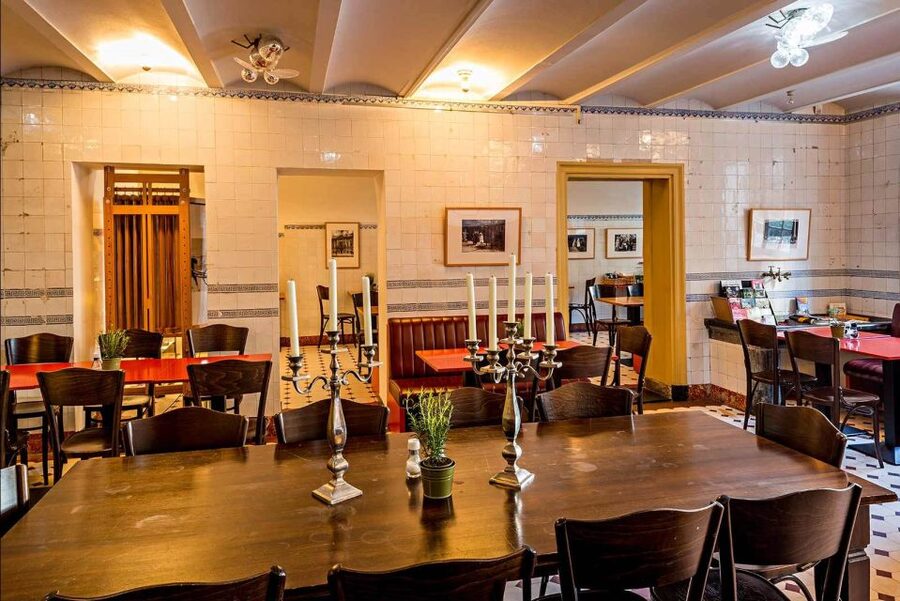
The museum has a café in the former palace kitchen. That gives you a pleasant place to pause, especially if you are combining the museum with a walk around the nearby area.
The audio guide is available in eight languages: English, Dutch, German, French, Chinese, Japanese, Ukrainian, and Korean. If you prefer not to use an audio guide, the written descriptions are still useful, particularly for understanding the less famous works.
The collection is suitable for first-time Escher visitors, families, art students, graphic designers, and anyone curious about the link between art and mathematics. It is also a good choice for a rainy afternoon because the visit is indoors and compact.
I would be less enthusiastic if your main goal is a large, varied art museum with many different artists. Other influential artists are represented, but Escher is clearly the focus. The museum is best approached as a concentrated study of one artist inside a royal building.
Should you book Escher in Het Paleis?
Book it if you want to see Escher’s original prints in context, especially Metamorphosis III, Day and Night, and Ascending and Descending. The palace setting, multilingual audio guide, and hands-on second floor make the visit more varied than a standard print exhibition.
Families should book with the treasure hunt and interactive section in mind. Escher fans should allow at least 90 minutes so the less familiar works do not get lost behind the famous illusions. If you have only a short stop in The Hague, the museum is compact enough to fit into a busy day.
Skip it only if you have no interest in optical art, geometric pattern, or historic interiors. For everyone else, the $15 admission buys a focused, memorable museum visit with enough visual surprises to keep both children and adults looking twice.
FAQ
Where is Escher in Het Paleis located?
The museum is at Het Paleis, Lange Voorhout 74 in The Hague, South Holland.
How do I reach the museum from The Hague Central Station?
You can take tram 9 to Korte Voorhout or tram 17 to Kneuterdijk.
How long is the ticket valid?
The ticket is valid for 365 days, with availability and starting times subject to checking.
What is included with admission?
Admission to Escher in Het Paleis is included. An audio guide is also available in eight languages.
Is a guided tour included?
No. A guided tour for groups of up to 20 people costs EUR 60 per guide and requires advance reservation.
What languages are available for the audio guide?
The audio guide is available in English, Dutch, German, French, Chinese, Japanese, Ukrainian, and Korean.
Are children admitted free?
Children up to age six enter free when accompanied by a paying adult.
Can I bring luggage or a large bag?
No. Luggage and large bags are not allowed inside the museum.
Is the museum open on public holidays?
The Palace is closed on Christmas Day and January 1. It is open on Easter, King’s Day, Ascension Thursday, Whitsun, and Whit Monday.
Just added in The Hague
- The Hague: City Walking Tour★ 4.5 · 156 reviews
- The Hague: Old City Private Walking Tour★ 4.4 · 81 reviews
- The Hague 2-Hour Walking Tour | Discover The City With A Local★ 4.5 · 81 reviews
- Food Walking Tour of The Hague – by Bites & Stories★ 5.0 · 188 reviews
- Hague: The Heart of Old Town Exploration Game and Tour★ 3.5 · 25 reviews
- Discover Delft with a self-guided Outside Escape city game tour!★ 5.0 · 32 reviews
- Discover The Hague with a self-guided Outside Escape city tour★ 4.5 · 35 reviews
- e-Scavenger hunt Delft: Explore the city at your own pace★ 4.5 · 26 reviews
Castle & Palace Tours, compared.
Castle De Haar Small-Group Tour from Amsterdam
Read our review →
Amsterdam Castle & Utrecht City – Private Day Tour
Read our review →
Full-Day Private Historic Royal Tour around Palaces and Castles
Read our review →Browse the lists this tour appears in