
Reviewed · TOURS IN THE HAGUE
The Hague: Beginner’s Surf Lesson
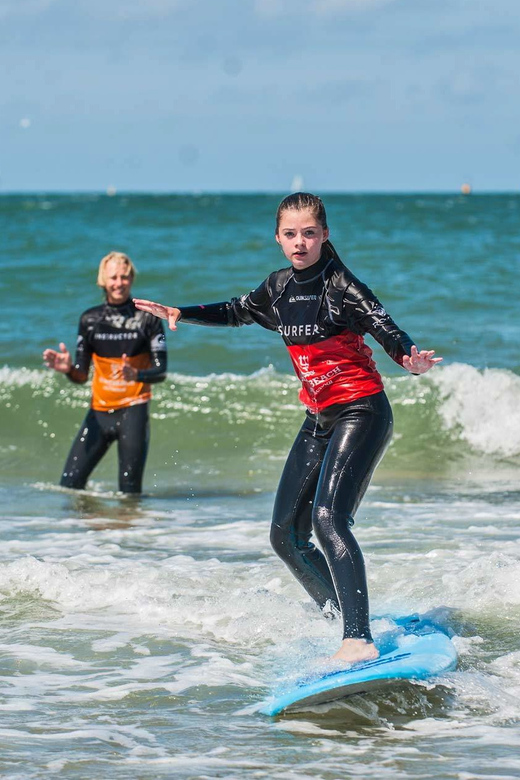
Catching your first wave is the whole point here, and this two-hour lesson gives you a sensible, friendly start in the North Sea. You’ll learn on the beach first, then head into the water with a certified instructor and a soft-top board. The six-person maximum means you should get more attention than in a large beginner class.
I like the practical setup: a warm wetsuit, cap, changing room, hot shower, and locker are included. I also like the €15 rental credit, which you can use after the lesson when you want more time with the equipment. The main drawback is simple: you need to be at least 16, and the North Sea is not a gentle swimming pool.
Key points for your Scheveningen surf lesson
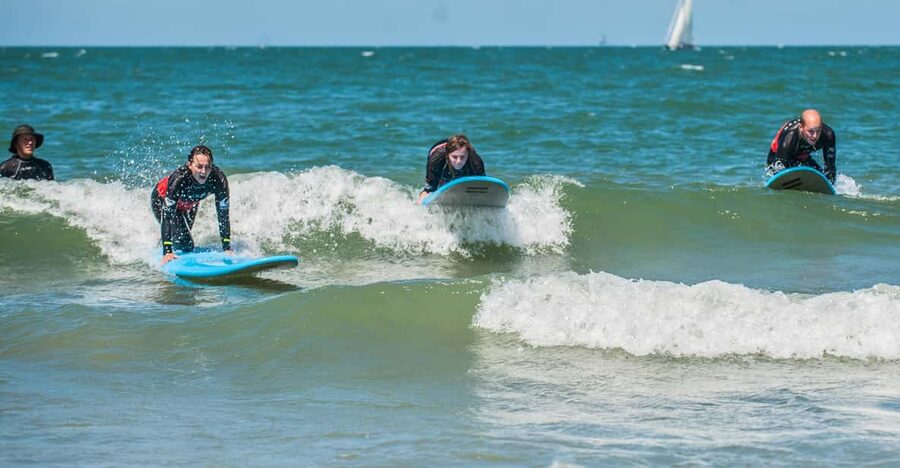
- Small groups of six or fewer: You get a better chance to ask questions and receive help with your stance and board control.
- Beach and water instruction: The lesson covers safety and technique before you paddle out to practice.
- Warm equipment included: A wetsuit and cap are supplied, with gloves and boots available in winter when needed.
- A first-wave goal: You work on reading waves, timing your takeoff, and keeping the soft-top board under control.
- €15 rental credit: Continue surfing later by using the credit when it suits you after the lesson.
- English and Dutch instruction: You can take the class with an instructor speaking either language.
Starting at Strandweg 3 in Scheveningen
Your lesson begins at Strandweg 3, 2586JK Scheveningen, the seaside district of The Hague. This is a beach-based experience, not a city sightseeing tour with a quick photo stop. Plan to arrive ready for an active session and bring the two things not supplied: swimwear and a towel.
The meeting point is also where the activity ends. That makes the day easy to manage, since you return to the same place for changing and a hot shower after the water session.
Scheveningen is The Hague’s main beach district, so this lesson gives you a taste of the city’s coastal side. You are not being taken to a remote surf camp. You are learning in a well-known seaside area, with the practical facilities needed for a short introduction.
The exact start time depends on availability. I would check the schedule before building the rest of your day around it. A two-hour lesson can fit neatly into a visit to The Hague, but changing and getting to the beach add a little time around the lesson itself.
Other trips people book in The Hague:
- The Hague: City Canal Cruise
★ 4.6 · 2,024 reviews - The Hague: Madurodam Miniature Park Entry Ticket
★ 4.6 · 1,559 reviews - The Hague: Hop-on Hop-off Old-Fashioned Heritage Tram Tour
★ 4.4 · 1,083 reviews
Why the six-person limit matters
Surfing is physical, and the first lesson is full of small corrections. Your feet need to land in the right place. Your hands need to push the board down in the right way. You need to look forward instead of staring at the nose. In a large class, those details can disappear in the crowd.
Here, the group is limited to six participants. That does not guarantee private coaching, but it gives the instructor a workable group to manage in the water. You can expect a shared lesson with room for questions and individual pointers.
The format also suits people who do not want to make a big production of their first attempt. You do not need to arrive as a surfer. You only need to meet the age requirement, be ready for a physical activity, and accept that the first few tries may involve more falling than standing.
The tone sounds especially important here. Ayoub, Gijs, and Connor have been singled out for friendly, helpful, and professional teaching. If one of them leads your class, you can expect a relaxed approach paired with clear instruction. The important thing is not a particular instructor, since schedules can change, but the school’s focus on making beginners feel comfortable.
Beach briefing: safety before the waves
The lesson begins on the beach with an explanation of how to stay safe in the water. That is not filler. A beginner needs to understand how to carry a board, how to move through the breaking waves, and how to avoid losing control of the equipment.
You will hear several ways to go safely into the water before trying to surf. The instructor also explains basic surf techniques, so you can connect the dry-land practice with what happens at sea.
I like this order. It gives you a chance to hear the instructions while standing still, rather than trying to learn everything when you are cold, wet, and wrestling with a board. The beach portion also lets you rehearse the basic movement before asking the waves to cooperate.
You should pay close attention to the safety talk, even if you have watched surfing videos or tried a board before. The lesson is built for beginners, and the instructor’s advice about the local water and the safest way to go out is more useful than general surfing theory.
Soft-top boards and the first water practice
After the beach briefing, you take a soft-top surfboard into the water. A soft-top board is a sensible choice for a first lesson because it is designed with beginner use in mind. You still need to control it carefully, but it is a more forgiving starting point than a narrow performance board.
The first job is board control. You learn how to keep the board positioned properly and how to respond as the water moves it. That may sound basic, but it is the foundation of the whole lesson. If the board is pointing the wrong way or drifting out of position, standing up becomes much harder.
The instructor then helps you read the waves. You are not expected to understand every change in the sea after one class. Instead, you begin to recognize which waves are useful for a beginner and when to prepare for a takeoff.
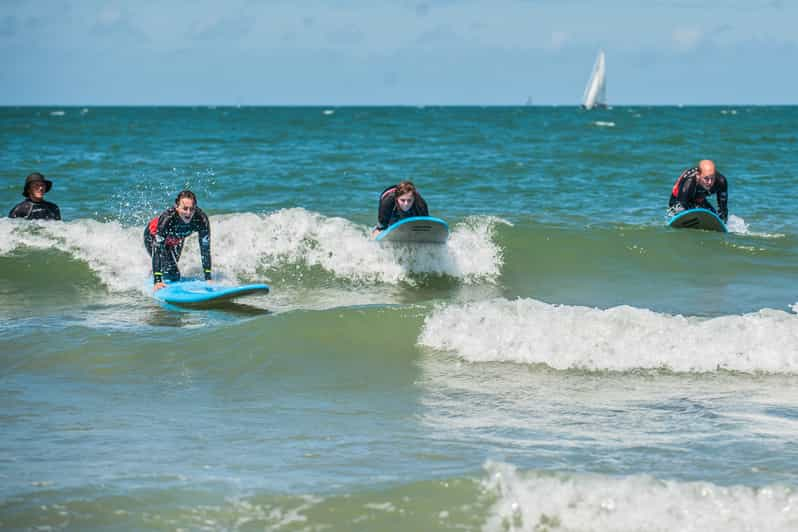
This is where a small group can make a real difference. You can watch other beginners try the same steps, then adjust your own position. You also get a better chance to hear the instructor’s advice instead of guessing from a distance.
Same city, a different sort of day:
- The Hague: Escher in The Palace Museum Ticket
★ 4.6 · 896 reviews - The Hague: Scheveningen Beach RIB Speedboat Tour
★ 4.7 · 330 reviews - Scheveningen: LEGOLAND® Discovery Centre Entry Ticket
★ 4.1 · 257 reviews - Interactive Safe 2,5hr Bike tour with Entertaining Guide
★ 4.6 · 238 reviews
Timing the takeoff and catching your first wave
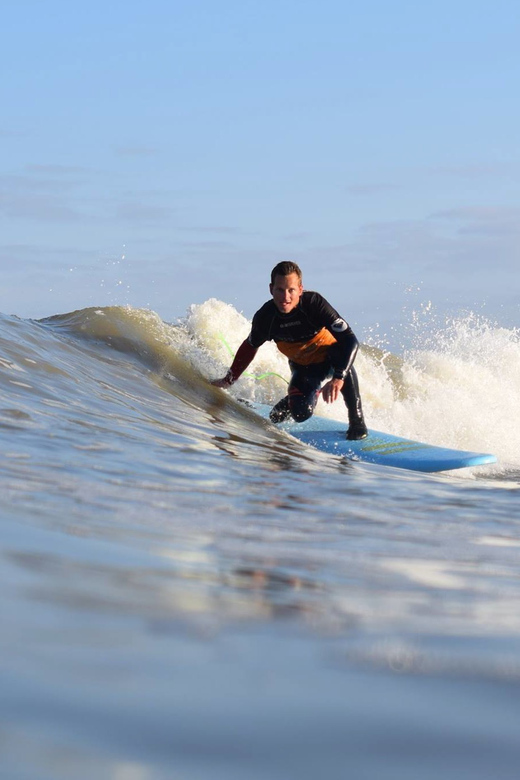
The lesson works toward the moment when you catch a wave and get to your feet. Timing matters. You need to start at the right moment, keep the board under control, and move from lying down to standing without throwing off your balance.
The first successful ride may be short. That is fine. A beginner lesson is not about covering a long stretch of beach or looking polished. It is about learning the sequence well enough to repeat it.
You will practice how to position yourself, when to begin the takeoff, and how to keep your balance once the wave carries the board forward. The instructor can help you understand why a particular attempt worked or failed, which is far more useful than simply being told to try again.
The supplied equipment supports this stage. You receive a soft-top board, a warm wetsuit, and a cap. In winter, gloves and boots are available if needed. The warm gear matters in the North Sea, since cold water can distract you from the lesson and shorten your patience quickly.
Still, do not mistake warm equipment for warm water. You are surfing in the sea, and conditions can make the class more demanding than a calm-water introduction. The attraction is also the challenge: you are learning to respond to actual waves rather than practicing on a motionless surface.
What the facilities add to the $45 price
At $45 per person, the lesson is priced as a practical introduction rather than a full day of surfing. You get two hours of instruction, the board, wetsuit, cap, and access to the basic changing facilities. That gives the price reasonable value if you want guidance and equipment without buying or carrying your own gear.
The €15 rental credit improves the deal for anyone who thinks one lesson may not be enough. You can use it whenever it suits you after the lesson. It does not replace the instruction, but it gives you a reason to continue practicing instead of treating your first wave as a one-time stunt.
The school provides separate changing rooms, hot showers, and lockers for personal belongings. These details matter more after a cold-water lesson than they do on a brochure. You can change out of the wetsuit, secure your belongings, and warm up before leaving the beach.
You still need to bring swimwear and a towel. That is easy to overlook when the surfboard and wetsuit are handled for you. Pack both, and remember that the towel is especially useful after the hot shower and changing-room stop.
Who should book this beginner class
I would choose this lesson if you are curious about surfing but do not know where to begin. The instruction covers the basics in a clear order, and the small group keeps the experience from feeling like a mass activity.
It also suits solo visitors. The group format gives you a shared activity without requiring you to organize a private lesson. Couples and friends can book together, though the class is still designed around learning rather than simply spending time at the beach.
The age rule is firm: you must be at least 16. The supplied information does not give a maximum age, and one participant specifically valued being treated like everyone else as a 54-year-old grandmother. That is useful context if you are an older beginner who worries the class is aimed only at young athletes.
You should be comfortable with an active, wet lesson. The class is not a beach walk or a short demonstration. You will handle a board, enter the water, practice takeoffs, and try to catch waves. If you want a dry introduction to surfing, this is the wrong choice.
The practical limits of a two-hour lesson
Two hours is enough time to cover safety, technique, and repeated attempts, but it is not enough time to become an independent surfer. You will leave with a first set of skills, not mastery.
Your experience will also depend on the sea conditions and on how quickly your body learns the movements. Some people may stand up quickly. Others may spend most of the lesson learning to control the board and paddle into position. Both outcomes fit a genuine beginner class.
That is why I would judge the lesson by what you learn, not only by how long you ride. Understanding how to enter the water safely, read a wave, and time the takeoff gives you a base for future practice.
The €15 rental credit is useful here. If you need more attempts, you have a built-in reason to return to the board after the lesson. I would see the credit as added flexibility, not a promise that one class will make you surf confidently on your own.
Booking, cancellation, and language options
Instruction is available in Dutch and English. Choose the language that lets you follow safety directions without hesitation. Clear communication matters most when you are in the water with a board.
You can reserve now and pay later, which helps if your schedule is still changing. Free cancellation is available up to 24 hours in advance for a full refund. I would still check the available start times before booking, especially if the surf lesson needs to fit around trains, meals, or another timed activity in The Hague.
The provider is Hart Beach Quiksilver Surfschool. The activity begins and ends at the same Scheveningen address, and the group size is limited to six participants.
Should you book the Scheveningen surf lesson?
Book it if you want a real first try at surfing, not just a photograph with a board. The strongest reasons are the small class, certified instruction, warm equipment, useful facilities, and the chance to keep practicing with the €15 rental credit.
I would be cautious if you dislike cold water, need a completely predictable activity, or want advanced coaching. This is a beginner lesson in the North Sea, so conditions and your own balance will shape the session.
For most first-timers aged 16 or older, $45 is a fair price for two hours of instruction and equipment. Bring swimwear and a towel, listen closely during the safety briefing, and treat standing up as a bonus while you focus on learning the basics. If Ayoub, Gijs, or Connor happens to be teaching, you may also get the warm, playful instruction that has helped make this school a popular choice.
FAQ
Where does the surf lesson start and finish?
The lesson starts at Strandweg 3, 2586JK Scheveningen, The Hague. The activity ends back at the same meeting point.
How long does the lesson last?
The surf lesson lasts two hours. Available starting times depend on the schedule when you book.
What languages are spoken during the lesson?
The instructors speak Dutch and English.
What equipment is included?
You receive a soft-top surfboard, a warm wetsuit, and a cap. Gloves and boots are available if needed during the winter months.
What should I bring?
Bring your own swimwear and towel. Lockers, changing rooms, and hot showers are provided.
How old must I be to participate?
You must be at least 16 years old to take part.
Just added in The Hague
- Private Tour of The Hague, Delft and Rotterdam with Lunch★ 5.0 · 3 reviews
- Historical The Hague: Private Tour with Local Guide★ 5.0 · 6 reviews
- The Blue’s Clues in Delft Exploration Game and Tour★ 3.5 · 10 reviews
- The Hague Self-Guided Audio Tour★ 5.0 · 3 reviews
- Discover Historical Delft with an Audio Guide★ 5.0 · 3 reviews
- Delft 2-Hour Walking Tour | Discover The City With A Local★ 4.5 · 8 reviews
- 90 minutes Self Guided Walking Tour with puzzles in Den Haag★ 4.5 · 7 reviews
- The Hague Walking Tour★ 4.5 · 16 reviews
Tours in The Hague, compared.


Hop-on Hop-off Old-Fashioned Heritage Tram Tour
Read our review →

Scheveningen: LEGOLAND® Discovery Centre Entry Ticket
Read our review →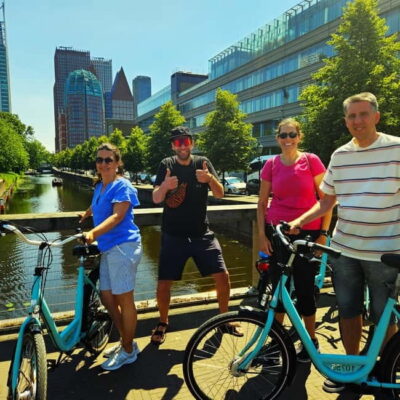
Interactive Safe 2,5hr Bike tour with Entertaining Guide
Read our review →
Food Walking Tour of The Hague – by Bites & Stories
Read our review →Browse the lists this tour appears in