
Reviewed · WALKING TOURS
Historical Walking Tour, private with local Dutch guide
Amsterdam’s story begins with water, trade, and a stubborn little settlement that grew into a world city. This private walk follows that story from the medieval Weeping Tower through Dam Square, the canal ring, and the Jordaan, finishing near Westerkerk and the Anne Frank House. Guide Anna brings 25 years of local life to the route, adding the sort of context you will not get from a map alone.
I like the private format, which lets you ask questions, pause for photos, and shape the conversation around architecture, art, trade, or Jewish history. I also like the clear route from old defensive walls to elegant merchant canals, since it gives you a useful sense of how Amsterdam was built. The main drawback is physical: you will stand and walk for about two hours, and mobility aids are not available.
Key points at a glance
- A strong first-day orientation: The route links Amsterdam’s oldest sights with its best-known neighborhoods, helping you understand the city’s layout quickly.
- Anna’s local perspective: She has lived in Amsterdam for 25 years and is praised for clear English, dry humor, patience, and thoughtful answers.
- A private, flexible outing: Only your group takes part, so the pace and subjects can be adjusted.
- History beyond the postcard sights: Expect stories about medieval defenses, the spice trade, Jewish Amsterdam, artists, shipbuilders, guilds, and merchants.
- A useful finish: The walk ends near Westerkerk and the Anne Frank House, with the central canals and Jordaan already under your belt.
- Plan for pavement and standing: This suits most people who can walk comfortably for two hours, but not those who use a walker or have trouble standing.
Why this walk works well on your first day
Amsterdam can feel confusing at first. Canals cut through the center, bicycles appear from every direction, and several neighborhoods look similar until you understand how the city grew. This route gives you a practical map in your head.
You begin at the eastern edge of the old center and move west through several layers of the city. The early stops explain defense and water control. Dam Square shows the political and commercial center. The canal ring explains the wealth of the Dutch Golden Age. The Jordaan then gives you a more residential, local-feeling finish.
I especially like this order because it is not just a parade of famous buildings. You see why Amsterdam is where it is, how it kept water out, and how merchants used canals to move goods. That makes later sightseeing easier. Once you understand the basic plan, you can return to places that catch your eye instead of wandering without a clue.
The private setting matters here. Anna can change the emphasis if your group is more interested in architecture than commerce, or art than military history. Previous tours have also included extra attention to Jewish Amsterdam, beyond the Anne Frank House, along with snack stops and suggestions for the rest of your stay.
More Walking Tours in Amsterdam
- Anne Frank’s Story – Guided Walking Tour through Amsterdam
★ 5.0 · 11,619 reviews - Amsterdam: Life of Anne Frank and World War II Walking Tour
★ 4.8 · 10,467 reviews - Absolutely Amsterdam – the Essential Introductory Walking Tour
★ 5.0 · 3,629 reviews
Starting at the Weeping Tower
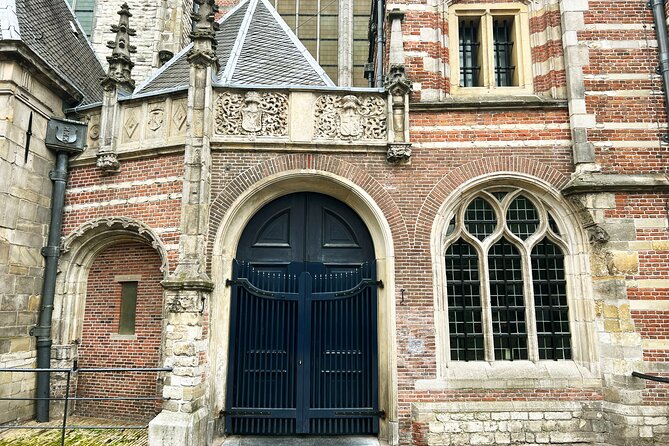
Meet at Café the Schreiertower, beside the Weeping Tower on Prins Hendrikkade. This medieval watchtower is one of the few surviving reminders of Amsterdam’s earliest days, making it a fitting starting point.
Anna uses the tower to explain the origins of the city. You will hear how a settlement shaped by water developed into a major port and trading center. The stop is brief, about five minutes, but it sets up the central theme of the walk: Amsterdam was built by managing water and connecting people through trade.
The meeting point is near public transportation, which helps if you are arriving from Amsterdam Central Station or another part of the city. Look for the café and tower rather than relying only on a street number. The route then heads into the old center.
Zeedijk and the city’s watery defenses
Zeedijk is one of Amsterdam’s oldest streets. Its name points to its original job, a dike protecting the settlement from flooding. It also included locks, so this was not simply a road but part of the city’s water-control system.
This is a small stop, yet it gives you a useful lesson in Amsterdam’s geography. The city’s famous canals are attractive today, but they also formed part of a practical system for drainage, movement, and defense. You begin to see why streets, canals, and dikes often seem to meet at odd angles.
The old center can be busy, especially around the main routes. Stay close to the group and watch for bicycles. Anna’s local experience is useful here, since she knows how to keep a walking group moving without turning the tour into a race.
The Waag and the medieval city wall
The Waag began as a medieval city gate connected to Amsterdam’s defensive wall and moat system. Its sturdy shape gives you a clear picture of a city that once needed gates, walls, and controlled entry points.
The stop lasts about five minutes, but it helps bridge the gap between Amsterdam’s humble origins and its later commercial power. The city did not begin with grand canal houses. It first needed protection, access to water, and a way to control goods and people entering the settlement.
I would not expect a long architectural lecture at each early stop. The strength of this tour is the way Anna links short explanations into a larger story. You keep walking, but the city around you begins to make sense.
Other guided walks around Amsterdam:
- Amsterdam: Anne Frank Guided Small Group Walking Tour
★ 4.8 · 2,722 reviews - Amsterdam: Anne Frank Walking Tour – Guided in EN/DE/IT/ES
★ 4.9 · 2,676 reviews - Amsterdam: Guided Cultural Walking Tour
★ 4.9 · 2,384 reviews - Amsterdam: Guided Ganja Walking Tour of Coffee Shops
★ 4.2 · 2,092 reviews
The East India Company and the business of empire
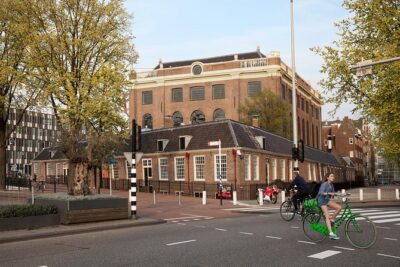
At the Oostindisch Huis, you reach one of the most important stops for understanding Amsterdam’s global role. This was once an office and warehouse of the Dutch East India Company, founded in 1602.
Here the focus shifts from local survival to international commerce. You will learn about the spice trade and the rise of the modern corporation and stock market. That makes this more than a stop for admiring an old building. It connects Amsterdam’s canals and warehouses to ships, investors, company offices, and far-reaching trade networks.
This part is valuable if you want history with an economic angle. It also adds balance to the city’s picturesque image. Canal houses and merchant wealth were built on a complicated system of trade and power, and this stop gives Anna a natural place to explain that background.
Amsterdam in miniature, then at full scale
The Kleinste Huis van Amsterdam, or smallest house in Amsterdam, offers a lighter moment. It stood beside a gate decorated with the city crest and other symbolic details.
The building itself is tiny, so do not expect a long visit inside. The interest lies in what it reveals about Amsterdam’s narrow urban spaces and the symbolic language used around city gates. It is also a good example of how this walk mixes major landmarks with small details you could easily miss on your own.
That combination is one of the tour’s better features. You get the broad story of trade and urban growth, then pause for a peculiar building that makes the city feel more human and less like a museum display.
Dam Square, Amsterdam’s central stage
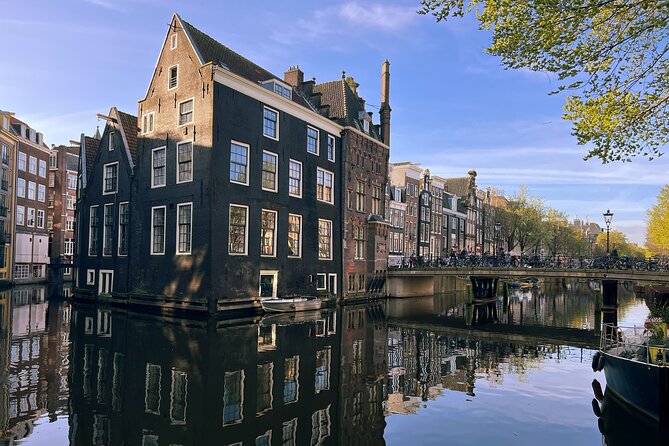
Dam Square is the old market square and the heart of central Amsterdam. Today it is framed by the Royal Palace and the national Second World War monument, but its importance began with commerce and public life.
Anna can help you read the square as more than a place to take a quick photo. It is a meeting point, a ceremonial space, and a reminder that Amsterdam’s center grew around trade. The Royal Palace adds political history, while the war monument brings the city’s modern past into view.
This can be one of the busier parts of the route. Expect crowds and activity rather than a quiet square. The benefit of having a private guide is that you can stop for an explanation without needing to listen over a large group.
The canal ring and the wealth of the Golden Age
The canal ring receives about 30 minutes, the longest single stop on the route. That is appropriate. Amsterdam’s canals are beautiful, but their real interest lies in the planning and money behind them.
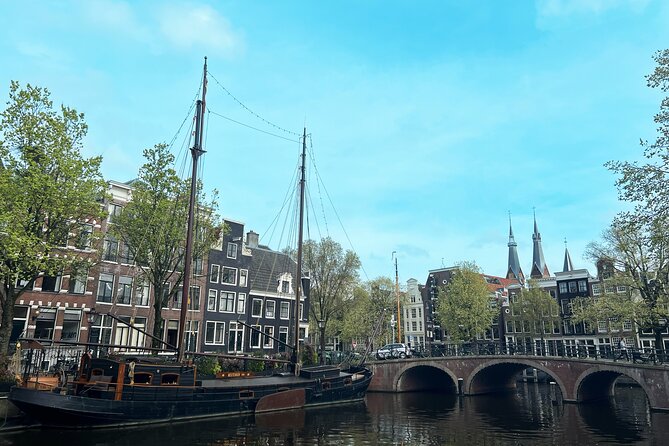
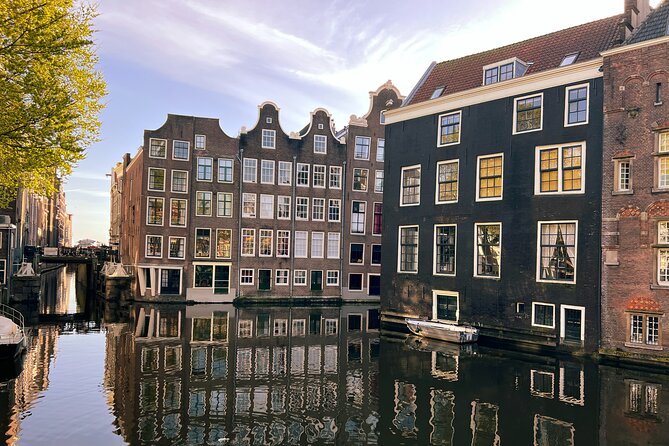
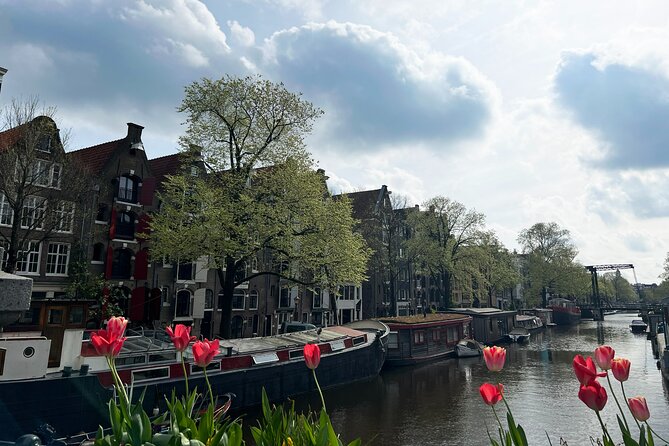
The Grachtengordel was built for wealthy merchants during the Dutch Golden Age. Along the water you will see grand canal houses in the northern baroque style, along with a changing collection of houseboats. Anna explains how the canals helped organize the expanding city and made it possible to move people and goods through the center.
You should allow time to look up. Canal façades often reveal more from above eye level than at street level, with differing roof shapes, narrow widths, and decorative details. The private format also gives you room to ask why the houses look so tall and narrow, or how trade shaped their design.
Houseboats add a modern layer to the scene. They are not simply decoration. They show how the canals remain part of daily life, even as the old merchant houses now serve many different purposes.
The route is especially good for first-time visitors who want orientation without committing half a day to a museum. You get architecture, urban planning, and social history while walking through the city itself.
The Jordaan, brown cafés, and small-scale Amsterdam
The Jordaan receives another 30 minutes. This charming neighborhood is known for picturesque streets, traditional brown cafés, and independent boutiques. After the grander scale of the canal ring, the Jordaan feels more intimate.
This is a good place to notice the difference between Amsterdam’s formal center and its neighborhood life. Streets are smaller, buildings feel closer together, and the route offers more chances to see ordinary city details rather than official monuments.
Anna can personalize this section around your interests. Previous outings have included snack breaks, and she has offered ideas for places to explore after the walk. Do not count on a specific food stop being guaranteed, but the format allows for a pause if the timing and group preferences suit it.
The Jordaan is also where Anna’s conversational style matters most. The strongest praise for her focuses on dry wit, clear English, and an ability to connect with different personalities. That is important on a walking tour. Two hours of facts can feel heavy, while stories, humor, and questions keep the pace lively.
Westerkerk and the Anne Frank House area
The final stop is Westerkerk, a Dutch Protestant church known for its elegant design and landmark spire. Locals particularly identify with this church, and its position beside the canal makes it one of the city’s most familiar sights.
The tour ends nearby, at Prinsengracht 279, close to the Anne Frank House. This is a practical finish. You can continue exploring the canals, visit the church if open, or use the area as a base for the next part of your day.
The tour does not include admission to museums or attractions. All tour fees and taxes are included, but you will need to arrange and pay separately for anything you visit afterward. If the Anne Frank House is part of your plan, treat it as a separate booking and allow time between activities.
What the private format adds at $96.02 per person
At $96.02 per person, this is not the cheapest way to walk through Amsterdam. You are paying for a private experience rather than a basic group stroll, so the value depends on how much you want interaction and flexibility.
For a couple, family, or small group, the price can make sense if you want to ask many questions or focus on specific subjects. Anna can adjust the conversation, pause when needed, and give recommendations for the rest of your visit. A group discount may also apply, which could improve the value for a larger party.
The listed duration is about two hours. One outing described by the guide’s clients ran closer to three hours, suggesting that a private walk may sometimes stretch when conversation, snacks, or extra interests take over. Plan your day with some breathing room rather than scheduling a museum immediately afterward.
The tour averages booking about 70 days ahead, so reserve early if your Amsterdam dates are fixed. Confirmation arrives at booking, and free cancellation is available up to 24 hours before the start time. Changes or cancellations inside that window are not refundable.
Who should book this Amsterdam walk?
I would choose this tour for a first visit, especially if you prefer history explained through streets and buildings instead of a long indoor lecture. It suits couples, families, and small groups who want a guide to respond to their questions.
It is also a good match if you care about subjects often skipped on a standard city walk: the spice trade, the growth of corporations and markets, Jewish Amsterdam, architecture, shipbuilders, guilds, artists, and the city’s modern culture.
You should think twice if you want a fast-paced sightseeing checklist or a tour with museum admission included. You should also choose another option if two hours of walking and standing will be difficult. Service animals are welcome, but mobility aids are not available, and the tour is not recommended for people who use a walker.
My take: a smart introduction with room for questions
I like this tour because it gives Amsterdam a clear shape. You start with medieval defenses, follow the city’s commercial rise, walk through the canal ring, and finish among the smaller streets of the Jordaan. That is a useful lesson in how the city grew, not just a string of photo stops.
Anna is the main reason to book it. Her 25 years in Amsterdam, dry humor, strong English, and ability to tailor the walk make the private format worthwhile. I would book it early in an Amsterdam stay, leave extra time after the scheduled two hours, and tell her in advance if your group has a particular interest in art, architecture, Jewish history, or local life.
Skip it if you need a low-cost group tour or cannot comfortably walk and stand. For everyone else, it is a thoughtful way to get your bearings and begin seeing Amsterdam as a living city rather than a collection of famous canals.
FAQ
How long is the Historical Walking Tour?
The tour lasts approximately two hours. A private outing may run longer if the group pauses, asks many questions, or adds time for snacks and conversation.
Where does the tour begin?
The meeting point is Café the Schreiertower at Prins Hendrikkade 95, 1012 AE Amsterdam. The nearby landmark is the Weeping Tower.
Where does the tour end?
The tour ends at Westerkerk, Prinsengracht 279, 1016 DL Amsterdam, near Westerkerk church and the Anne Frank House.
Is the tour private?
Yes. Only your group participates in the activity.
What language is the tour offered in?
The tour is offered in English.
Is admission to the attractions included?
The tour includes all fees and taxes listed for the walking experience. Admission tickets to museums or other attractions are not specified as included.
Are service animals allowed?
Yes, service animals are welcome.
Is the tour suitable for people with walking difficulties?
The tour is not recommended for people who have trouble walking or standing for two hours, or for participants who use a walker. Mobility aids are not available.
Can I cancel for a full refund?
Yes. You can cancel at least 24 hours before the local start time for a full refund. Cancellations or changes made less than 24 hours before the start time are not accepted for a refund.
More Historical Tours in Amsterdam
- Amsterdam Food and Cultural Tour with Tastings
★ 5.0 · 2,442 reviews - Amsterdam: Haunted History and Ghost Walking Tour
★ 4.5 · 488 reviews - Amsterdam High-End Dutch Food & History Tour – Up to 8 guests
★ 5.0 · 482 reviews - Amsterdam: Historic City Sightseeing Canal Cruise
★ 4.5 · 444 reviews
Just added in Amsterdam
- Guided Day Trip – Volendam, Zaanse Schans, Marken & Edam★ 4.0 · 232 reviews
- Private Tour Zaanse Schans Windmills and Volendam in Jaguar★ 5.0 · 10 reviews
- Zaanse Schans and Giethoorn Unique Day Trip with Boat Cruise★ 4.5 · 17 reviews
- Half-Day Private Guided Sightseeing Tour of Zaanse Schans★ 5.0 · 14 reviews
- Zaanse Schans Private Tour Windmills★ 5.0 · 18 reviews
- Private bike tour: Hidden gems around Amsterdam and surroundings★ 5.0 · 4 reviews
- Bike tour in Amsterdam with an Italian guide★ 5.0 · 15 reviews
- Amsterdam Sightseeing Tour + Hidden Gems + Tastings + PDF guide★ 5.0 · 35 reviews
Walking Tours, compared.
Anne Frank’s Story – Guided Walking Tour through Amsterdam
Read our review →
Life of Anne Frank and World War II Walking Tour
Read our review →

Anne Frank Walking Tour – Guided in EN/DE/IT/ES
Read our review →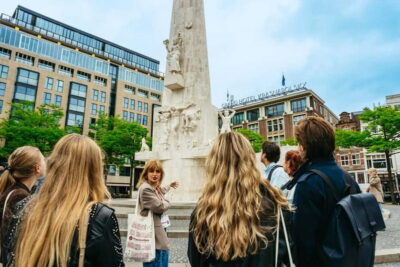

Anne Frank Walking Tour Amsterdam Including Jewish Cultural Quarter
Read our review →
Amsterdam Highlights Walking Tour: Small Group Experience
Read our review →Browse the lists this tour appears in