
Reviewed · TOURS IN ROTTERDAM
Rotterdam: Architecture Highlights Tour including the Depot
Rotterdam’s best story is written in concrete, glass, steel, and mirrored panels. This private walking tour links the city’s boldest buildings, from the curved Depot Boijmans van Beuningen to the practical drama of Central Station, while giving you rooftop views that ordinary sightseeing often misses. The Depot is the star, but the route works because it explains how Rotterdam keeps rebuilding itself.
I like the tour’s small private-group format, which gives you room to ask about design, engineering, and the city’s postwar changes. I also like the rooftop choice: weekdays bring a terrace at Timmerhuis, while weekends offer Het Witte Huis, Europe’s oldest skyscraper. The main consideration is the price, $494 for up to six people, which is strong value for a full group but costly for one or two guests.
Key points
- The Depot’s curved mirror skin reveals how unusual architecture can also solve practical storage needs.
- A rooftop stop changes by day: Timmerhuis on weekdays, Het Witte Huis on weekends.
- Markthal combines homes, food, and public space in one of Rotterdam’s most recognizable buildings.
- Central Station and Schouwburgplein show the city’s modern public architecture at street level.
- Frank Schipper may lead your tour, and his warm, clear explanations have earned especially strong praise.
- Three Rotterdam architecture postcards and a 50 percent Cube Houses discount add useful extras.
Why Rotterdam works so well as an architecture tour
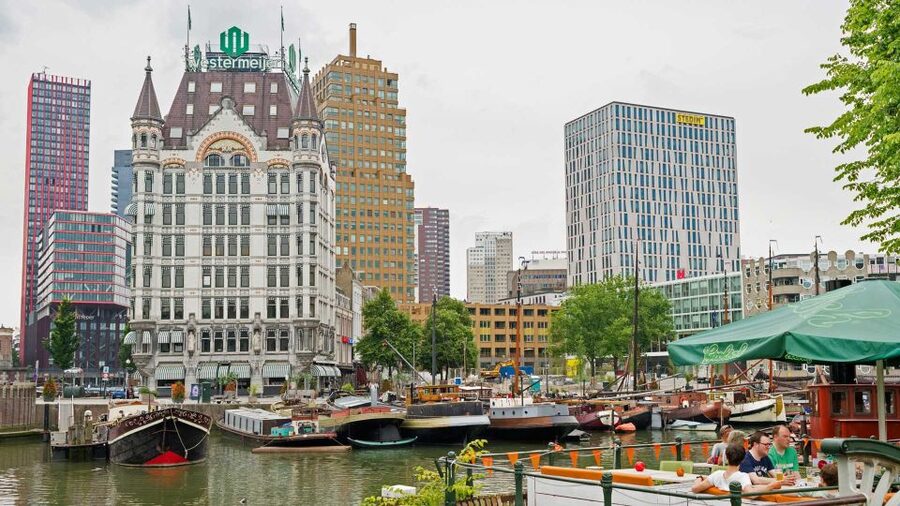
Rotterdam is not a city that hides its buildings. Its architecture is often large, experimental, and meant to be seen from several angles. This tour makes sense because you move through different periods instead of looking at one isolated landmark.
You begin outside Het Witte Huis, the meeting point. From there, the route covers historic buildings, postwar monuments, daring modern projects, and the newest addition to Museumpark. That progression helps you see Rotterdam as a city in constant conversation with its past.
The focus is not only on appearance. Your guide explains design choices, construction methods, and the thinking behind each project. That matters here. Without context, a tilted house or a giant mirrored bowl can seem like a photograph waiting to happen. With a good explanation, you start to see the engineering and city planning underneath.
This is a private tour for groups of up to six. I consider that a major advantage for anyone who wants to ask questions or keep the pace personal. Guides speak Dutch, English, and German. Frank Schipper is one named guide associated with the experience, and his friendly, detailed approach has been especially well received by German-speaking groups and architecture professionals.
Other trips people book in Rotterdam:
- Rotterdam: Harbor Sightseeing Cruise
★ 4.3 · 7,599 reviews - Rotterdam: 1-Hour Sightseeing Splash Tour
★ 4.5 · 3,299 reviews - Rotterdam: Rotterdam Zoo Blijdorp Entry Ticket
★ 4.6 · 2,754 reviews
Rooftop views from Het Witte Huis or Timmerhuis
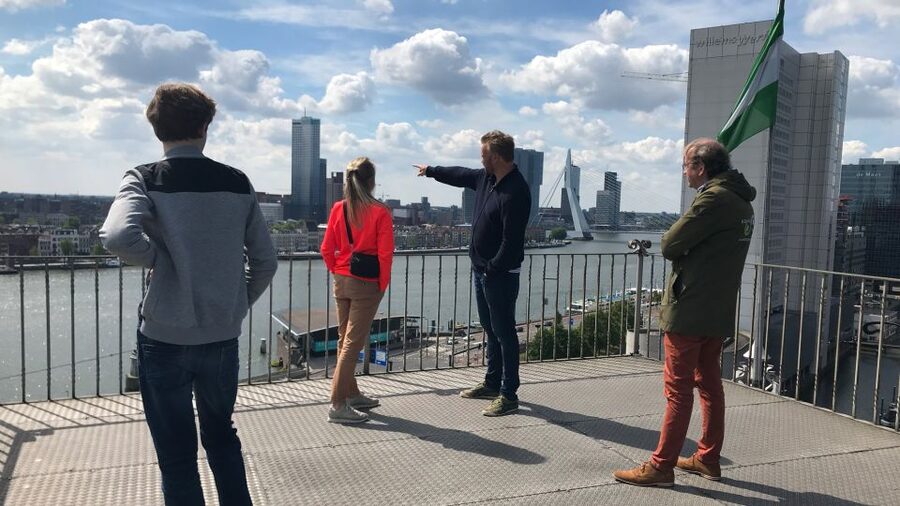
The opening rooftop stop depends on the day. On weekends, you visit the roof of Het Witte Huis. On weekdays, you enter a rooftop terrace at Timmerhuis.
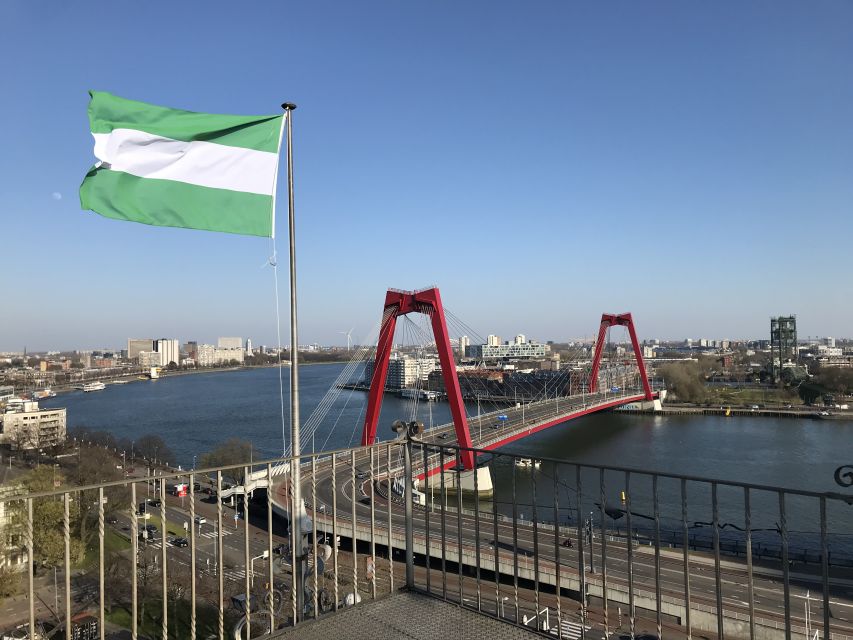
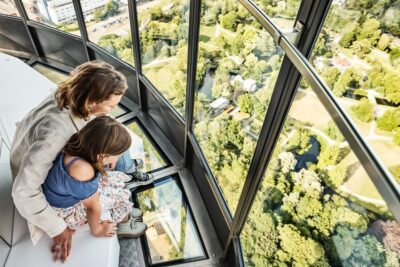
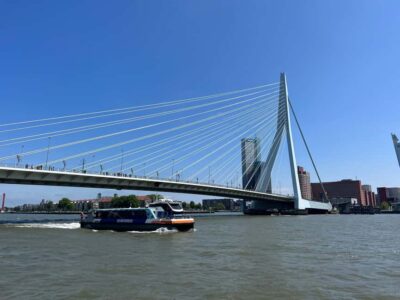
Het Witte Huis is a particularly good weekend choice because it connects old Rotterdam to the new city around it. From above, you can see Markthal, the Cube Houses, the Erasmus Bridge, the Willems Bridge, and De Rotterdam. That one view gives you a quick lesson in the city’s mix of historic survival, modern housing, bridges, and high-rise development.
The building is also described as Europe’s oldest skyscraper. That makes the rooftop more than a photo stop. It places Rotterdam’s current building experiments in a longer story of height and ambition.
The weekday alternative, the Timmerhuis rooftop, gives you a view toward the city center and Markthal. Timmerhuis itself becomes important later in the walk, so seeing it from above first can help you understand its shape and setting. The terrace is usually closed to the public, making this one of the tour’s more unusual access points.
The changing schedule is worth noting before you book. If the rooftop is a main reason for choosing this experience, select the day that offers the view you prefer. Weekend tours favor the historic skyscraper and a broader riverfront panorama. Weekday tours focus on Timmerhuis and its city-center outlook.
Markthal, Cube Houses, and the new Grotekerkplein
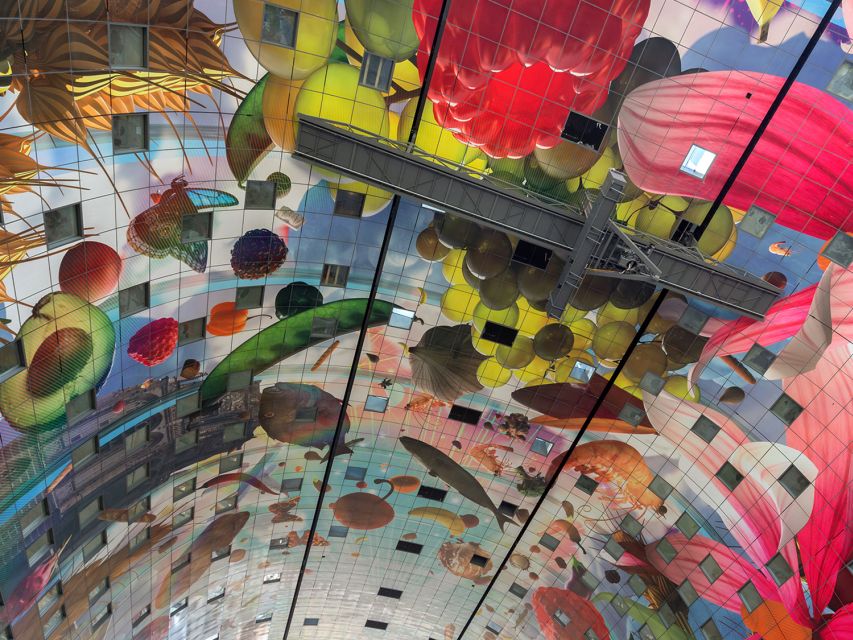
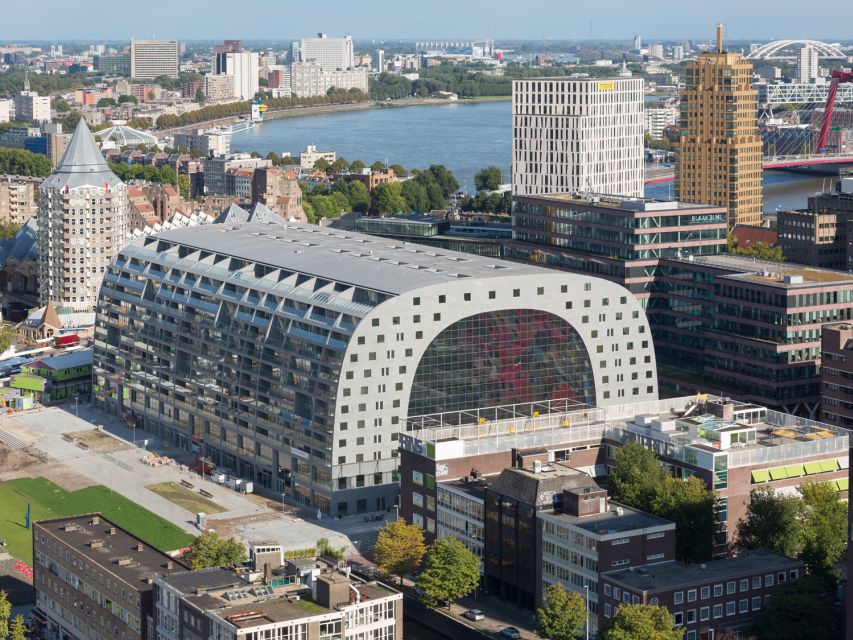
The walk continues through Markthal, one of Rotterdam’s clearest examples of architecture doing several jobs at once. The building combines housing with a lively food scene, placing apartments around a large covered market hall.
That arrangement is the point. Markthal is not simply a place to buy food, and it is not only a dramatic shell for apartment homes. Your guide explains how the design joins private housing, public movement, and food in one structure. The experience is better when you look up, look across, and consider how the building functions, not just how it photographs.
The tour also passes the Cube Houses. You receive a 50 percent discount on admission, which is useful if you want to see one from the inside after the walk. The tour itself does not list Cube House entry as included, so plan for that discount rather than assuming free admission.
Near Grotekerkplein, the route takes in a recently refurbished city park with a public stage for music and dance. This is a smaller stop, but it gives the tour a change of scale. Rotterdam architecture is not only about tall buildings and large engineering projects. Public squares and open areas shape how people use the city at ground level.
On weekdays, the rooftop terrace near Grotekerkplein adds another view of the center and Markthal. The tour therefore connects the building’s street-level public life with a higher view of its position in the city.
Timmerhuis and Rotterdam’s practical imagination
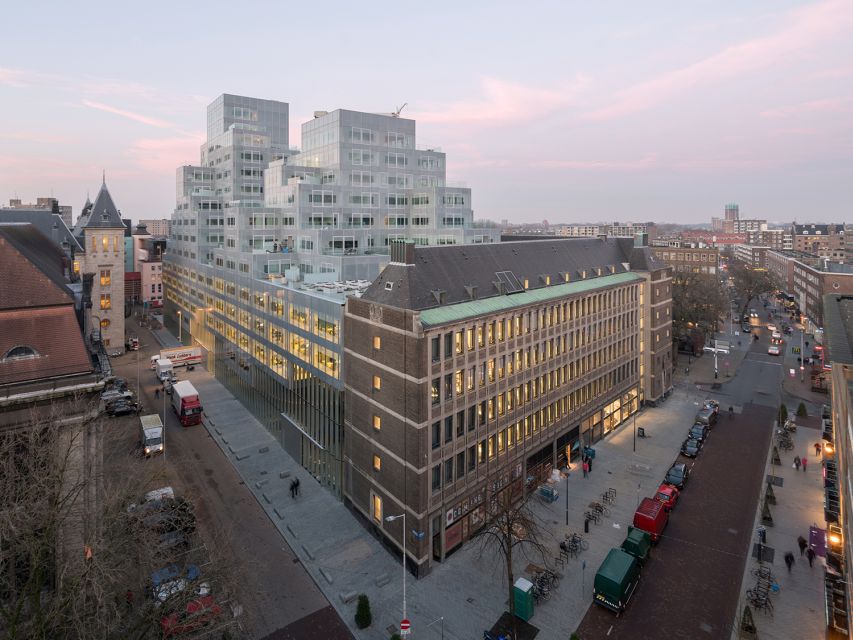
Timmerhuis is one of the route’s most interesting design projects because it joins an older municipal office block from the 1950s with a new steel-and-glass structure. The result is a pixellated form that appears to grow from the existing building.
The project was created by OMA, a Rotterdam-based architectural firm known for challenging familiar ideas about space and form. Your guide explains the redevelopment rather than asking you simply to admire it. That distinction is important. You get to think about how a city can reuse an older office block while adding a new structure with a very different visual language.
The building also rewards close attention. At a distance, its irregular glass-and-steel sections can look like a collection of stacked boxes. From the street, you can better appreciate how the old and new parts meet. The rooftop access on weekday tours makes Timmerhuis even more central to the experience.
You also pass Dudok’s Dudok, followed by historical and postwar buildings such as the post office and de Bijenkorf warehouse. These stops add useful contrast. Rotterdam’s architecture is not one uninterrupted march toward futuristic design. Different periods remain visible along the same walk.
Same city, a different sort of day:
- Rotterdam: Euromast Lookout Tower Ticket
★ 4.4 · 2,549 reviews - Rotterdam: Pancake Cruise
★ 4.4 · 1,986 reviews - Rotterdam: Harbor Cruise with Live Guide
★ 4.0 · 1,270 reviews - Rotterdam: Harbor Cruise on a Historic Ship
★ 4.2 · 812 reviews
From Schouwburgplein to Central Station
The route continues past Forum to Schouwburgplein and then Kruiskadeplein. These public spaces help you understand how Rotterdam handles movement, gathering, and large urban buildings.
At Kruiskadeplein, you see Groothandelsgebouw, Rotterdam Central Station, and de Delftse Poort. Central Station is one of the tour’s essential stops. Its striking form works as both a transport gateway and a piece of civic design. Your guide draws attention to the station’s architecture rather than treating it as a place you simply pass on the way to another sight.
This section is useful for visitors arriving in Rotterdam by train. You may have noticed the station’s bold exterior without knowing how it fits into the city’s wider architectural character. The tour gives it a place in the story.
The walk then takes in Calypso, Pauluskerk, and de Unie. These buildings add variety in color, shape, and purpose. You get a sense of how Rotterdam’s central districts mix housing, religious and social buildings, cultural venues, and transport infrastructure.
The route covers a lot in 2.5 hours. That is a strength if you want a broad introduction, but it also means the tour is not a slow interior tour of every building. You should expect a focused walking survey with explanations, views, and selected entries rather than long visits inside each stop.
Museumpark and the mirrored Depot
The final section reaches Museumpark, where you see Sonneveld House and Het Nieuwe Instituut. These buildings help bridge the gap between Rotterdam’s modernist past and its newer design culture.
Sonneveld House brings a more domestic scale to the tour. After large public projects, stations, offices, and market halls, a house lets you consider how architectural ideas affect daily living. Het Nieuwe Instituut adds a design-focused setting before the walk reaches its most recent architectural highlight.
Depot Boijmans van Beuningen is the destination many people will remember. Its exterior is a large, curved mirror surface that reflects the surrounding city and sky. The shape is unusual, but the concept goes beyond visual drama. The building houses the world’s first publicly accessible art depot.
Your guide explains how the double-curved facade was made from reflecting panels. You also hear about the aviation engineering techniques used to operate the enormous entrance doors. That detail gives the building a practical edge. You are not only looking at a shiny object. You are learning how difficult shapes and heavy moving parts can be made to work.
The Depot is a strong finishing point because it brings together the tour’s main themes: bold design, technical problem-solving, public access, and Rotterdam’s taste for trying something new. The route has shown you how the city rebuilt, adapted, and experimented. The Depot gives that story a modern final chapter.
How the guide affects the experience
Architecture tours rise or fall on the guide. A list of building names is easy to find. What you need is someone who can explain why the buildings matter without turning the walk into a lecture.
The strongest feedback about this experience centers on the guide’s explanations, warmth, and willingness to answer questions. Frank Schipper is praised by name for leading an informative and good-humored route. His style appears especially suited to groups who want more than a quick photo stop, including architecture students and professionals.
That does not mean you need technical training to enjoy the tour. The subject matter includes construction, statics, facades, and urban redevelopment, but the private format lets you ask for more or less detail. If you are traveling with people who have different levels of interest, that flexibility is helpful.
You should tell the guide what interests you most at the beginning. You might prefer engineering, postwar rebuilding, housing, public space, or photography. The tour already has a set route, but a private group has more room for questions than a large public walk.
Price, timing, and who gets the best value
The price is $494 per group of up to six. For six people, that works out to about $82 per person. For two people, it is about $247 per person, so the value changes sharply with group size.
I think the price makes the most sense for a family group, a small architecture club, or friends who want a private guide without splitting into several bookings. The rooftop access, expert guide, three postcards by Rotterdam architecture photographer Ossip van Duivenbode, and 50 percent Cube Houses discount add value, but the main purchase is the guide’s interpretation and the private format.
At 2.5 hours, the tour is long enough to give you a real introduction without taking over the entire day. You can pair it with a separate visit to Cube Houses or Depot Boijmans if you want more time inside those places.
The tour offers free cancellation up to 24 hours before departure and reserve now, pay later booking. Those terms help if your Rotterdam schedule is still changing. Check the available starting times before booking, since the activity does not list one fixed departure time.
There is mixed information about mobility. The tour is marked wheelchair accessible, but it is also described as not suitable for people with mobility impairments. Because the route includes walking and rooftop access, I would contact the provider before booking if you use a wheelchair or have difficulty walking. Assistance dogs are allowed, but other pets are not.
Should you book the Rotterdam architecture tour?
Book it if you want Rotterdam explained through its buildings, not just photographed from the street. It is especially well suited to first-time visitors, design-minded travelers, small private groups, and anyone curious about how the city combines old structures with daring new work.
The best reasons to choose it are the rooftop access, the detailed Depot explanation, and the chance to ask a local guide your own questions. Choose a weekend if Het Witte Huis and its wide view appeal most. Choose a weekday if you prefer the Timmerhuis terrace and want that building to play a larger role.
Skip it if you want a relaxed museum visit, extensive time inside every building, or a low-cost group tour. The route is active and broad, and the price is hard to justify for one or two people unless architecture is a central interest.
For the right group, this is a smart way to get your bearings in Rotterdam. You finish with a clearer sense of why the city looks the way it does, and why it keeps testing new ideas.
FAQ
How long does the Rotterdam architecture tour last?
The tour lasts 2.5 hours.
How many people can join the private group?
The price covers a private group of up to six people.
What languages are available?
The live guide can conduct the tour in Dutch, English, or German.
Where does the tour meet?
Meet your guide outside the entrance of Het Witte Huis.
Which rooftop do I visit on a weekday?
Weekday tours include entrance to a rooftop terrace at Timmerhuis, near Grotekerkplein.
Which rooftop do I visit on a weekend?
Weekend tours visit the roof of Het Witte Huis, described as Europe’s oldest skyscraper.
What can I see from the Het Witte Huis rooftop?
The view includes Markthal, the Cube Houses, the Erasmus Bridge, the Willems Bridge, and De Rotterdam.
Is entry to the Cube Houses included?
Cube House entry is not listed as included, but you receive a 50 percent discount on the entrance ticket.
What is included with the tour?
The package includes an expert local guide, the applicable rooftop entrance, and three postcards by Rotterdam architectural photographer Ossip van Duivenbode.
Can I cancel the booking?
You can cancel up to 24 hours in advance for a full refund. Reserve now and pay later is also available.
Just added in Rotterdam
- Rotterdam: City Walk Audio Guide in 7 Languages on your Phone★ 3.5 · 6 reviews
- Rotterdam Must Do Tour: Highlights, History, WW2 and Architecture★ 5.0 · 20 reviews
- e-Scavenger hunt Breda: Explore the city at your own pace★ 4.5 · 27 reviews
- e-Scavenger hunt Rotterdam: Explore the city at your own pace★ 4.5 · 13 reviews
- All-Inclusive Private Windmill Tour to Kinderdijk from Rotterdam★ 4.5 · 59 reviews
- Discover Rotterdam: Classic Highlights Bike Tour with a Local★ 5.0 · 22 reviews
- Rotterdam in half a day: All-inclusive, Authentic private Tour of Rotterdam★ 5.0 · 146 reviews
- Discover Breda with a self-guided Outside Escape city game tour!★ 5.0 · 16 reviews
Tours in Rotterdam, compared.


Browse the lists this tour appears in