
Reviewed · TOURS IN ROTTERDAM
Rotterdam Walk: Hilights, Gems, Architecture & WWII | 2 or 3hrs
Rotterdam’s story is one of destruction followed by bold reinvention. This walking tour connects the city’s WWII bombing and postwar rebuilding with its sharp modern architecture, moving from the mirrored Boijmans depot and the Maas waterfront to the cube houses and colorful Markthal.
I like the way WWII history stays central without swallowing the whole tour. I also like the route’s mix of famous sights and quieter corners, especially the Shipping Quarter and old harbor. The main consideration is pace: two to three hours on foot covers a lot, but you will not have time to tour the museums or fully explore the Markthal during the walk.
Key points
- WWII context with visual aids: Yoreh is known for using photographs to show how bombing changed Rotterdam.
- A strong architecture route: See the mirrored Boijmans depot, Erasmus Bridge, White House, cube houses, and Markthal.
- Small group format: The tour has a maximum of 15 people, making questions and conversation easier.
- A useful first-day introduction: The route finishes inside the Markthal, with time afterward for food and further exploring.
- No admission fees during the walk: The tour visits the exteriors and public spaces of the attractions.
- A local, personal perspective: Guides including Yoreh and Elmer bring practical tips about what to see next.
Rotterdam’s story begins with the bombed city

The best reason to take this walk early in your stay is that it gives you a framework for Rotterdam. The city can seem like a collection of dramatic buildings, broad streets, bridges, harbors, and construction sites. This tour explains why it looks that way.
The focus on WWII is especially useful. Rotterdam was invaded and bombed, and the destruction reshaped the center. Instead of rebuilding every old street and façade, the city moved in a more experimental direction. The result is a place where prewar traces, working harbors, postwar planning, and daring new buildings sit close together.
Your guide uses photographs to help you compare Rotterdam before and after the bombing. That makes the story easier to grasp than a string of dates. You see modern Rotterdam not as a random collection of unusual buildings, but as a city shaped by loss, practical rebuilding, and a willingness to try something new.
The route is also personal. Yoreh is a native of Rotterdam and has led many of these walks. His style combines history, humor, visual material, and recommendations for the rest of your visit. Elmer is also named as a guide, so the exact personality of the tour can vary, but the focus remains the city’s past, present, and future.
Other trips people book in Rotterdam:
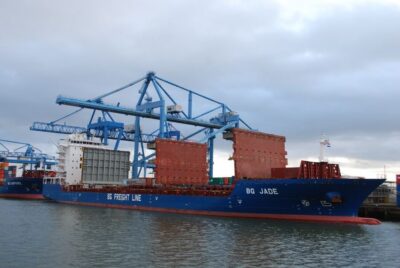
- Rotterdam: Harbor Sightseeing Cruise
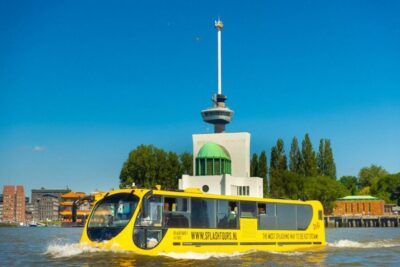
★ 4.3 · 7,599 reviews - Rotterdam: 1-Hour Sightseeing Splash Tour
★ 4.5 · 3,299 reviews - Rotterdam: Rotterdam Zoo Blijdorp Entry Ticket
★ 4.6 · 2,754 reviews
From Museumpark to the mirrored Boijmans depot
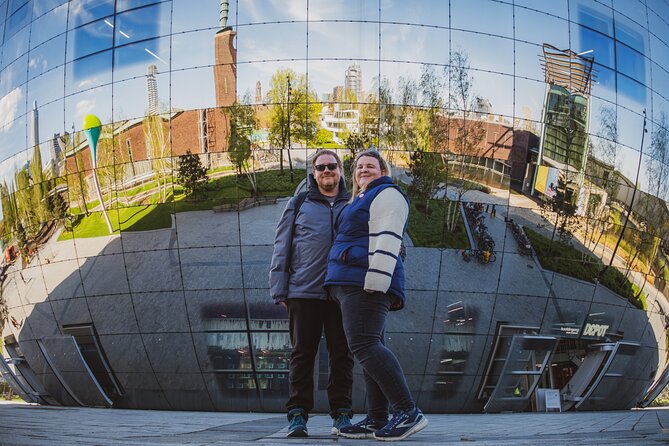
The walk begins at the Vaimoo shared-bike station near Museumpark, at Museumpark 20. The first stop is the Depot Boijmans Van Beuningen, the famous mirrored art storage building.
The depot is not presented as a museum visit. You do not enter with admission included. Instead, it serves as an introduction to Rotterdam’s Museum District and the Land of Hoboken, an area with a strong cultural role in the city.
The mirrored exterior is an immediate lesson in Rotterdam’s approach to architecture. It is practical, unusual, and designed to make a storage building part of the public city. Your guide explains the surrounding museums and helps place the depot within the wider district.
This opening stop lasts about 15 minutes. That is enough for orientation and photographs, but not enough for a full look at the art collection or the building’s interior. If the depot interests you, plan a separate visit.
The Shipping Quarter and the wide Maas
The route then moves toward Nieuwe Werk and Het Scheepvaartkwartier, also called the Shipping Quarter. This area provides a useful change of mood. After the compact Museum District, you reach a more open part of Rotterdam with a strong connection to the river.
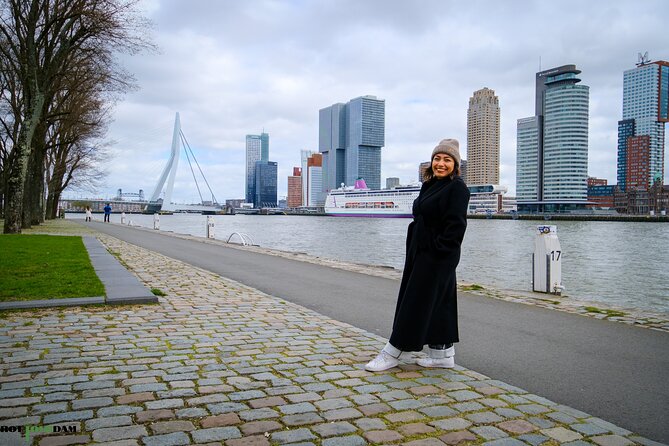
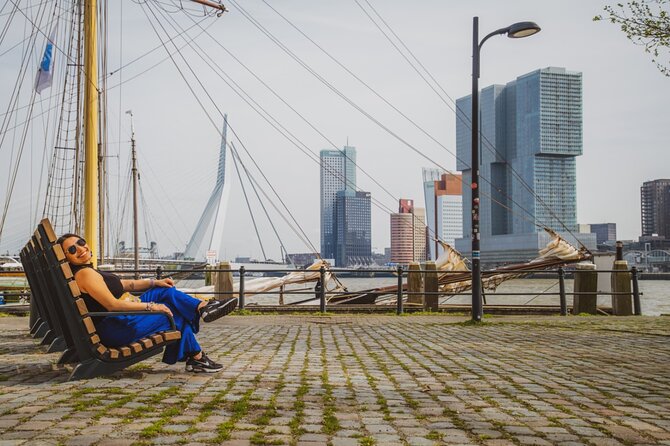
From the Maas side, you can see Hotel New York, the steamship Rotterdam, and the Erasmus Bridge. The view gives you a better sense of Rotterdam as a harbor city rather than simply a place of striking buildings.
This is one of the more distinctive parts of the walk. The Shipping Quarter is less obvious than the city’s headline sights, and the open riverfront gives the group room to pause. The stop lasts about 30 minutes, making it the longest single pause on the route.
You should expect weather to matter here. The experience requires good weather, and the riverfront can feel exposed. Bring a coat or rain layer when conditions are uncertain. If poor weather causes cancellation, you are offered another date or a full refund.
Erasmus Bridge and the turning point of WWII
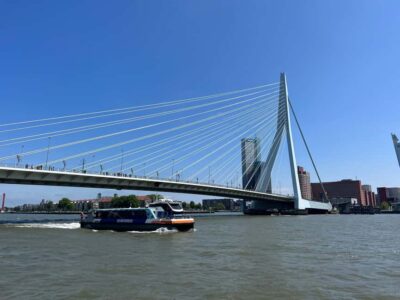
The Erasmus Bridge is Rotterdam’s visual signature, a large white crossing over the Maas that links the northern and southern parts of the city. The bridge is impressive on its own, but the historical explanation gives it more weight.
Here, the guide discusses the invasion, the bombing, and the effect of WWII on Rotterdam. The bridge becomes a useful point for understanding how the city connects its older harbor identity with its modern rebuilding.
The stop lasts about 20 minutes. That is enough for an explanation and photographs, but not an extended bridge walk. The tour’s value is the context. You are not just shown a famous structure and moved along. You learn how the city’s modern identity grew out of a painful break with the past.
This is also where the tour’s visual approach helps most. Old photographs can make the scale of destruction more real, especially when you are looking at a city that now appears so modern and energetic.
Same city, a different sort of day:
- Rotterdam: Euromast Lookout Tower Ticket
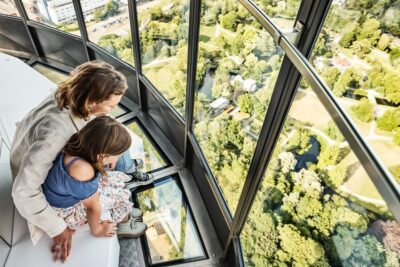
★ 4.4 · 2,549 reviews - Rotterdam: Pancake Cruise
★ 4.4 · 1,986 reviews - Rotterdam: Harbor Cruise with Live Guide
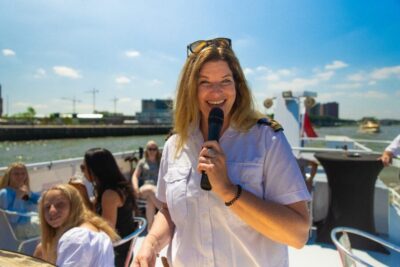
★ 4.0 · 1,270 reviews - Rotterdam: Harbor Cruise on a Historic Ship
★ 4.2 · 812 reviews
The Maritime District as an open-air museum
Next comes Rotterdam’s Maritime District and the Maritiem Museum area. The walk passes historic boats, including vessels that are among the last of their kind and more than 100 years old.
This section gives you a glimpse of the city’s working maritime past without requiring a museum admission. The boats and harbor structures help balance the newer architecture. Rotterdam is not only glass, concrete, and bold urban design. It also has a long relationship with shipping, trade, and water.
The stop is brief, around 10 minutes. Think of it as a curated look at the public harbor setting, not a full museum visit. If you want detailed displays or time aboard the vessels, you would need to return independently.
The Destroyed City and the meaning of Square 1940
At Square 1940, you see Ossip Zadkine’s sculpture The Destroyed City. It is one of Rotterdam’s most important WWII memorials.
The statue gives the historical discussion an emotional center. Buildings and bridges explain how the city changed, but the sculpture represents the human cost and the feeling of a city wounded by war. Your guide explains its meaning and its place in Rotterdam’s memory.
The stop lasts about 10 minutes. It is short, but this is not a place that needs a long activity. A few quiet minutes and a clear explanation can be more effective than a rushed lecture.
If you prefer architecture alone, this section may feel more solemn than the rest of the walk. That is also its strength. The tour does not treat Rotterdam’s rebuilding as a simple success story. It keeps the cost of that transformation in view.
The White House and Rotterdam’s early skyscraper ambition
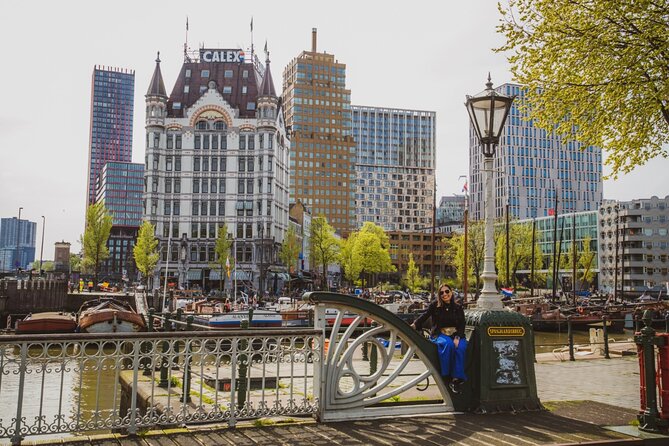
The next stop is Witte Huis, or the White House. This historic office building was once the tallest office tower in Europe.
Its importance is easy to miss beside Rotterdam’s newer towers. The building shows that Rotterdam’s appetite for height and modern business architecture did not begin after WWII. There was already a push toward a more ambitious city before the bombing.
The stop lasts about 15 minutes. Your guide places the building in the city’s longer architectural story, giving you a useful bridge between older Rotterdam and the experimental structures that follow.
This is one reason the tour works well for people who are not architecture specialists. You do not need to know architectural terms in advance. The guide explains why a building matters, how it fits the city, and what to notice.
Oude Haven and the cube houses overhead
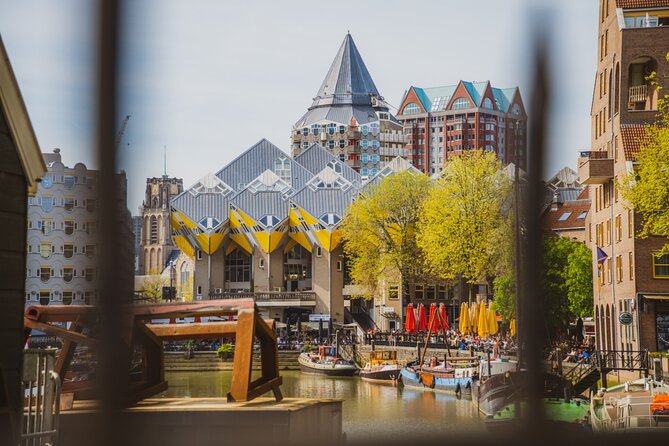
Oude Haven, or the Old Harbor, is one of the oldest harbors in the Netherlands. It is also one of the most pleasant pauses on the route, with views toward the cube houses.
The harbor gives you another contrast. Historic boats and older waterfront elements sit below the bright, angular housing above. From here, the cube houses look especially theatrical, almost as if they were placed on a stage.
The stop lasts around 15 minutes. It is a good place to take photographs and hear how the old harbor fits into Rotterdam’s present-day center. You also get a preview of the next stop, where the route moves directly into the cube house complex.
Walking through the cube house forest
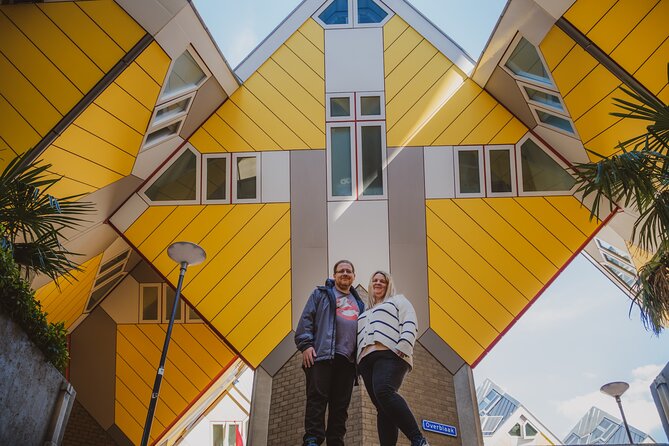
The cube houses on Overblaak are among Rotterdam’s best-known sights. Their tilted forms turn ordinary ideas about walls, windows, floors, and streets upside down.
The tour does more than point at them. It explains the why, how, and architecture behind the design as you walk through the cluster. That matters because the buildings can seem like a visual trick if you only stop for a photograph. With explanation, you begin to understand the relationship between the angled houses, the public space below, and the idea of creating a concrete forest.
The stop is listed at about 10 minutes, so expect a concise outdoor explanation rather than a detailed architectural workshop. You can visit the demo cube house independently after the tour. That is the better plan if you want to see what one of the interiors feels like.
The cube houses are also a good example of the tour’s balance. They are fun, photogenic, and strange, but the guide connects them to Rotterdam’s larger habit of testing new urban ideas.
Markthal, where the walk finishes
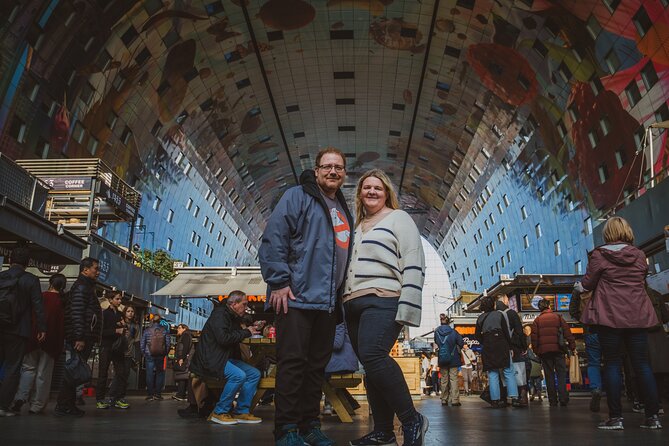
The tour ends inside the Markthal, a modern indoor market with food stalls, restaurants, and a huge colorful artwork across its interior. The guide explains why locals sometimes compare the artwork to a modern Sistine Chapel.
The stop lasts about 15 minutes, but the building deserves more time than that if you want to eat, browse, or study the artwork. The tour does not include food or a separate admission. It simply brings you to the market and gives you the background to appreciate it.
This is a smart ending. You finish near the cube houses and can visit the demo house on your own. You can also stay in the Markthal for a meal, which is exactly what I would suggest if your schedule allows.
Do not book this tour with only a few minutes to spare afterward. The route ends inside the market hall, and the building is much more enjoyable when you are not hurrying to your next appointment.
What the $49.60 price gives you
At $49.60 per person, the tour is not the cheapest way to walk around Rotterdam. Its value depends on how much context you want.
You are paying for a two to three hour guided route, a maximum group size of 15, local interpretation, WWII background, architecture explanations, and practical suggestions for the rest of your stay. There are no admission tickets included because the stops are public spaces or exterior visits.
I think the price is reasonable if you are new to Rotterdam and want to understand the city quickly. It is less useful if you already know the center well or prefer to explore buildings at your own speed.
The small group limit matters. Fifteen people is large enough for a social walk but small enough for questions. The guides are repeatedly described as friendly, energetic, humorous, and easy to talk with. That personal interaction is part of the value, especially when you want advice about museums, neighborhoods, food, or places to return to later.
Group discounts are available, so check the final price if you are booking with family or friends.
Timing, walking comfort, and who should book
This is a walking tour lasting roughly two to three hours. The listed stop times add up to about 140 minutes, and the route also includes the walking between them. Wear comfortable shoes and allow flexibility around the stated duration.
The route suits first-time visitors, architecture fans, history-minded travelers, cruise passengers, and anyone who wants a useful introduction before exploring alone. Several people have used it before a cruise, and the finish at the Markthal makes it easy to continue with lunch or further sightseeing.
It also works well for people who do not usually seek out history tours. The mix of photographs, humor, buildings, harbors, and short explanations keeps the walk moving. You can ask questions without needing specialist knowledge.
The main limitation is depth. You see many places, but none receives a full museum-style treatment. You will need separate visits for the Boijmans depot, Maritime Museum, demo cube house, and longer time inside the Markthal.
The tour is offered in English. Service animals are allowed, public transportation is nearby, and most people can participate. Good weather is required, and cancellation can occur if the minimum number of participants is not met.
Should you book the Rotterdam walk?
I would book this for your first day in Rotterdam, especially if the city’s modern architecture initially feels confusing. The route gives you a clear story: harbor beginnings, wartime destruction, postwar rebuilding, and an ongoing taste for unusual design.
Book it if you want a local guide, strong WWII context, photographs that show change over time, and a route that reaches both famous sights and less obvious waterfront areas. Plan a little extra time afterward for the Markthal and the demo cube house.
Skip it if you want long museum visits, a private tour, or a slow architectural study with lots of time at each building. For most first-time visitors, though, this is a practical way to get oriented and make better choices for the rest of a Rotterdam stay.
FAQ
How long does the Rotterdam walking tour last?
The experience lasts approximately two to three hours.
What language is the tour offered in?
The tour is offered in English.
What is the maximum group size?
The tour has a maximum of 15 participants.
Where does the tour start?
It starts at the Vaimoo shared-bike station near Museumpark, Museumpark 20, 3015 CX Rotterdam.
Where does the tour finish?
The tour ends inside the Markthal at Verlengde Nieuwstraat, 3011 GX Rotterdam.
Are admission tickets included?
The listed stops have no admission charge during the walk. The tour visits public areas and explains places such as the Boijmans depot, Maritime Museum area, cube houses, and Markthal. You can visit some interiors separately after the tour.
Can I visit the demo cube house after the walk?
Yes. The tour ends near the cube houses, and you can enter the demo cube house independently afterward.
Is the tour suitable for most people?
Most people can participate. The experience is near public transportation, and service animals are allowed.
What happens if the weather is poor or the tour does not reach its minimum group size?
If poor weather or an insufficient number of participants causes cancellation, you are offered a different date or experience, or a full refund. You can also cancel for a full refund up to 24 hours before the start time.
Just added in Rotterdam
- Rotterdam: City Walk Audio Guide in 7 Languages on your Phone★ 3.5 · 6 reviews
- Rotterdam Must Do Tour: Highlights, History, WW2 and Architecture★ 5.0 · 20 reviews
- e-Scavenger hunt Breda: Explore the city at your own pace★ 4.5 · 27 reviews
- e-Scavenger hunt Rotterdam: Explore the city at your own pace★ 4.5 · 13 reviews
- All-Inclusive Private Windmill Tour to Kinderdijk from Rotterdam★ 4.5 · 59 reviews
- Discover Rotterdam: Classic Highlights Bike Tour with a Local★ 5.0 · 22 reviews
- Rotterdam in half a day: All-inclusive, Authentic private Tour of Rotterdam★ 5.0 · 146 reviews
- Discover Breda with a self-guided Outside Escape city game tour!★ 5.0 · 16 reviews
Tours in Rotterdam, compared.


Browse the lists this tour appears in