
Reviewed · WALKING TOURS
Rotterdam Travel to the Future Walking Tour
Rotterdam’s most interesting sights are not just famous buildings. They are working experiments: a yellow wooden footbridge, a farm on a roof, public art in former back streets, and housing designed at unusual angles. This private walking tour connects those ideas with the city’s better-known sights, including Markthal, the Cube Houses, Laurenskerk, and Erasmus Bridge.
I like the route’s focus on everyday urban projects, not just postcard views. I also like the way it brings together old Rotterdam and new Rotterdam, from the medieval church to MVRDV architecture and rooftop agriculture. The main drawback is the price: at $274.03 per person, this is costly for a three-hour walk, especially if your group is small.
Key points at a glance
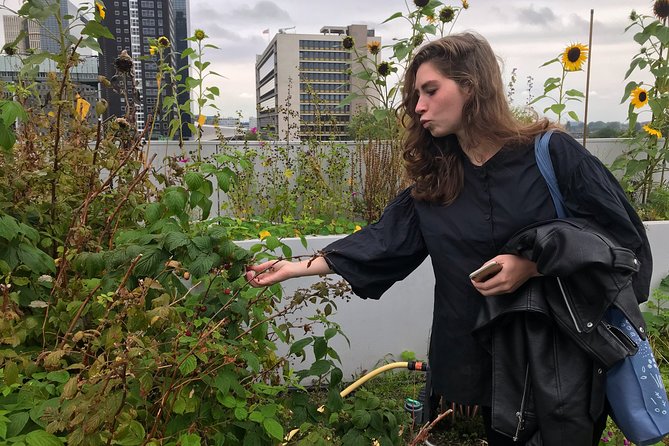
- A private walk through Rotterdam’s future-facing projects: See the yellow Luchtsingel, rooftop farming, public gardens, and other social projects.
- Strong art coverage: Street sculptures and graffiti are treated as part of Rotterdam’s story, not just decoration.
- Classic sights are included: The route reaches Laurenskerk, Markthal, the Cube Houses, and Erasmus Bridge.
- A guide-led experience: An English-speaking certified guide leads only your group.
- A useful family option: Past guide feedback describes children as young as five and seven staying interested.
- Plan for extra spending: Food, coffee, tea, snacks, and entrance tickets are not included.
Rotterdam as a city-sized experiment
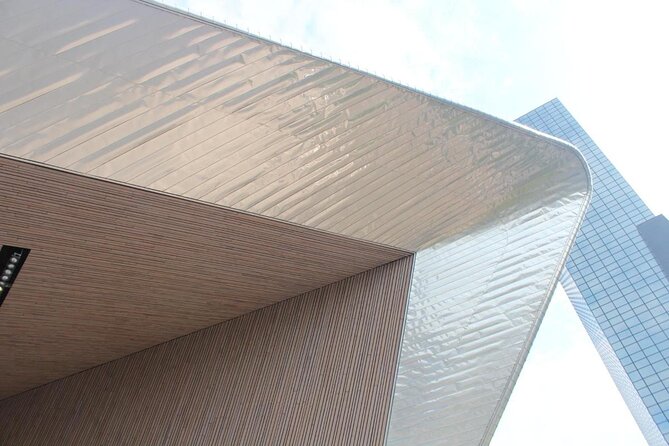
If Amsterdam feels shaped by its past, Rotterdam often feels like a city testing its next idea. Much of the center was destroyed during the Second World War, and rebuilding gave architects room to try forms that would have been difficult in an older Dutch city.
This walk uses that story well. You are not simply shown a strange building and told its name. You are asked to think about why Rotterdam has so many unusual public spaces, social projects, and bold housing schemes.
The route also helps you see how change happens at street level. A wooden bridge can reconnect neighborhoods. A rooftop can become a farm. A former neglected area can gain studios, shops, food businesses, and public attention.
That makes this a good choice if you like architecture, urban planning, public art, or the practical side of city renewal. It is less suitable if you want a long visit inside museums or a food tour with generous tastings.
More Walking Tours in Rotterdam
- Rotterdam: Architectural Highlights Guided Walking Tour
★ 4.8 · 215 reviews - Rotterdam: Highlights & Gems Walking Tour with Dutch Local
★ 5.0 · 133 reviews - Rotterdam 2-Hour Walking Tour | Discover The City With A Local
★ 4.5 · 111 reviews
Starting near Ode aan Marten Toonder
The walk begins at Ode aan Marten Toonder on Verlengde Nieuwstraat. The meeting point is near public transportation, which makes it reasonably practical to reach from elsewhere in Rotterdam, though you should allow time to find the exact spot.
This is a walking experience from the start. The total time is about three hours, with several short stops and a few longer sections for explanation. Wear comfortable shoes, and remember that Rotterdam can feel exposed in windy or wet weather.
Because the activity is private, the guide can focus on the interests of your group. A family can ask more about unusual buildings and street art. An architecture enthusiast can spend more time on design and public-space choices. A first-time visitor can keep the discussion broad and practical.
The guide names appearing in the supplied material include Danya, Danny, and Danil Hochlovic. These may refer to the same guide, but the different spellings mean you should confirm who will lead your booking if that matters to you.
Yellow wood, rooftop farms, and public projects
The first major part of the walk focuses on innovative public spaces. One highlight is the yellow wooden Luchtsingel, a footbridge that links central Rotterdam with the northern part of the city.
Its color is hard to miss, but its purpose matters more than its appearance. The bridge was designed by Rotterdam architecture firm ZUS and supported by the city. Much of its funding came through a crowdfunding campaign involving local residents. That detail gives the project a useful human angle: this was not only a piece of design placed in the city, but also a way for people to help reshape their surroundings.
The bridge connected Schieblok with Hofbogen. Schieblok houses architects, designers, and other creative workers, while Hofbogen occupies the arches beneath a former railway viaduct. Those arches now contain shops, restaurants, bars, and cafes.
The tour also discusses rooftop agriculture. DakAkker, on top of the Schieblock, is described as a 1,000-square-meter open-air farm. It grows vegetables, fruit, and edible flowers and keeps bees. A bistro operates in the rooftop pavilion, although the business name and concept may change over time.
You should treat this section as a lesson in how cities can reuse overlooked spaces. It is not a formal farm visit or a guaranteed meal stop. Food and drinks are extra, and the tour does not promise a tasting. Still, the chance to understand rooftop growing, public access, and urban food production adds substance to what could otherwise be a quick photo stop.
The route also points out a garden designed by Piet Oudolf. The information provided does not specify how much time you will spend there, so think of it as part of the wider discussion about planting and public-space design rather than a dedicated garden tour.
Street art with a local story
Rotterdam’s public art is not kept in one tidy district. As you walk, sculptures and graffiti appear on walls, underpasses, and shared spaces. The guide explains the stories behind selected works and places them in the city’s social setting.
That is one of the strongest parts of the experience. Without context, graffiti can blur into background color. With a guide, a mural or painted wall can point to neighborhood change, identity, protest, or the way artists reclaim an unfriendly space.
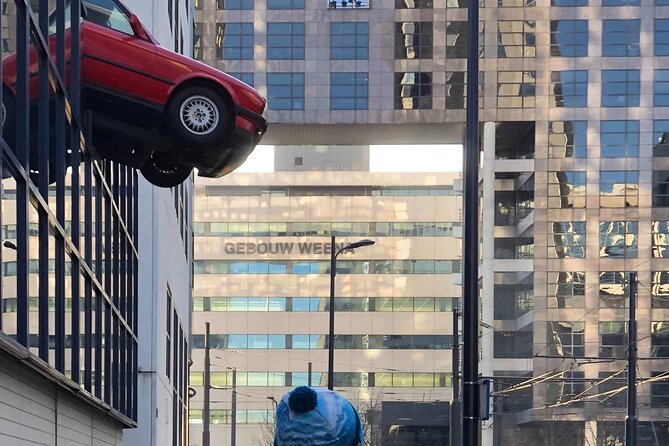
One account of the walk describes a bright yellow street and a red car breaking through a wall, presented as a symbol of a barrier between richer and poorer areas. The route also reaches the Luchtsingel through this more informal side of central Rotterdam.
Do not expect a polished gallery route. The appeal is that the art is encountered in ordinary public space. Some pieces may be temporary, and street art can change. That uncertainty is part of the experience, but it also means the exact selection may not be identical on every visit.
The street-art portion lasts about 15 minutes as a listed stop, so the guide cannot cover every major work in Rotterdam. If public art is your main interest, ask before booking whether the guide can give it extra attention within the private format.
Other guided walks around Rotterdam:
- Walking Rotterdam Food Tour
★ 5.0 · 89 reviews - Rotterdam: City Center Walking Tour
★ 4.5 · 88 reviews - Rotterdam Architecture Highlights Walking Tour
★ 5.0 · 66 reviews - Rotterdam Walking Tour and Harbor Cruise
★ 4.7 · 59 reviews
Laurenskerk and the fragments of older Rotterdam
Rotterdam’s modern image can make its older buildings easy to overlook. The Grote of Sint-Laurenskerk, usually called Laurenskerk, provides a useful pause in the route.
The church and the old city hall area help explain what Rotterdam was before reconstruction transformed the center. Here, the guide discusses the city’s past and important figures rather than treating the modern skyline as the whole story.
This stop is relatively short, about 15 minutes. It is best understood as a historical anchor. After seeing experimental bridges, angular homes, and large contemporary buildings, you get a reminder that Rotterdam also has older civic and religious roots.
Entrance tickets are not included. The provided details do not promise an interior visit, so ask the guide or provider if you specifically want to go inside Laurenskerk. The outdoor explanation may be enough for a general city walk, but it will not replace a full church visit.
Markthal, where architecture meets lunch
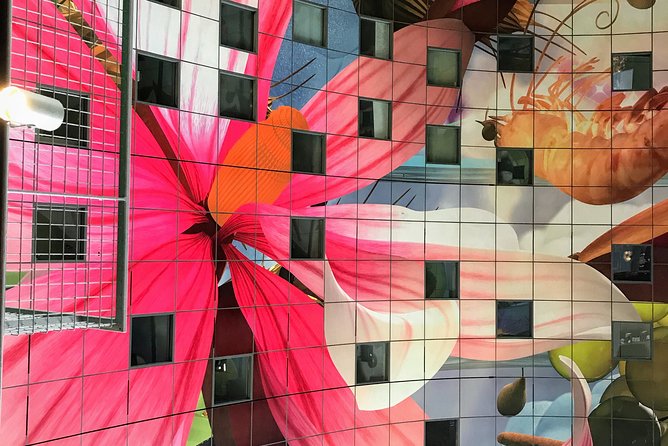
Markthal is one of Rotterdam’s most recognizable modern projects. Designed by MVRDV, it combines a covered market with housing, making it a useful example of how a large building can serve several purposes at once.
The guide discusses architecture and public space while leading you through the market. This is where the tour becomes especially practical. You can look at the building, then pause for food if something catches your eye.
Possible purchases include herring, farmer cheese, Dutch wine, truffle sausages, and other food products. These are not included in the tour price, and the stop is not a fixed meal. Bring a payment method and decide in advance whether you want a quick taste or a proper snack break.
The listed time here is about 30 minutes. That is enough to see the main interior and make a small purchase, but not enough for a leisurely meal at several stalls. If your group has strong food interests, tell the guide early so you can use the private format sensibly.
Markthal also works well for families because it gives children something immediate to look at and smell, rather than requiring them to listen to a long architectural explanation. Still, the guide’s main focus remains the building and public-space design.
Erasmus Bridge and the view across the river
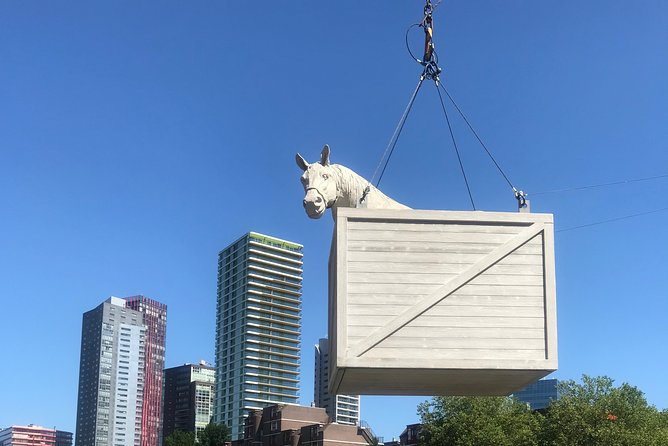
The walk continues to Erasmus Bridge, one of Rotterdam’s best-known modern structures. The bridge provides a broad view toward the opposite side of the city and helps you understand Rotterdam as a river port rather than only a collection of downtown buildings.
The tour also refers to OMA and architect Rem Koolhaas in this part of the route. The supplied information does not specify a separate interior visit or a detailed stop at an OMA building, so expect an outdoor discussion connected to Rotterdam’s architecture and skyline.
This is a good place for photographs, but the practical value is greater than a photo opportunity. From the bridge, you can see how the city’s newer architecture relates to the water, transport routes, and expanded urban areas.
Erasmus Bridge is also the finishing point. That makes the route easy to understand: you begin in the inner city, pass through old and experimental Rotterdam, and finish with a major view outward.
Cube Houses and the city’s unusual homes
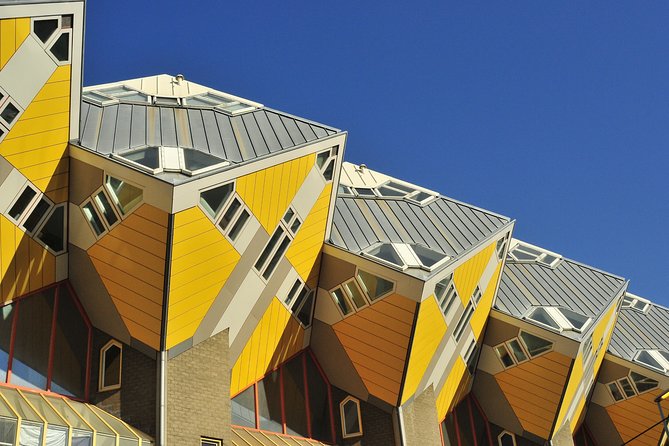
The Cube Houses are among Rotterdam’s most famous sights. Their tilted forms are immediately eye-catching, but the guide uses them to explain larger ideas: 20th-century architectural movements, social housing, and the challenge of making unusual designs work for daily life.
Nearby buildings such as the Pencil and the Apple are also part of the discussion. Together, these structures show how Rotterdam’s architectural identity is built from a cluster of bold projects rather than one isolated landmark.
The Cube Houses are visually strong, but they can be frustrating if you want to understand how people live inside them. The tour explains the design from the outside, and the provided information does not include an entrance ticket. If you want an interior visit, check whether that can be arranged separately.
This stop is especially useful for anyone who has already seen photographs of the houses but wants more context. Instead of leaving with only the memory of tilted yellow cubes, you get a clearer sense of the design movement and the social questions behind the project.
The guide’s storytelling style
The strongest guide feedback describes a light, engaging way of presenting information. The guide named Danya is praised for showing both well-known sights and less obvious parts of town, while keeping the talk accessible for families.
That matters on a route with architecture. Too many dates and technical terms can flatten the experience. The best version of this walk connects buildings to people, neighborhoods, and daily life.
Past guide feedback also highlights discussion of Rotterdam during the Second World War, the city’s reconstruction, and the character of local residents. The route is not only about shiny new buildings. It addresses how the city changed, including areas once associated with serious social problems and later efforts to bring them back into public use.
Because this is a private tour, you can ask for more history or more design depending on your interests. The exact balance will depend on your guide and group. The activity is offered in English, and confirmation is received at booking.
What the $274.03 price means
At $274.03 per person, this is not a budget walking tour. The value depends heavily on group size and how much you care about a private guide.
For one or two people, the price is difficult to justify against a standard group walk or a self-guided route. You will still need to pay for food and drinks, and entrance tickets are not included. The three-hour duration also limits how much ground and detail the guide can cover.
For a larger group, the cost may make more sense if the booking price is applied in a way that benefits the whole party. The private format gives you a guide focused on your group rather than a fixed audience, and it can be a useful choice for families with different ages and interests.
I would book this at the higher price when the route itself is the priority: experimental public projects, urban design, street art, and the connection between old and new Rotterdam. I would skip it if you mainly want a cheap orientation walk or a food experience with included tastings.
Practical details before you book
The activity lasts about three hours and is offered in English. A certified guide is included, while coffee, tea, snacks, and entrance tickets are not.
The route starts at Ode aan Marten Toonder, Verlengde Nieuwstraat, 3011 GA Rotterdam, and ends at Erasmusbrug, 3011 BN Rotterdam. Since the start and finish are different, plan the rest of your day around the Erasmus Bridge rather than expecting to return to the starting point.
Most people can participate, and the meeting area is near public transportation. The walk includes city streets, bridges, and outdoor public spaces, so weather can affect comfort. The exact walking distance is not provided, but comfortable footwear is a sensible choice.
Free cancellation is available if you cancel at least 24 hours before the local start time. A cancellation made less than 24 hours ahead is not refundable, and changes inside that period are not accepted.
Who should choose this Rotterdam walk?
I would choose this tour for an architecture-minded visitor who wants help making sense of Rotterdam’s unusual buildings. It also suits families because the route mixes visual sights, food-market activity, public art, and short history sections.
It is a strong option for repeat visitors, too. One guide account describes someone who had visited Rotterdam seven or eight times and still encountered new places. That is a useful clue: the route is not limited to the standard city-center checklist.
I would be more cautious if you have limited mobility, need a fully detailed accessibility plan, or want to spend most of the time indoors. The tour information says most people can participate but does not provide specific details about step-free access, seating, or walking distance. Ask before booking if those details affect your decision.
Should you book it?
Book it if you want Rotterdam explained as a living city experiment, not just photographed as a modern skyline. The Luchtsingel, rooftop farm, public art, Markthal, Cube Houses, and Erasmus Bridge give the walk a clear theme, while Laurenskerk keeps the story connected to the city’s older roots.
The price is the key question. If you are sharing it with a group and value a private guide, the route offers a focused way to understand Rotterdam’s design choices and social changes. If you are alone or watching your budget, use the stops as a self-guided plan and spend your money on a museum, meal, or separate architectural visit.
FAQ
How long does the Rotterdam Travel to the Future Walking Tour last?
The tour lasts approximately three hours.
What language is the tour offered in?
The tour is offered in English.
Is this a private tour?
Yes. Only your group participates in the activity.
Where does the tour start?
It starts at Ode aan Marten Toonder, Verlengde Nieuwstraat, 3011 GA Rotterdam, Netherlands.
Where does the tour end?
The tour ends at Erasmusbrug, 3011 BN Rotterdam, Netherlands.
What sights are included on the walk?
The route includes innovative public spaces, the yellow Luchtsingel, rooftop farming, street sculptures and graffiti, Laurenskerk, the old city hall area, Markthal, Erasmus Bridge, OMA-related architecture, the Cube Houses, the Pencil, and the Apple buildings.
Is food included in the price?
No. Coffee, tea, snacks, and food purchases at Markthal are not included.
Are entrance tickets included?
No. Entrance tickets are not included.
What is the cancellation policy?
You can cancel for a full refund up to 24 hours before the experience starts. Cancellations or changes made less than 24 hours before the local start time are not accepted for a refund.
Just added in Rotterdam
- Rotterdam: City Walk Audio Guide in 7 Languages on your Phone★ 3.5 · 6 reviews
- Rotterdam Must Do Tour: Highlights, History, WW2 and Architecture★ 5.0 · 20 reviews
- e-Scavenger hunt Breda: Explore the city at your own pace★ 4.5 · 27 reviews
- e-Scavenger hunt Rotterdam: Explore the city at your own pace★ 4.5 · 13 reviews
- All-Inclusive Private Windmill Tour to Kinderdijk from Rotterdam★ 4.5 · 59 reviews
- Discover Rotterdam: Classic Highlights Bike Tour with a Local★ 5.0 · 22 reviews
- Rotterdam in half a day: All-inclusive, Authentic private Tour of Rotterdam★ 5.0 · 146 reviews
- Discover Breda with a self-guided Outside Escape city game tour!★ 5.0 · 16 reviews
Walking Tours, compared.
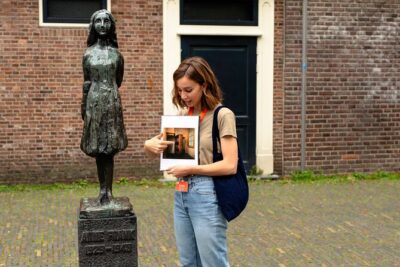
Anne Frank’s Story – Guided Walking Tour through Amsterdam
Read our review →
Life of Anne Frank and World War II Walking Tour
Read our review →
Anne Frank Walking Tour – Guided in EN/DE/IT/ES
Read our review →

Anne Frank Walking Tour Amsterdam Including Jewish Cultural Quarter
Read our review →
Amsterdam Highlights Walking Tour: Small Group Experience
Read our review →Browse the lists this tour appears in