
Reviewed · HISTORICAL TOURS
Rotterdam Must Do Tour: Highlights, History, WW2 and Architecture
Rotterdam’s story is written in its buildings. This two-hour walking tour links the city’s wartime destruction with its daring rebuilding, taking you from Rotterdam Centraal to the Markthal, Oude Haven, and the famous Cube Houses. It is less about checking off monuments and more about seeing why this city looks so different from Amsterdam, Delft, or Utrecht.
I like the small maximum group of 15, which gives the guide room to answer questions, and I like the route’s clear mix of architecture, shopping streets, harbor history, and World War II context. The main caution is pace: two hours is short for this many stops, so some places receive only a quick explanation rather than a full visit.
Key points to know before booking
- A compact architecture walk: You see Rotterdam Centraal, Luchtsingel, Markthal, the Cube Houses, and other distinctive buildings in one route.
- WWII history shapes the tour: The bombing and the city’s postwar rebuilding are central to the story, especially around Lijnbaan and Groot Handelsgebouw.
- Small groups matter: The maximum is 15 people, a useful balance between a social walk and personal attention.
- The guide makes the difference: Susan, Edwin, Michel, John, Ed, Tony, and Stephan have all led tours, with particular praise for clear history and local stories.
- Good value for a first look: At $29.41 per person, the price covers a local guide and a broad introduction without separate attraction admissions.
- Plan for a brisk outing: The route includes many stops, but food, drinks, and extended time inside attractions are not included.
Why Rotterdam needs a guided introduction
Rotterdam can feel puzzling at first. Its center has few old streets compared with other Dutch cities, yet the city is full of striking buildings, public art, and ambitious new design. A guide helps you read that contrast.
The key event is the bombing of Rotterdam during World War II. Much of the old center was destroyed, and the city chose to rebuild in a modern form rather than recreate the past street by street. That decision explains the broad shopping areas, large postwar buildings, pedestrian zones, and experimental architecture you see along this route.
I like that the tour does not treat the war as a detached history lesson. You encounter its effects in places such as Lijnbaan, the Groot Handelsgebouw, and the area around the city center. The story becomes easier to understand when you can see the buildings that came after the destruction.
The tour also makes room for older Rotterdam. Grote of Sint-Laurenskerk is the only surviving remnant of the medieval city, while Oude Haven preserves a sense of the port town that existed before the modern skyline took shape. That old and new contrast is the heart of Rotterdam.
A few more things to do in Rotterdam worth a look
- Rotterdam: Harbor Cruise on a Historic Ship
★ 4.2 · 812 reviews - MUST DO: Rotterdam highlights & history with a local guide
★ 4.5 · 57 reviews - Amsterdam Food and Cultural Tour with Tastings
★ 5.0 · 2,442 reviews
Starting at Rotterdam Centraal Station
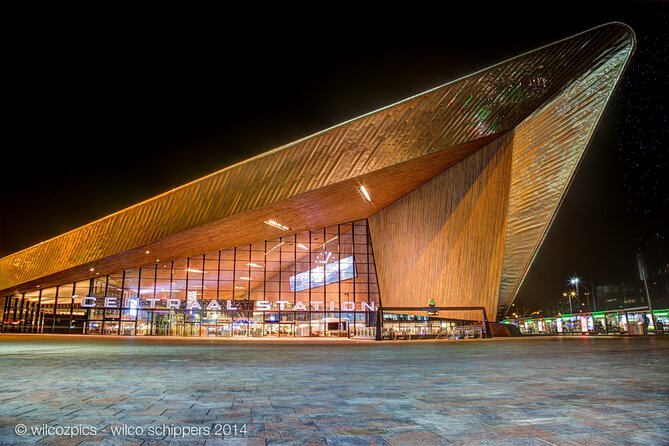
The meeting point is at Stationsplein 10, outside Rotterdam Centraal. This is a practical place to begin, especially if you arrive by train or need a clear central landmark.
The station itself is part of the lesson. Your guide introduces the city’s architecture here, so you begin with Rotterdam’s modern identity rather than simply walking past the building on the way to older sights. The station is also a useful orientation point for the rest of the walk.
The scheduled stop here is listed as about 30 minutes, though the whole activity lasts roughly two hours. That means the guide may spend a meaningful opening stretch explaining the station and the city’s design before moving through the center.
You should arrive ready to walk at once. The activity ends back at the meeting point, but the route includes many stops and is designed as a continuous city walk, not a series of long indoor visits.
Groot Handelsgebouw and the first postwar chapter
Groot Handelsgebouw was completed in 1953 and was one of the first major buildings built after the bombing. Its importance is not just visual. It shows how quickly Rotterdam tried to restore business and movement after the war.
This is a useful early stop because it gives you a physical marker for the rebuilding period. Instead of hearing only that Rotterdam was reconstructed, you see one of the structures that helped define the new city.
The stop is brief, listed at about 10 minutes. That is enough for an explanation and some exterior viewing, but not a full architectural study. If you care about postwar design, listen closely and ask questions while the guide is nearby.
West-Kruiskade and Lijnbaan
The West-Kruiskade and Kruiskade bring the tour into Rotterdam’s central shopping district. These streets add a more everyday side to the city, with shops and local urban life replacing the monumental scale of the station and postwar business buildings.
Lijnbaan is especially important. It opened in 1953 as the main pedestrian street in the rebuilt shopping district, after the older shopping center had been destroyed. It was designed for a new kind of city life, with pedestrians given a central place in the plan.
This stop helps explain why Rotterdam can feel open and spacious. The center was not rebuilt as a tight medieval network. It was planned around modern commerce, wider routes, and new ways of moving through the city.
Do not expect a long shopping break. The route treats these streets as part of the city’s history, not as free time for browsing. If you want to shop, return later after the walk.
Same city, a different sort of day:
- Rotterdam: Harbor Sightseeing Cruise
★ 4.3 · 7,599 reviews - Rotterdam: 1-Hour Sightseeing Splash Tour
★ 4.5 · 3,299 reviews - Rotterdam: Rotterdam Zoo Blijdorp Entry Ticket
★ 4.6 · 2,754 reviews - Rotterdam: Euromast Lookout Tower Ticket
★ 4.4 · 2,549 reviews
Luchtsingel and Rotterdam’s changing north side
The Luchtsingel is a 390-meter wooden pedestrian bridge connecting Rotterdam North with the city center. It crosses an area that had suffered from vacancy and neglect, helping reconnect a part of the city that had been left behind.
This is one of the more unusual stops because the bridge is both infrastructure and public statement. It shows Rotterdam trying new ways to link neighborhoods and bring activity back to underused areas.
The stop is short, about 10 minutes, so you will not spend the full length of the bridge on the tour. Still, it gives you a clear example of how Rotterdam keeps changing rather than treating reconstruction as a finished project.
For me, this is the sort of detail that makes the walk worthwhile. The tour is not limited to famous postcard buildings. It also points out how design can affect connections between parts of a city.
Nieuwe Delftse Poort and the memory of a lost gate
Rotterdam’s Delftse Poort was a city gate, with the last version built in 1764. A later reconstruction in steel, designed by artist Cor Kraat, was placed close to the original site on Pompenburg.
The stop is a reminder that Rotterdam’s past is not always preserved in its original material. Sometimes the city marks what was lost through a modern interpretation. That fits Rotterdam’s wider character: history is present, but often reshaped through contemporary design.
You will spend about 10 minutes here. The gate is not the kind of intact medieval structure you might expect from a European old town, and that is precisely the point. The guide can help you understand the difference between an original survivor and a later artistic reconstruction.
Laurenskerk, the city’s medieval survivor
Grote of Sint-Laurenskerk, also called Sint-Laurenskerk, is a Protestant church and the only surviving remnant of medieval Rotterdam. After seeing so much modern architecture, this stop gives the city a different scale and age.
The church can also be entered for free. The walking tour itself does not include a separate admission charge, and you may have a chance to look inside as part of the route. Because the stop is listed at about 10 minutes, you should not count on a long interior visit.
I would pay attention here even if your main interest is modern design. Without Laurenskerk, it would be harder to understand how much of the former city disappeared and how unusual it is to find this medieval survivor in the middle of modern Rotterdam.
Markthal and Rotterdam’s boldest interior
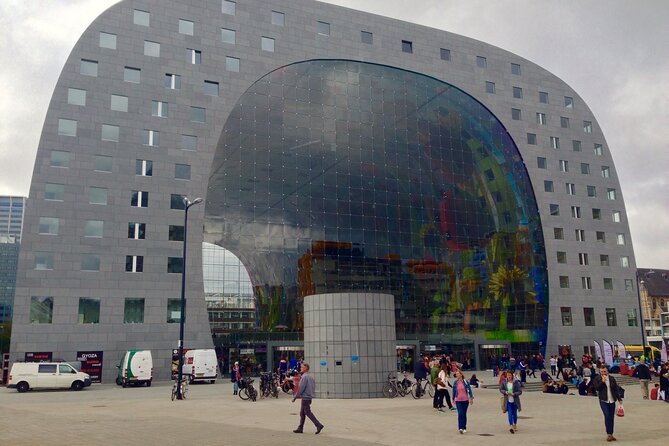
Markthal is one of the route’s headline sights. Designed by the architectural firm MVRDV, it has a gray natural-stone exterior and an arch-shaped, horseshoe-like form. Inside, a huge artwork covers the structure with enlarged fruits, vegetables, seeds, fish, flowers, and insects.
The building works on two levels. It is a market and food hall, but it is also a piece of public architecture designed to make you look upward. You can find restaurants inside, so this is the natural place to pause for food after the guided portion or before another Rotterdam visit.
The schedule allows about 30 minutes here, making it one of the longer stops. Even so, food and drinks are not included. If you want to eat, plan for that separately and check how much time remains in the group walk.
One less positive point is that the guide’s treatment of Markthal can shape your experience. The building deserves attention, and one past tour experience found the surrounding architecture underexplained. I would ask direct questions about the design, the interior artwork, and how Markthal fits into Rotterdam’s newer development.
Oude Haven and the Cube Houses
Oude Haven, or Old Harbour, is the historic harbor area in Rotterdam’s center, on the north side of the Maas. It has a more intimate feel than the large commercial streets and provides the setting for the famous Cube Houses.
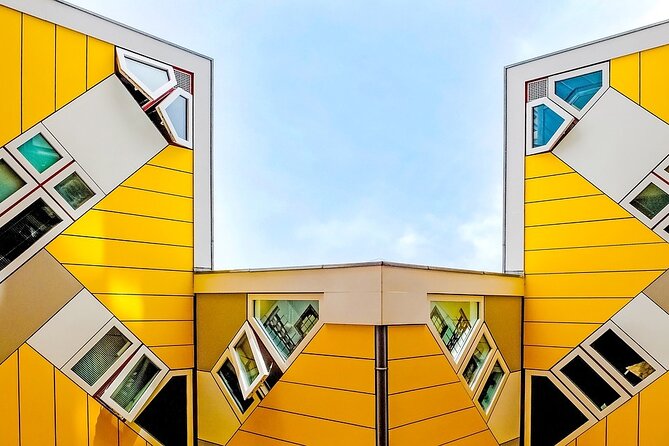
The Cube Houses are among Rotterdam’s most recognizable buildings. Their tilted forms make you stop and study how a residential building can work when the walls and windows do not follow the usual vertical pattern.
This is a strong final section because it brings together the tour’s main themes: the old port, the destruction of the wartime city, and Rotterdam’s willingness to try unusual architectural ideas. The Old Harbour gives you historical context, while the Cube Houses show the city’s modern design confidence.
The stop is listed at about 20 minutes. That is enough to see the area and hear the main explanation, but you should not expect a long interior tour of a Cube House. The route ends back at the original meeting point, so you can return to Oude Haven afterward if you want more photographs or a closer look.
The guides and the human side of the walk
The guide is the most important variable in a city walk. Names associated with this experience include Susan, Edwin, Michel, John, Ed, Tony, and Stephan.
Susan is particularly well suited to travelers who enjoy a friendly, personal approach. She has been praised for explaining buildings, sharing local history, and helping with practical shopping ideas, including gifts for grandchildren. Edwin’s strength is the connection between Rotterdam’s cultural history, architecture, and postwar reconstruction.
Michel has been described as clear and informative, with a good manner for first-time visitors. John brings obvious pride in Rotterdam and uses stories to make the city feel more personal. Ed is known for lesser-known facts and history, while Stephan has led small, flexible groups.
The experience can also handle a difficult day better than many fixed tours. When a cruise arrival was delayed, Tony helped arrange a quicker way to connect with the guide, and Susan adjusted the route for a shortened visit. That does not guarantee special arrangements every time, but it shows why contacting the local operator quickly matters if your schedule changes.
What $29.41 gets you
At $29.41 per person, the tour is fairly priced for a two-hour introduction with a local guide. You are paying for interpretation and route planning, not admissions. That matters in Rotterdam because the main appeal is often the relationship between public spaces and buildings rather than entering one paid monument after another.
The value is strongest if you are new to the city, have only a few hours, or want a framework for exploring independently afterward. You see a broad set of landmarks in one outing, including the station, postwar buildings, shopping district, bridge, church, market hall, old harbor, and Cube Houses.
The value is weaker if you prefer slow photography, long museum visits, or extended time at each building. The route covers a lot, and the two-hour limit means some stops are introductions rather than detailed visits.
Food and drinks are extra. Markthal offers places to eat, but you should treat that as an optional addition rather than part of the tour.
Who should book this Rotterdam walk?
I would choose this tour if you want a quick orientation with a clear theme. It suits first-time visitors, architecture fans, cruise passengers with limited time, and anyone curious about how World War II changed a major European city.
It is also a good fit if you enjoy asking questions. The group maximum of 15 gives you a better chance to speak with the guide than a large coach tour would.
Families may find the Cube Houses, bridge, market hall, and unusual buildings more engaging than a long museum visit. The route is also useful for anyone who wants practical ideas about where to shop and what parts of central Rotterdam deserve a second look.
I would look elsewhere if you want a war museum, a formal architectural lecture, or a tour with long interior visits. This is a city walk, and its strength is the connected story told while moving through real streets.
Booking confirmation is provided at the time of booking. Service animals are allowed, public transportation is nearby, and most people can participate. You can cancel for a full refund up to 24 hours before the start time, though changes made inside that window are not accepted. The tour requires a minimum number of participants, so a cancellation for that reason may result in another date, another experience, or a full refund.
Should you book it?
Book this tour if you want Rotterdam to make sense quickly. The route gives you the city’s essential contrast: medieval Laurenskerk beside bold modern design, old harbor beside Cube Houses, and postwar rebuilding beside new attempts to reconnect neglected areas.
The strongest reason to go is the combination of WWII history and architecture. The main weakness is the brisk pace, especially if you want detailed explanations at every stop. At $29.41, I think it offers good value for a first visit, provided you treat it as an orientation and save Markthal, Oude Haven, and the Cube Houses for extra time afterward.
FAQ
How long does the Rotterdam walking tour last?
The tour lasts approximately two hours.
Where does the tour begin?
It begins at Stationsplein 10, 3013 AJ Rotterdam, at Rotterdam Centraal Station.
Where does the tour end?
The activity ends back at the meeting point.
What sights are included on the route?
The route includes Rotterdam Centraal Station, Groot Handelsgebouw, West-Kruiskade, Lijnbaan, Luchtsingel, Nieuwe Delftse Poort, Grote of Sint-Laurenskerk, Markthal, Oude Haven, and the Cube Houses.
Is admission to the attractions included?
The tour includes a local guide, and the listed stops do not require a separate admission ticket. You can also enter Sint-Laurenskerk for free. Food and drinks are not included.
How many people can join, and what language is offered?
The tour is offered in English and has a maximum group size of 15 people.
Just added in Rotterdam
- Rotterdam: City Walk Audio Guide in 7 Languages on your Phone★ 3.5 · 6 reviews
- e-Scavenger hunt Breda: Explore the city at your own pace★ 4.5 · 27 reviews
- e-Scavenger hunt Rotterdam: Explore the city at your own pace★ 4.5 · 13 reviews
- All-Inclusive Private Windmill Tour to Kinderdijk from Rotterdam★ 4.5 · 59 reviews
- Discover Rotterdam: Classic Highlights Bike Tour with a Local★ 5.0 · 22 reviews
- Rotterdam in half a day: All-inclusive, Authentic private Tour of Rotterdam★ 5.0 · 146 reviews
- Discover Breda with a self-guided Outside Escape city game tour!★ 5.0 · 16 reviews
- Breda Fun Puzzle Quest: True Lord Self-Guided Tour★ 4.0 · 9 reviews
Historical Tours, compared.
Amsterdam Food and Cultural Tour with Tastings
Read our review →
Kinderdijk UNESCO World Heritage Entry Ticket
Read our review →
Hop-on Hop-off Old-Fashioned Heritage Tram Tour
Read our review →
Amsterdam High-End Dutch Food & History Tour – Up to 8 guests
Read our review →
Cruise through the Historic City Center with Guide
Read our review →
Browse the lists this tour appears in